NASA's Curiosity rover returned a composite panorama from Mount Sharp captured in November 2025 using navigation cameras across Sols 4,722 and 4,723. The black-and-white frames were merged and tinted blue and yellow to highlight lighting changes over a Martian day. Curiosity is perched above boxwork formations — mineral-rich ridges left by ancient groundwater — and recently collected a rock sample at a site called Nevado Sajama. New autonomy features let the rover conduct science while communicating with orbiters, maximizing output from its limited power.
Curiosity Returns Striking Panorama From High On Mount Sharp — New Samples, Ancient Water Clues
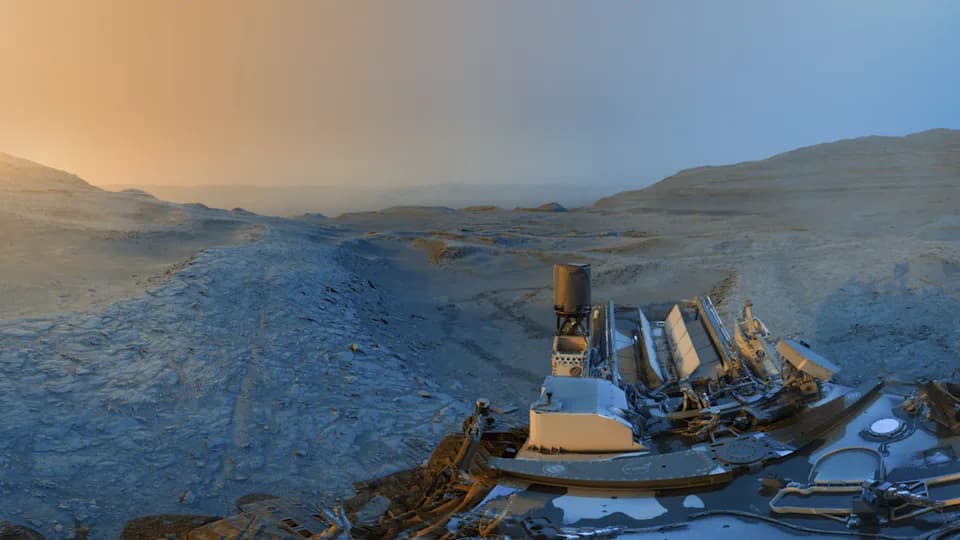
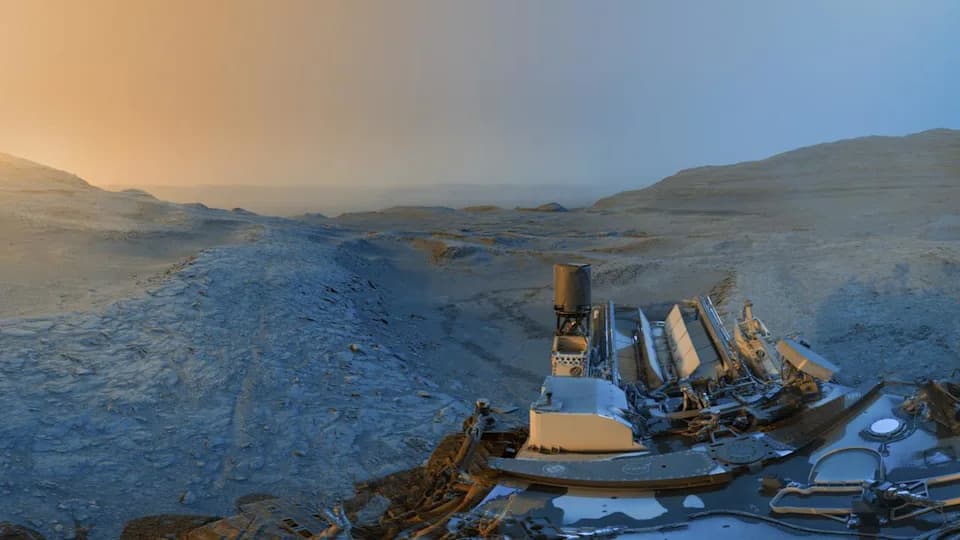
NASA's Curiosity rover captured this panoramic view from high on the slopes of Mount Sharp inside Gale Crater, combining images taken on two different Martian days in November 2025 to highlight changing light across ancient, water-shaped terrain. | Credit: NASA/JPL-Caltech
NASA's Curiosity rover has sent a striking new "postcard" from high on the slopes of Mount Sharp, offering an expansive view of the rugged Martian terrain the robotic geologist has been studying for more than a decade.
Two-Sol Composite Shows Lighting Changes Across a Martian Day
The panorama is a composite assembled from navigation-camera frames captured in November 2025 across two Martian days (Sols 4,722 and 4,723). Black-and-white images were taken at 4:15 p.m. local Mars time on Sol 4,722 and at 8:20 a.m. on Sol 4,723, then stitched together and color-tinted with cool blue and warm yellow hues to emphasize changing illumination.
"Adding color to these kinds of merged images helps different details stand out in the landscape," NASA officials said in a statement releasing the new image.
Overlooking Boxwork: Clues to Ancient Groundwater
In the panorama, Curiosity is perched on a ridge overlooking a region known as the boxwork formation — intricate networks of mineral-rich ridges that remained where groundwater once flowed through fractures billions of years ago. Wind erosion later stripped away softer material, leaving harder mineral veins exposed. Scientists study these features because they preserve evidence of past water activity and changing environmental conditions on Mars.
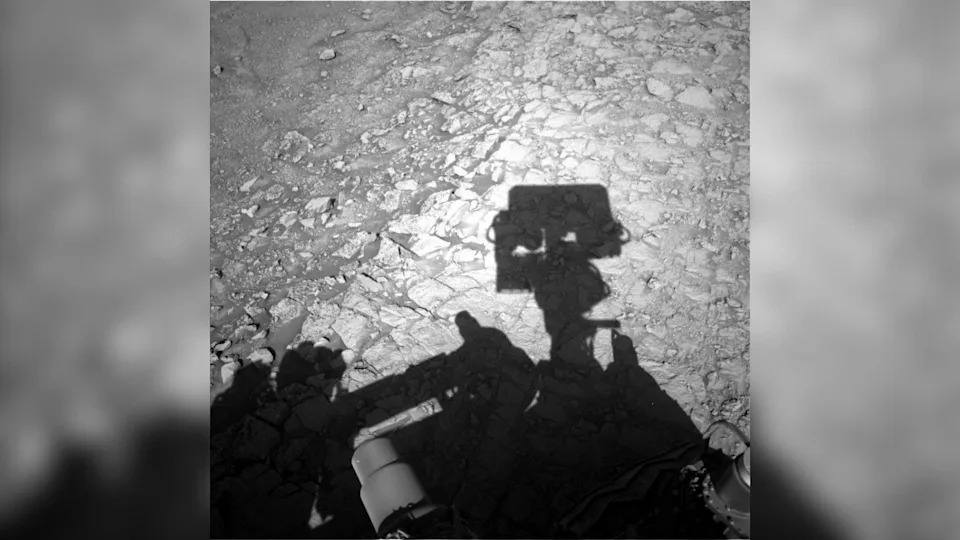
This photo captures Curiosity's shadow overlaid on the Martian boxwork terrain. | Credit: NASA/JPL-Caltech
Sampling, Tracks and the View Toward Gale Crater
Visible wheel tracks in the foreground trace the rover's deliberate progress as it continues to climb Mount Sharp, a roughly 3-mile-high (5-kilometer) mountain inside Gale Crater and Curiosity's primary science target since its 2012 landing. Using the drill at the end of its robotic arm, Curiosity recently collected a rock sample from the top of the ridge at a site the team calls Nevado Sajama. A shallow hollow behind the rover marks an earlier drill site dubbed Valle de la Luna.
The panorama looks north across the boxwork formations and down Mount Sharp's slopes toward the floor of Gale Crater; the crater rim appears on the distant horizon about 25 miles (40 kilometers) away.
More Efficient Science With New Autonomy
In recent months the mission team has relied more heavily on updated multitasking and autonomy capabilities that let Curiosity perform science observations while simultaneously communicating with orbiters overhead. These improvements increase operational efficiency and help the rover squeeze more science out of its aging radioisotope power system.
More than 13 years after landing, Curiosity continues to deliver dramatic imagery and important geological data that help researchers reconstruct how water once moved through Gale Crater — and whether those ancient environments could once have supported microbial life.
Help us improve.