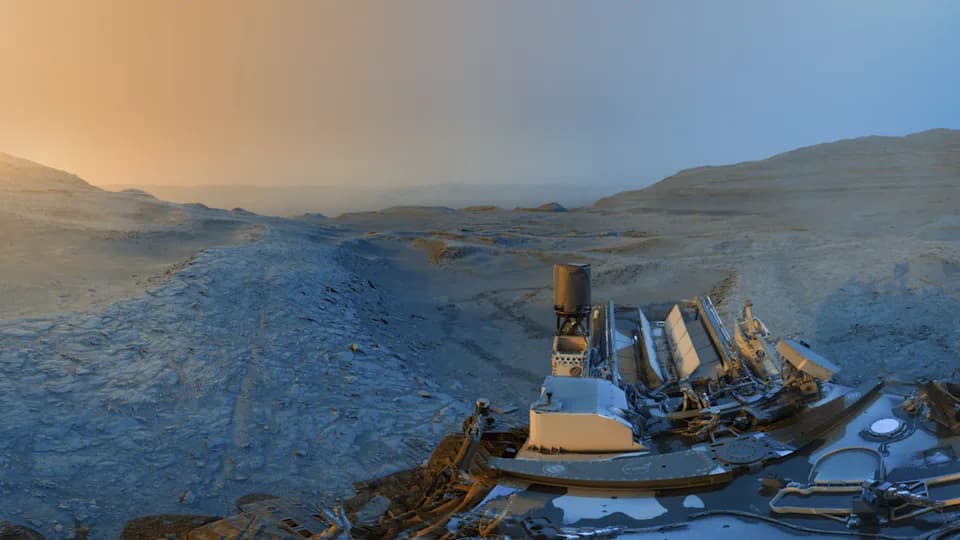
NASA's Curiosity rover stitched navigation-camera images taken on Nov. 18, 2025 into a color-enhanced panoramic mosaic that resembles an Earthlike sunrise or sunset. The rover was positioned on a ridge of Mount Sharp, about 3 miles high, overlooking Gale Crater; the crater rim appears roughly 25 miles away and Curiosity’s wheel tracks are visible. Curiosity has collected 42 powdered rock samples since landing in 2012. Its counterpart Perseverance has also returned high-resolution panoramas and reported a potential biosignature in Sept. 2025.
NASA’s Curiosity Captures Sunrise-Like Panorama on Mars — A New 'Postcard' From Mount Sharp
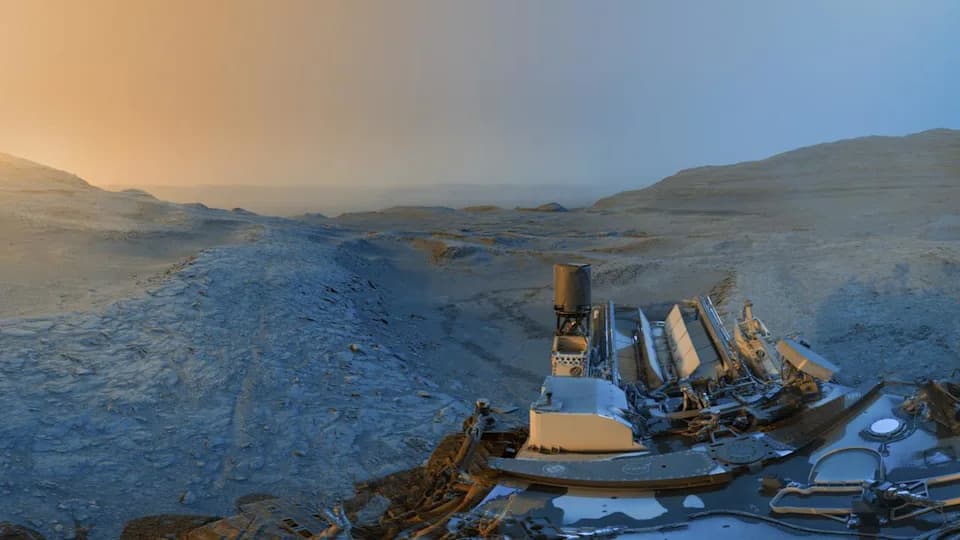
NASA’s Curiosity Mars rover used its black-and-white navigation cameras to capture panoramas at two times of day on Nov. 18, 2025. Color was later added to the merged photos for an artistic interpretation of the scene that resembles daylight on Earth.
NASA's Curiosity rover has produced a color-enhanced panoramic mosaic that evokes the look of an Earthlike sunrise or sunset on Mars. The composite, created from navigation-camera shots taken on Nov. 18, 2025, was later tinted by NASA "for an artistic interpretation of the scene," the agency said when the image description was posted Dec. 30.
Where the Photo Was Taken
At the time the images were captured, Curiosity was perched atop a ridge on Mount Sharp, a mountain that rises roughly 3 miles (about 5 kilometers) above the floor of Gale Crater. The ridge is part of a boxwork formation — an intersecting network of ridges in Mount Sharp's lower foothills that could be billions of years old.
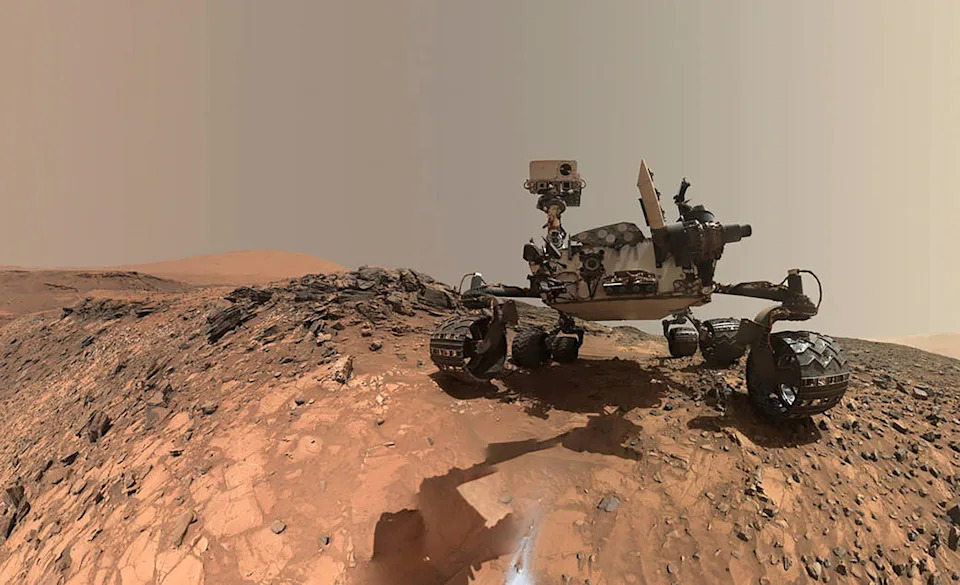
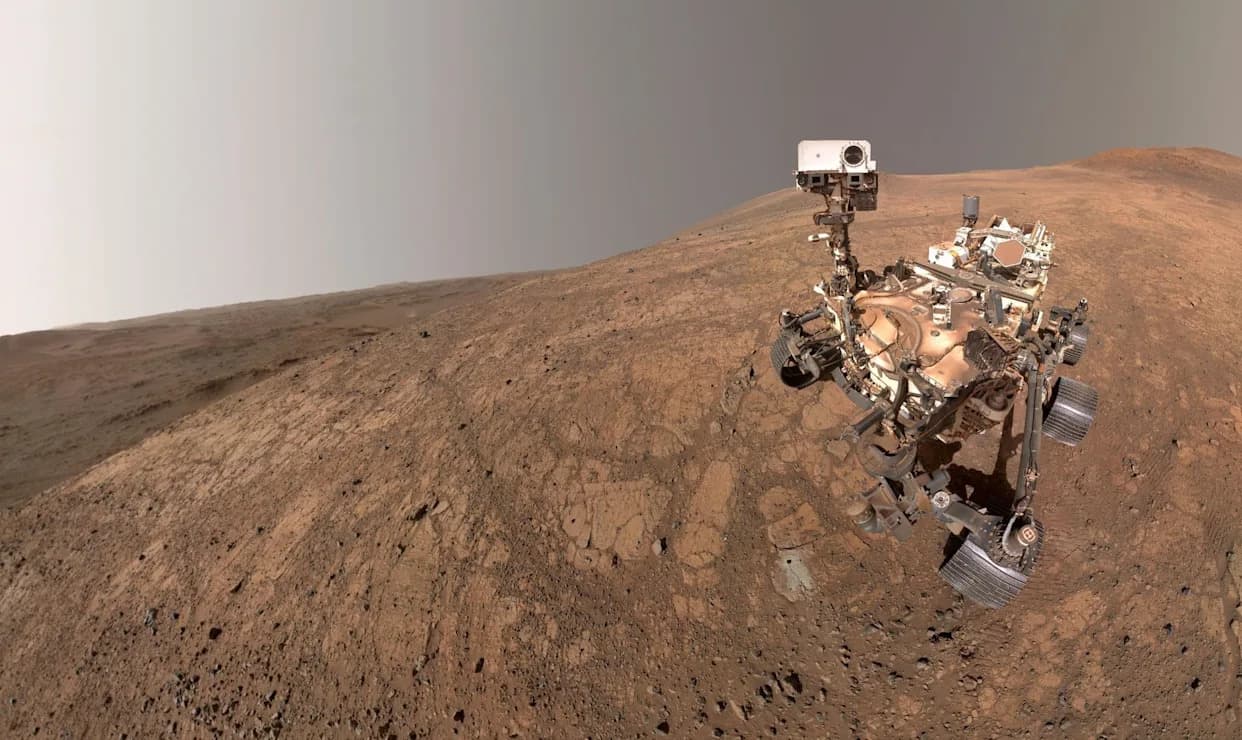
NASA's Curiosity Mars rover is seen at the site from which it reached down to drill into a rock target called 'Buckskin' on lower Mount Sharp in this low-angle self-portrait taken August 5, 2015 and released August 19, 2015. The selfie combines several component images taken by Curiosity's Mars Hand Lens Imager (MAHLI).
What the Mosaic Shows
The stitched mosaic reveals the rim of Gale Crater about 25 miles (roughly 40 kilometers) away, and even includes Curiosity’s own wheel tracks, tracing the rover’s winding path across the iron-oxide–stained terrain. NASA notes the added color is an interpretation intended to convey the scene’s visual mood rather than provide a strictly true-color view.
Why It Matters
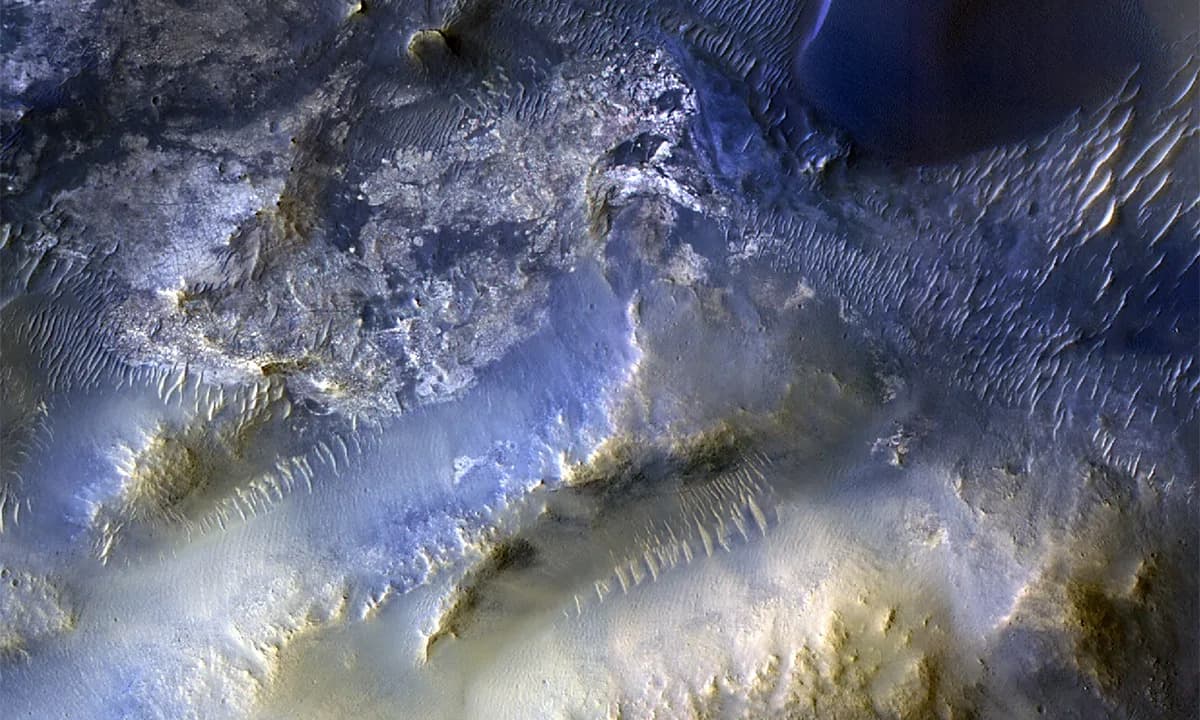
Curiosity — a car-sized mobile laboratory that launched in November 2011 and landed in August 2012 — has spent more than a decade investigating the Gale Crater region to learn whether Mars could once have supported life. Over its mission, Curiosity has collected and powdered 42 rock samples with the drill at the end of its robotic arm, revealing details about ancient environments preserved in Martian rocks and sediments.
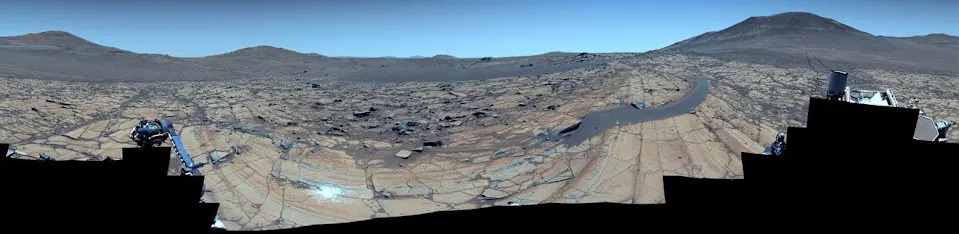
NASA's Perseverance Mars rover captured this mosaic of an area nicknamed "Falbreen" on May 26. This enhanced-color version, which had its color bands processed to improve visual contrast and accentuate color differences, shows the Martian sky to be remarkably clear and deceptively blue.
Curiosity and its sister rover Perseverance (which arrived at Mars in 2021) are both operated remotely from Earth and continue to return high-value scientific data and dramatic imagery. In August 2025, Perseverance produced a 96-image, color-enhanced panorama NASA described as "deceptively" blue. In September 2025, NASA announced that one of Perseverance’s finds contained a potential biosignature, a discovery that has generated considerable scientific interest and follow-up study.
Why the image feels familiar: Martian dust and sunlight interact differently than on Earth, producing unique tints; color-enhanced mosaics can highlight features and moods that help the public imagine what a sunrise or sunset on Mars might look like.
What to Watch Next
Images like this postcard-style panorama continue to underscore the scientific and public-engagement value of robotic exploration. They also help illustrate why space agencies and private companies consider Mars a top candidate for future human missions.
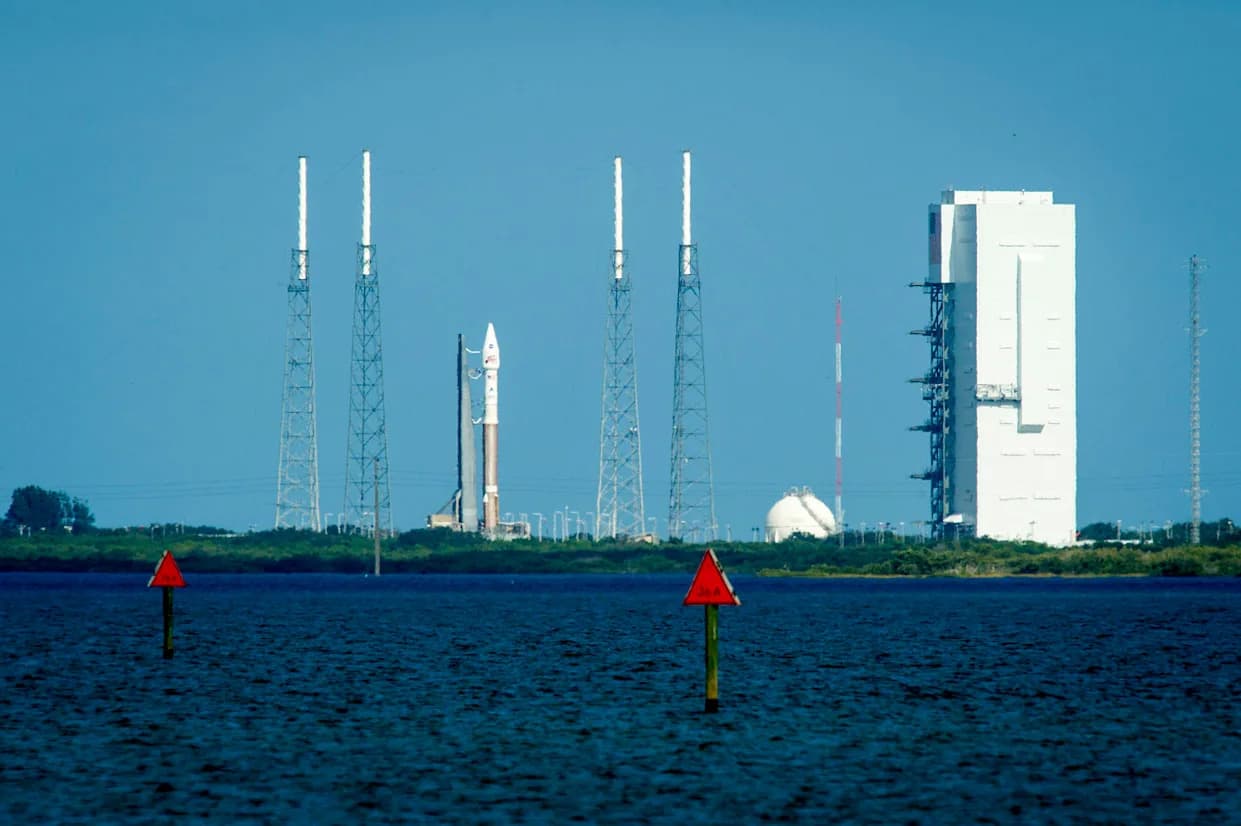
Reporting note: The image was assembled from Curiosity's navigation-camera frames taken Nov. 18, 2025, and color was later added by NASA for artistic interpretation. Curiosity landed in Gale Crater in Aug. 2012 after launching from Florida in Nov. 2011.
Help us improve.