John McAuliff, a 33-year-old small-business owner, narrowly won a Virginia House of Delegates seat by making datacenter impacts and electricity costs the centerpiece of his campaign. His message resonated in a district split between Loudoun and Fauquier counties, where residents worry about landscape changes and rising energy demand. McAuliff’s 50.9%–49% victory, built on local affordability concerns, offers a model for Democrats aiming to compete in exurban and rural areas.
Datacenters, Electricity Bills and an Electric Scooter: How a Democrat Flipped a Red Virginia District

John McAuliff, a 33-year-old small-business owner and former civil servant, pulled off an unexpected victory in Virginia’s House of Delegates by focusing his campaign on the local impacts of datacenters—from noise and landscape changes to rising electricity costs. His narrow win in a traditionally Republican-leaning district has prompted interest from Democrats looking for strategies to compete in exurban and rural areas.
Running to preserve a way of life
The northern Virginia district McAuliff sought to represent is a mix of subdivisions, farmland and small towns. It had not sent a Democrat to the House of Delegates in decades. McAuliff campaigned in a way that appealed to independents and Republicans: going door to door on an electric scooter, saying he wanted to "preserve their way of life," rejecting the label "woke," and criticizing distant federal "chaos." But the issue that repeatedly opened conversations was datacenters and their effect on daily costs.
"Most of the year I spent knocking on the doors of folks we didn’t think were Democrats—either independents or Republicans, and once in a while, a Democrat. They would start to shut the door in my face. But then they wanted to talk about datacenters. They wanted to have that conversation, which gave me the opportunity to make that contrast," McAuliff said.
Why datacenters resonated
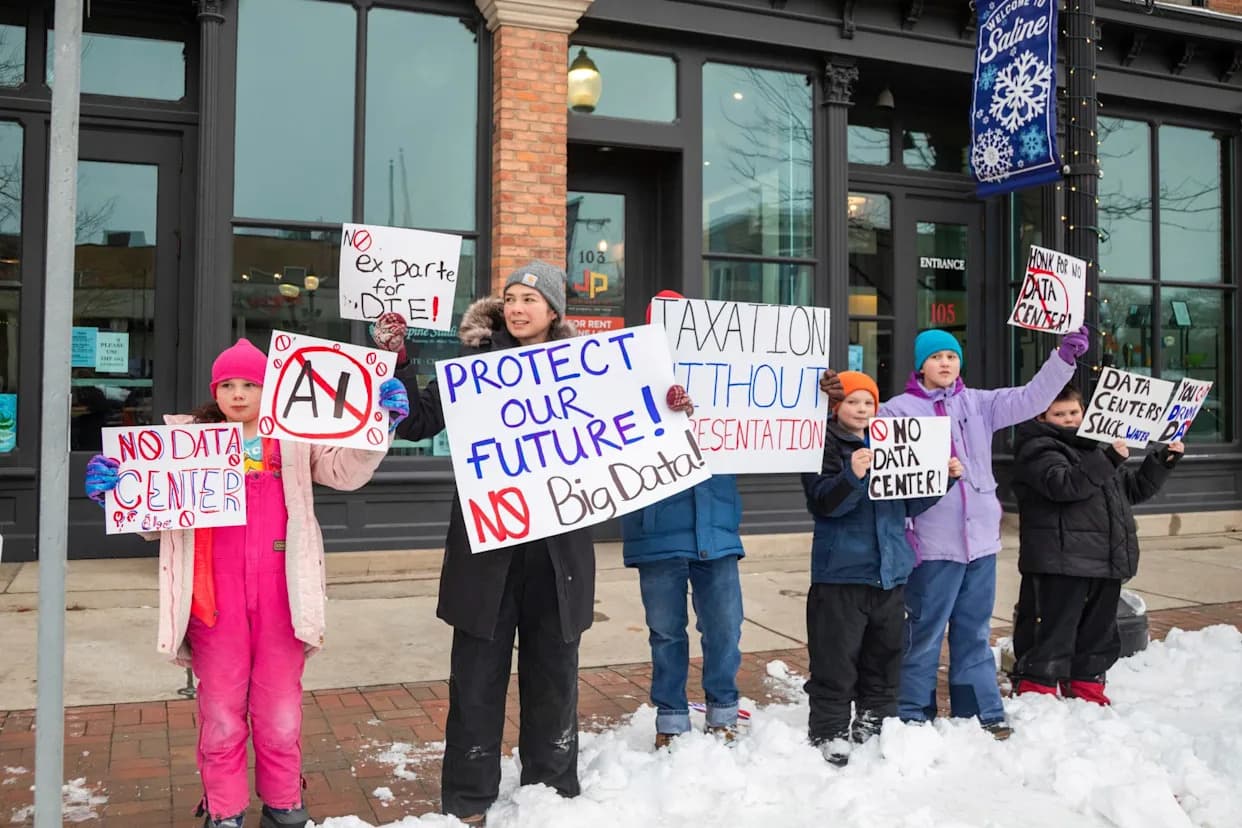
Much of the district includes Loudoun County, which accounts for roughly half of the 30th district and hosts one of the densest concentrations of datacenters in the world. These warehouse-sized facilities, humming with servers, can dominate the landscape near subdivisions. Developers have proposed similar projects in Fauquier County, the district’s more Republican-leaning half. Residents in both counties voiced concerns about aesthetics, local development and electricity bills.
A 2024 report from Virginia’s Joint Legislative Audit and Review Commission projected that the state’s energy demand could roughly double over the next decade, driven largely by datacenter growth and the new infrastructure—transmission lines, substations and imported power—required to serve that load. The report noted that while datacenters are charged for usage under current rate structures, ratepayers may still face higher energy prices to cover infrastructure costs.
Earlier this month the state utility regulator approved an electricity rate increase, though it was smaller than the increase requested by Dominion Energy, a major regional supplier. McAuliff argued the cost of new infrastructure is being shifted onto ordinary Virginians: "They’re essentially an artificial tax on everyday Virginians to benefit Amazon, Google," he said, while also calling for better community benefits and compensation from large tech firms.
The campaign and the result
McAuliff’s opponent was Geary Higgins, a Republican and former Loudoun County supervisor elected in 2023. The race became expensive: McAuliff spent just under $3 million and Higgins about $850,000, according to the Virginia Public Access Project. While datacenters were central to McAuliff’s message, his platform also included codifying abortion access, increasing teacher pay and holding local officials accountable for governance failures.
McAuliff acknowledged datacenters were a niche topic, but he said they were the most salient local issue voters raised while door-knocking. To highlight Higgins' record, McAuliff’s campaign created a site tying Higgins to datacenter expansion; Higgins and his supporters disputed those attacks as inaccurate. The election was close: McAuliff won 50.9% to Higgins’s 49%.
Broader lessons
Party leaders and analysts noted McAuliff slightly outperformed other Democrats on the ballot, an outcome they attribute to his ability to find local, cross-partisan issues. "In an area that is generally very red, he was able to find the issues that Republicans and Democrats agree on, and also present the argument that he would be the one to solve them," said Congressman Suhas Subramanyam, who represents the area. Democratic organizers see the result as proof that focusing on practical affordability and community impacts can resonate in exurban districts.
Help us improve.