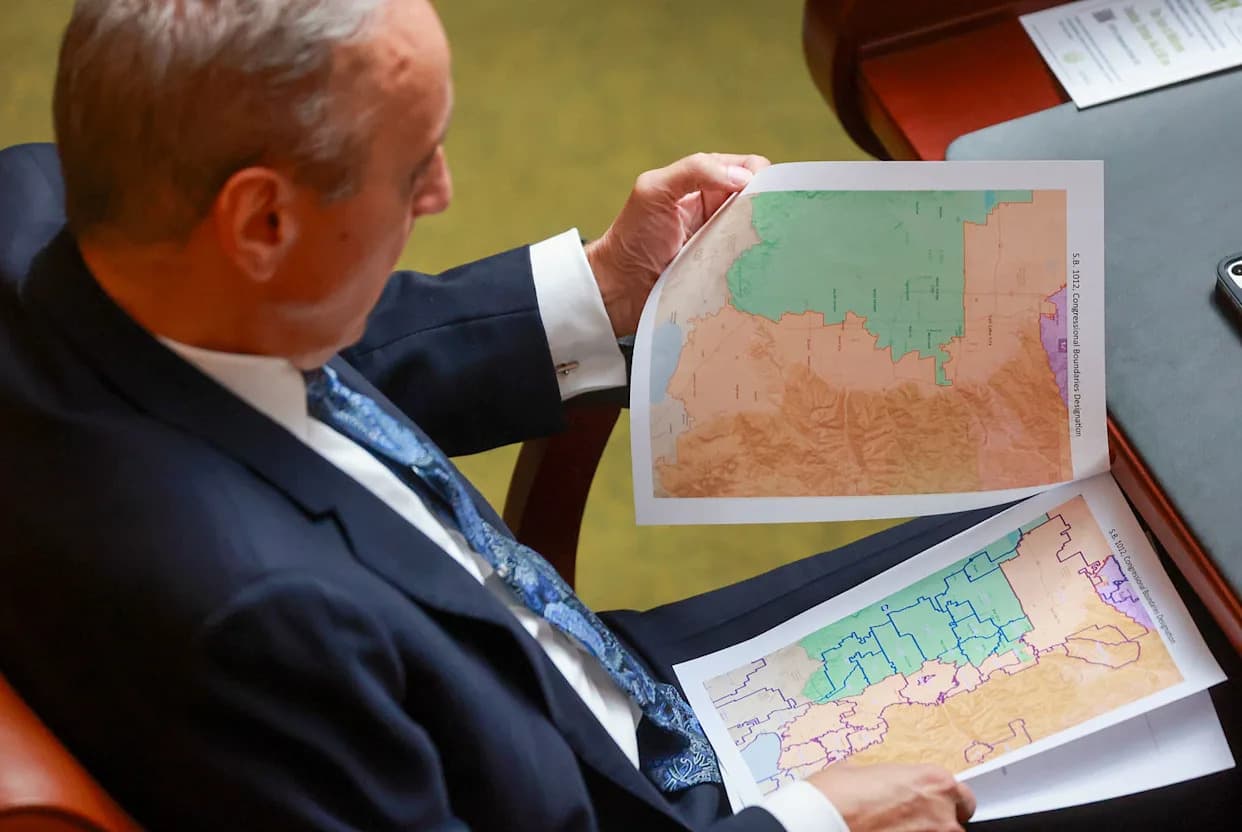
An 18-year-old University of Alabama freshman, Daniel DiDonato, had a dorm-room map selected by a federal judge to remedy a Voting Rights Act Section 2 violation in Alabama. DiDonato submitted six plans on October 10 using Dave's Redistricting App and filed under the initials "DD" because he was a minor when he submitted them. Judge Anna Manasco chose his map because it fixed the violation while making the fewest possible changes to the enacted plan; Alabama has appealed to the 11th Circuit. The selection energized the online redistricting community and underscored how accessible tools are democratizing mapmaking.
Dorm-Room Redistricting: 18-Year-Old's Map Adopted as Alabama Law

A federal judge this month adopted a new Alabama state senate map submitted by a member of the public identified only as "DD." That submission turned out to be an 18-year-old University of Alabama freshman, Daniel DiDonato, who discovered his dorm-room map had been chosen as he prepared for a 9:30 a.m. political science class.
Background
In August, U.S. District Judge Anna Manasco found that Alabama's 2021 senate map diluted the influence of Black voters around Montgomery in violation of Section 2 of the Voting Rights Act. After the state legislature declined to adopt a remedial plan, Judge Manasco appointed a special master to propose alternatives and invited public submissions.
How the map was created
DiDonato, who grew up in Russell County on the Alabama-Georgia line, was the only private citizen to file plans. In early October he spent several late nights in his dorm using Dave's Redistricting App, a free online tool, and ultimately filed six plans on October 10. He identified himself in court papers as "DD" because he was a minor at the time of submission.
Working without racial or partisan overlays at first, DiDonato focused on equalizing population and making minimal changes to the enacted map. He later re-enabled demographic layers to confirm that one additional district would give Black voters a realistic opportunity to elect their preferred candidate—the remedy Judge Manasco required.
Selection and reaction
The special master, Richard Allen, included one of DiDonato's maps alongside two plans he authored and submitted all three to the court. Allen criticized DiDonato's map as only a weak remedy because it altered two districts rather than three. Both the state and the plaintiffs lodged objections: Alabama accused the plan of racial gerrymandering while also calling it "the least bad of several bad options," and the plaintiffs argued the map did not create a sufficiently strong opportunity for Black voters in one affected district.
"To say that I gerrymandered a map while drawing the maps blind to race and party—I don't find any basis to suggest that is the case," DiDonato said, calling the state's objection offensive and disingenuous.
Judge Manasco ultimately selected DiDonato's plan because it remedied the Section 2 violation while changing only two districts rather than three, consistent with the court's directive to make the fewest possible alterations to the enacted plan. The decision puts nearly 300,000 Alabamians under the new lines, though Alabama has appealed to the U.S. Court of Appeals for the Eleventh Circuit.
Aftermath and significance
DiDonato was invited to testify but could not attend a hearing because he lacked transportation. He said he does not drive and could not find a friend to give him an early-morning ride. He also declined payment: the special master will be compensated for his work, but DiDonato said he does not expect payment for his submission.
The case has energized an online community of redistricting enthusiasts often called Election Twitter. DiDonato said the reaction there has been enthusiastic, with many young mapmakers feeling encouraged by his unexpected impact. He also reflected on the symbolic weight of remedying a Voting Rights Act violation in Alabama, a state with a long history of voter suppression.
"The Voting Rights Act has a long and storied history that dates back here to Alabama, very locally to the Montgomery region," he said. "Knowing that Black voters are continuing the struggle for voting rights, and that I got to be a part of the history to fix that … it feels like an honor and it's kind of humbling."
Help us improve.