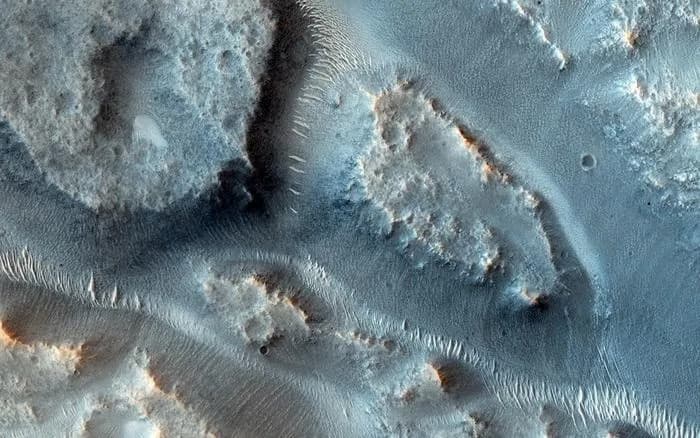
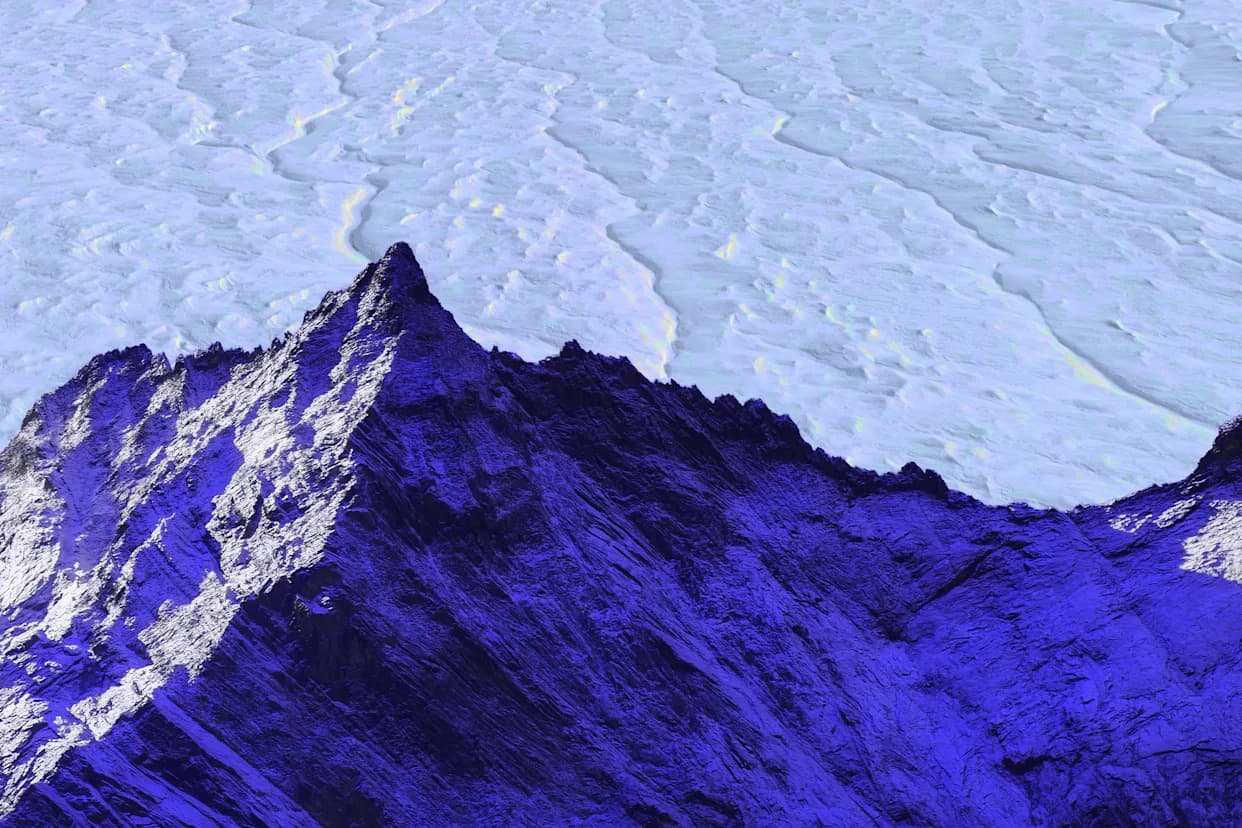
The 2018 MARSIS detection of a bright radar echo beneath about 1,500 meters of Mars' south polar ice has been re-examined using a deeper SHARAD observation enabled by a 120° "very large roll." SHARAD recorded only a faint return at the site and no signal in an adjacent area, reducing the likelihood of a subsurface liquid lake. Researchers Gareth Morgan and Thane Putzig suggest a smooth rock layer or ancient lava could explain the original echo. The new maneuver significantly improves MRO's ability to search for buried ice and other subsurface resources.
New NASA Radar Deflates 7‑Year Martian 'Lake' Claim — Finds Rock, Not Water

A Martian mystery that grabbed headlines seven years ago — a bright radar echo beneath the planet's south polar ice that some interpreted as a buried lake — has been re-examined with a more powerful radar technique. The new observations make a stable subsurface liquid reservoir at that site far less likely.
In 2018, the European Space Agency's MARSIS instrument detected an unusually strong radar reflection beneath roughly 1,500 meters of polar ice. Many researchers suggested the signature resembled liquid water or a highly saline brine, the only plausible liquid that might remain unfrozen in such cold conditions.
NASA's SHARAD radar aboard the Mars Reconnaissance Orbiter (MRO) could not initially reach the required depth to test the claim. In a paper published in Geophysical Research Letters, SHARAD scientists Gareth Morgan and Thane Putzig describe a new operational method — a "very large roll" that rotates MRO about 120° mid-orbit — which aimed the antenna more directly and boosted the radar's depth sensitivity.
With the enhanced technique, SHARAD recorded only a faint return where MARSIS had seen a bright echo, and a follow-up pass over an adjacent area showed no return at all. That pattern argues against a widespread, liquid reservoir at the site.
“The lake hypothesis generated lots of creative work, which is exactly what exciting scientific discoveries are supposed to do,” Morgan said. “While this new data won’t settle the debate completely, it makes it very hard to support the idea of a liquid water lake.”
Morgan and Putzig suggest a simpler explanation for the original MARSIS signal: an unusually smooth subsurface layer — perhaps an old lava flow or a specific rock unit — can produce a bright radar reflection without requiring liquid water.
Even if the lake interpretation is weakened, the new maneuver is a major capability gain for MRO. The "very large roll" expands SHARAD's ability to probe buried ice, stratified rock, and other subsurface features that matter for planetary science and for locating resources that could support future human missions.
One promising target for deeper radar study is Medusae Fossae, a vast equatorial formation that returns very weak radar echoes. Some researchers interpret it as volcanic ash; others suspect it could hide ancient ice. Confirming equatorial ice would be valuable for crewed exploration because those regions receive more sunlight and offer more clement conditions for operations.
MRO has been orbiting Mars since 2006, and with this new technique it can revisit old anomalies with greater depth sensitivity. The faint SHARAD return confirms that something unusual lies beneath the south polar ice, but strong evidence for a buried liquid lake reported in 2018 is now much less convincing.
Sources: NASA; Geophysical Research Letters; quotes and analysis by Gareth Morgan and Thane Putzig.
Help us improve.