Clear or mostly clear skies across much of the U.S. make Thanksgiving night a prime opportunity to observe the Moon, Saturn and autumn constellations. The Moon will be near first quarter in the south‑southwest with Saturn less than 20° to its left; Saturn’s rings are tilted only about 0.5° and will look like a thin line in modest telescopes. Look for the Summer Triangle, the Great Square of Pegasus, the Big Dipper and Cassiopeia, and note that stars such as Algenib and Almach lie roughly 400 light‑years away.
Thanksgiving Night Sky 2025: Moon, Saturn and Autumn Stars Put on a Post‑Dinner Show

The national weather outlook for Thanksgiving Day points to generally fair skies across much of the United States, making this Thanksgiving a great opportunity for some after‑dinner stargazing. Exceptions include parts of the Great Lakes—where snow showers and local lake‑effect squalls are possible, especially in northeast Ohio, northwest Pennsylvania, and western and northern New York—along with light snow in parts of Montana and northern Idaho and coastal rain in Washington and Oregon. Much of the West should be unseasonably mild while large portions of the East may feel brisk and unusually cold.
If your household follows the typical American routine, you’ll gather for a mid‑to‑late afternoon turkey dinner, and many will migrate indoors afterward to watch football or holiday programming. But if you host a sizable gathering and skies are mainly clear, consider inviting everyone outside for a short, memorable stargazing session.
Bring binoculars—or better yet, a telescope—and you may start a holiday tradition. As darkness falls on Thanksgiving night, the Moon will sit in the south‑southwest and will be only a few hours from first quarter (the familiar "half" phase). Less than 20° to its left—roughly two clenched fists at arm’s length—will be the planet Saturn.
Why the Moon is a great target near first quarter:
- The Moon isn’t so bright that surface detail is washed out.
- The terminator (the day/night boundary) casts strong shadows that make craters, mountain ranges and rilles stand out in dramatic relief.
Set up a telescope and people will gather—one look through the eyepiece often elicits delighted exclamations. Even binoculars reveal stunning lunar detail and are easy to share with family members of all ages.
Saturn will shine at about first magnitude with a calm yellow‑white hue, appearing slightly brighter than the nearby star Fomalhaut to its lower right. In 2025 Saturn’s ring plane is tilted only about 0.5° toward Earth, so through moderate and small telescopes—especially above ~30× magnification—the rings will appear as a thin line crossing the planet’s disk rather than the broad open rings seen when the tilt is larger.
What else to look for
Many summer star groups and the rich Milky Way star fields remain visible low in the western sky. Capella, a bright yellow star, climbs in the northeast as a hint of the bright winter constellations to come—Orion will dominate the evening sky in a few weeks.
High in the west sits the Summer Triangle, formed by Vega, Altair and Deneb. As autumn deepens that triangle sinks lower each night; use binoculars to sweep the dense star fields inside it for an impressive view of countless faint stars.
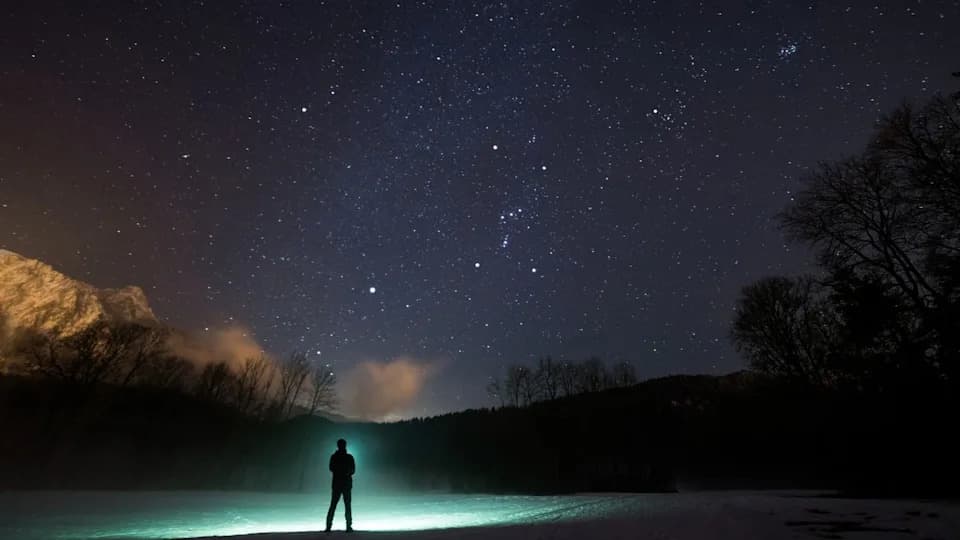
Nearly overhead in the south‑southeast is the Great Square of Pegasus, a handy autumn landmark made of four bright stars. If you have a clear view to the northern horizon you’ll find the Big Dipper, which can seem unusually large because of the moon illusion that makes objects near the horizon appear bigger. Above the Dipper is Cassiopeia, the Queen, whose zig‑zag of five stars forms a familiar 'M' shape.
Historical perspective: the first Thanksgiving is commonly dated to 1621. Many stars you see on a November evening emitted their light long before that time. According to the 2025 Observer’s Handbook of the Royal Astronomical Society of Canada, two stars that are visible on November evenings and lie near 400 light‑years away are Algenib (a third‑magnitude star at the lower left of the Great Square of Pegasus) and Almach (a second‑magnitude star in the chain marking Andromeda). When you spot these stars you’re seeing light that began its journey around the same era the first pilgrims arrived in New England.
Tips for a successful family stargazing session
- Dress warmly and bring a blanket or folding chairs.
- Let eyes dark‑adapt for 10–15 minutes for better star visibility.
- Share binoculars and a low‑power telescope for the Moon and brighter planets; a laptop or phone star‑map app can help point out constellations.
From the author: have a happy and safe Thanksgiving, and may you enjoy clear skies.
About the author: Joe Rao is an instructor and guest lecturer at New York’s Hayden Planetarium and writes about astronomy for publications including Natural History and Sky & Telescope.
Help us improve.