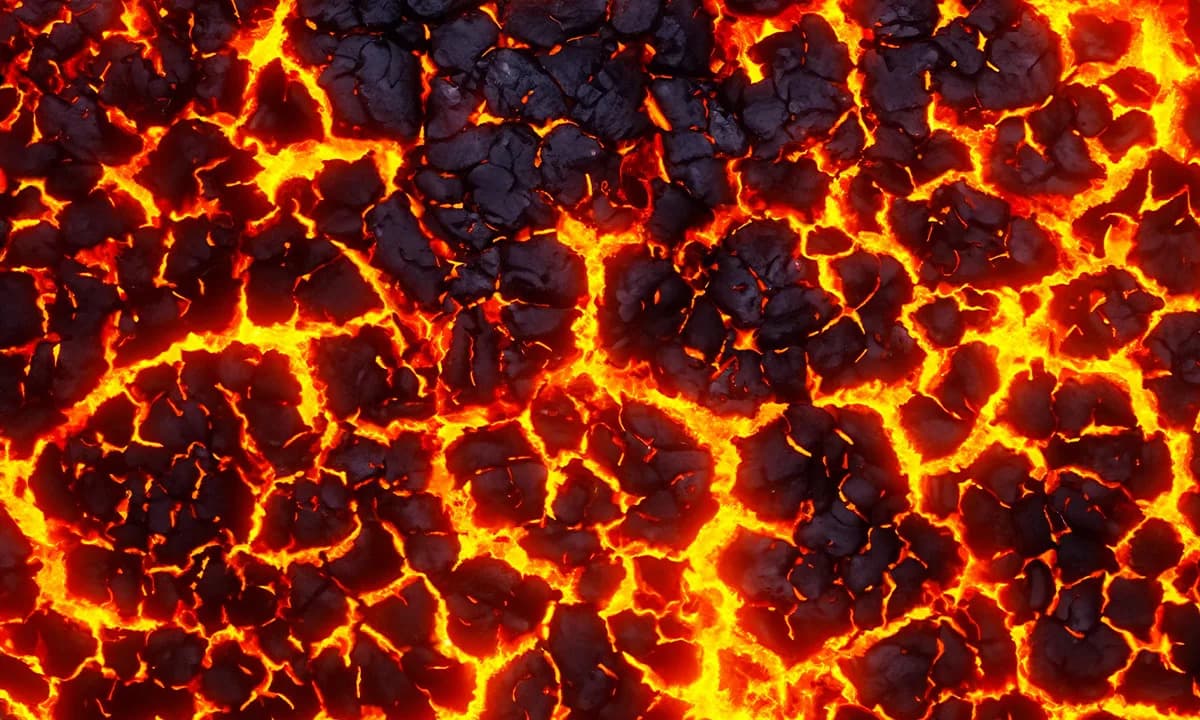
Seismic evidence points to two continent-sized "lava puddles" about 1,800 miles (2,900 km) below Earth’s surface beneath the Pacific and Africa. Known as LLSVPs and ULVZs, these regions dramatically slow seismic waves, indicating an unusual composition. Researchers suggest silicon and magnesium from the core could have mixed into a primordial basal magma ocean, producing the heterogeneous pockets seen today. If confirmed, these relics may record early core–mantle interactions that helped shape Earth's cooling, volcanism and atmosphere.
Deep 'Lava Puddles' at the Base of Earth's Mantle May Hold Clues to How Life Began

Two enormous, enigmatic blobs deep inside Earth could carry chemical traces that help explain how our planet became habitable. Located roughly 1,800 miles (2,900 km) beneath the surface beneath the Pacific Ocean and Africa, these continent-sized concentrations of anomalous material are often described as "lava puddles" clinging to the core.
Scientists cannot visit these regions directly, but seismic waves provide a window into the deep interior. As seismic waves pass through the features—known as large low-shear-velocity provinces (LLSVPs) and ultra-low-velocity zones (ULVZs)—they slow dramatically, signaling that the blobs' composition differs from the surrounding mantle.
"These are not random oddities," said Yoshinori Miyazaki, a geodynamicist at Rutgers University who led the study. "They are fingerprints of Earth's earliest history. If we can understand why they exist, we can understand how our planet formed and why it became habitable."
In Earth's infancy the planet was largely a magma ocean. When that ocean cooled, conventional models predict a relatively stratified mantle. Instead, the observed massive, amorphous structures suggest a more complex early history. Miyazaki and colleagues propose that chemical exchange between the core and the lowermost mantle—specifically leakage of silicon and magnesium from the core—could have produced heterogeneous mixtures that cooled unevenly, leaving persistent, chemically distinct pockets.
Those pockets may be relics of an ancient "basal magma ocean." If so, core–mantle chemical interactions of that kind could have influenced Earth's long-term cooling, volcanic behavior and the early composition of the atmosphere—processes central to making the planet hospitable.
"This work is a great example of how combining planetary science, geodynamics and mineral physics can help us solve some of Earth's oldest mysteries," said Jie Deng, an assistant professor of geosciences at Princeton University and co-author of the study. "The idea that the deep mantle could still carry the chemical memory of early core-mantle interactions opens up new ways to understand Earth's unique evolution."
The study was published on September 12 in Nature Geoscience. While direct sampling of these deep structures remains impossible with current technology, ongoing advances in seismic imaging, mineral physics and computational modeling will help test whether the blobs really are preserved fragments of Earth's earliest magma ocean.
Help us improve.