
Seismologists William Frazer and Jeffrey Park analyzed earthquake waves and discovered a previously unreported, relatively low‑density rock layer about 20 kilometers thick beneath Bermuda. They propose this underplated layer, likely emplaced during volcanic activity 30–35 million years ago, provides buoyancy that sustains the bathymetric swell supporting the archipelago. This offers a viable alternative to the classic deep mantle plume explanation, though the authors note other interpretations remain possible.
Hidden 20‑km Rock Layer Found Under Bermuda — Could Explain Why the Islands Haven't Sunk

bermuda from space
The islands of Bermuda have long puzzled scientists. Not because of the folklore around the Bermuda Triangle, but because the archipelago sits atop a pronounced bathymetric "swell" — a raised block of oceanic crust that conventional models say should have subsided by now.
Two seismologists, William Frazer (Carnegie Science) and Jeffrey Park (Yale University), examined seismic records to search for an explanation. Their analysis, published in Geophysical Research Letters, identifies a previously unreported, relatively low‑density layer roughly 20 kilometers (about 12 miles) thick beneath the oceanic crust beneath Bermuda.
How this differs from the usual explanation
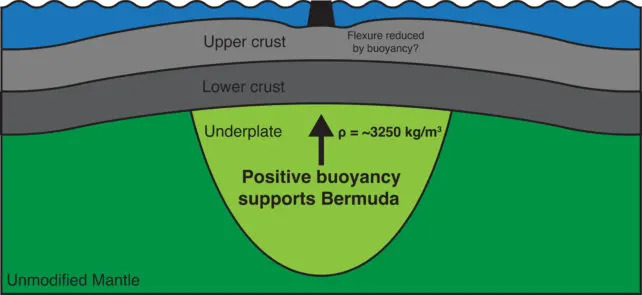
This illustration shows the underplate that could be helping Bermuda 'float' above water. (Frazer & Park,Geophys. Res. Let., 2025)
Typical volcanic island chains produced by hotspots (for example, Hawaii) show a trail of progressively older volcanoes, occasional active volcanism, and evidence of a deep, rising mantle plume. A mantle plume produces a buoyant uplift of the seafloor — a swell — as hot, less‑dense mantle material rises toward the crust.
Bermuda, however, displays the swell without clear evidence for an active deep plume. Because volcanic activity there ceased millions of years ago, the swell and the islands should have subsided, yet they remain elevated.
What the seismic evidence shows

Subscribe to ScienceAlert's free fact-checked newsletter
Frazer and Park used earthquake waves that passed beneath Bermuda to probe the mantle. Seismic waves travel faster through denser rock and slow in lower‑density material; by measuring travel times and waveform shapes, seismologists can infer variations in composition and density below the seafloor.
Their results suggest a laterally extensive, low‑density layer some ~20 km thick directly beneath the oceanic crust. The authors propose this layer was emplaced when Bermuda was volcanically active about 30–35 million years ago and now acts as an underplated, buoyant sheet that helps support the bathymetric swell.
"We identify features associated with a ~20‑kilometer‑thick layer of rock below the oceanic crust that has not yet been reported," the authors write. "This thick layer beneath the crust likely was emplaced when Bermuda was volcanically active 30–35 million years ago and could support the bathymetric swell."
Implications and caveats
If confirmed, underplating offers a plausible alternative to a classic deep mantle plume for explaining why Bermuda's 181 islands (remnants of volcanic activity roughly 33 million years ago) remain above sea level. However, the authors emphasize that underplating is one interpretation of the seismic signatures — other models may also fit the data, and additional geophysical and geological constraints will be needed to confirm the hypothesis.
The study refines our understanding of how crustal buoyancy can be maintained long after volcanic activity wanes and highlights the value of seismic imaging for detecting hidden crustal structures. The research appears in Geophysical Research Letters.


