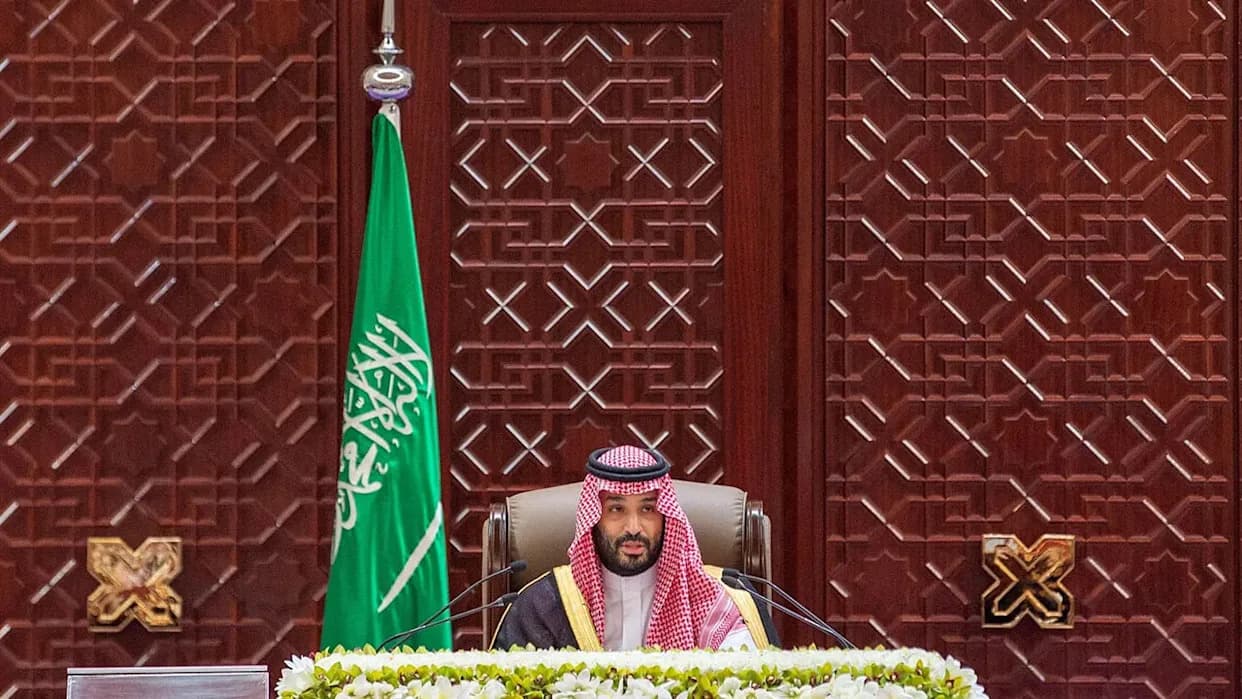
The crown prince’s Washington visit was framed as a two‑way strategic exchange, not a one‑sided payoff: roughly $1 trillion in deals aim to advance Saudi Vision 2030 while delivering U.S. commercial and security benefits. Key areas include defense (possible F‑35s and tanks), civil nuclear cooperation, semiconductors, energy and rare‑earth minerals. Symbolic gestures and presidential language signaled Riyadh’s elevated regional role, while Saudi normalization with Israel remains contingent on a credible path to Palestinian statehood.
MBS’s Washington Visit: A Strategic, Two‑Way Deal Beyond the $1 Trillion Headline

Observers can read Crown Prince Mohammed bin Salman’s Washington visit in several ways, but framing the outcome as a two‑way strategic exchange captures its intent. The roughly $1 trillion in deals and investment pledges were presented not as unilateral gifts to the United States or favors to an administration, but as commercial and political transactions designed to advance Saudi Arabia’s Vision 2030 while delivering tangible benefits to U.S. partners.
Economic and strategic scope
The $1 trillion figure is eye‑catching, but it needs context. Spread across defense, energy, technology, nuclear cooperation and rare‑earth minerals, the packages target core sectors of the global economy and reflect a G20 country attempting a rapid structural transformation. These are long‑term commitments intended to secure the kingdom’s economic trajectory and industrial base.
Defense and deterrence
Defense sales — including potential F‑35 fighters and advanced tank systems — would significantly strengthen Riyadh’s deterrent posture. If those approvals proceed on terms acceptable to Saudi negotiators, they would alter the balance of military capabilities in the region; if they stall, the likely impediment will be procedural or political hurdles in Washington rather than a lack of Saudi intent.
Nuclear cooperation and technology ties
On civil nuclear development, the United States remains a preferred partner for Riyadh. That preference suggests Saudi ambitions for a peaceful nuclear program would proceed under American engagement and oversight, reducing the incentive to turn to rival powers for sensitive capabilities — a geopolitical and economic win if implemented under U.S. frameworks. Similarly, agreements in semiconductors and other high technology sectors underscore an effort to anchor advanced supply chains and expertise in long‑term partnerships.
Symbolism and diplomacy
Symbolic gestures at the White House — including the reception accorded to the crown prince — sent a deliberate signal about how Washington views Saudi Arabia’s role. The administration’s willingness to take Saudi counsel on regional matters, from Syria to Sudan, highlights Riyadh’s diplomatic weight. Equally notable was the president’s language calling both Saudi Arabia and Israel “great allies,” a departure from the more conditional phrasing of past administrations and an indicator of shifting U.S. posture in the region.
Israel, normalization and Palestinian statehood
The crown prince reiterated that Saudi normalization with Israel remains conditional on a credible path to Palestinian statehood. That position has not changed, and it now sits against a broader international context shaped by two years of war in Gaza. If Israel embraces a U.S.‑backed plan that addresses Palestinian aspirations, Riyadh appears positioned to move toward normalization; until such a breakthrough, closer U.S.–Saudi ties will proceed through other political and commercial milestones.
On deterrence: Commentator Abdulrahman Al‑Rashed has observed that the emerging security partnership is aimed at broader deterrence and strategic alignment, not a narrow focus on any single threat.
Critics who claim the United States was shortchanged argue that Saudi negotiators secured everything they wanted. Yet securing large investment pledges and strategic partnerships is precisely the point of such diplomacy — mutual commitments aimed at mutually beneficial outcomes. Whether these commitments translate into concrete projects will depend on follow‑through from both sides and the ability of U.S. and Saudi institutions to negotiate technical, legal and political details.
In short, the visit was designed as a two‑way street: Saudi Arabia sought investments, technology and security guarantees to underpin its economic transformation, while the United States gained opportunities to deepen strategic partnerships, access energy and critical materials, and reinforce regional stability through closer ties. The real test now is implementation.
Help us improve.