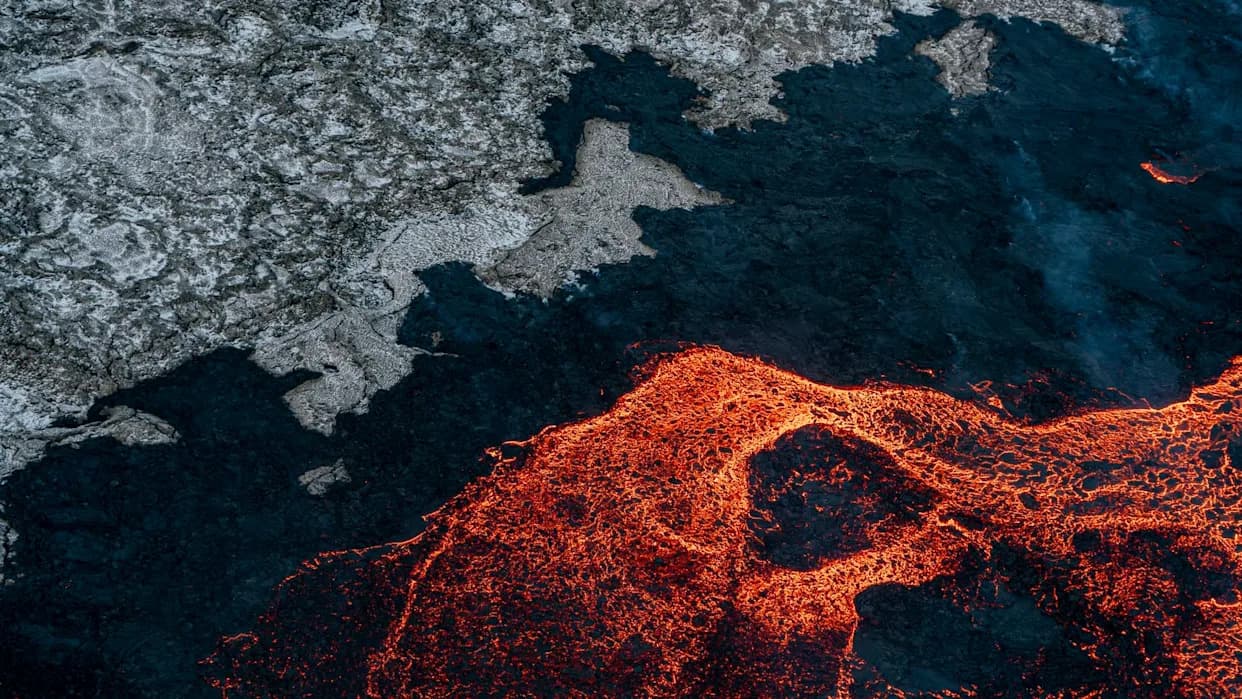
Iceland plans to drill two boreholes into a magma reservoir near the Krafla volcano in 2026 to capture the first direct measurements of molten rock and to test a "near‑magma" geothermal system. The reservoir was discovered in 2009 at roughly 2,104 meters depth, prompting the Krafla Magma Testbed program. If engineers can build tools to withstand extreme heat, pressure and acidity, the work could improve eruption forecasting, deepen understanding of continental formation, and point to far more powerful, low‑cost geothermal electricity.
Iceland's 2026 Mission: Drilling into a Magma Chamber for Direct Measurements and Near‑Magma Power

A pioneering scientific and engineering effort in Iceland aims to drill two boreholes into a subsurface magma reservoir near the Krafla volcano in 2026. One hole will collect the first direct measurements of molten rock, while the second will test a "near‑magma" geothermal system that could unlock far higher power yields than conventional geothermal wells.
Project overview
The site was identified in 2009 by Landsvirkjun, Iceland's national power company, when drilling unexpectedly encountered a magma body about 2,104 meters beneath the surface. That discovery led to establishment of the Krafla Magma Testbed to study how to probe and harness energy near active magma reservoirs in a controlled way.
What the teams will do
Researchers plan to drill two boreholes: one aimed at obtaining direct physical and chemical measurements of magma and its surroundings, and a second designed to explore whether systems placed adjacent to extremely hot rock can produce electricity much more efficiently than today’s geothermal wells. The operation itself is expected to take roughly two months once drilling begins.
"It's the first journey to the center of the Earth," said Björn Þór Guðmundsson of the Geothermal Research Cluster.
Potential scientific and energy benefits
Direct access to magma would provide unprecedented data to improve models of how continents form and evolve and could refine eruption forecasts by revealing conditions inside active magmatic systems. From an energy perspective, "near‑magma" geothermal could operate at much higher temperatures and pressures than conventional geothermal resources, potentially yielding far more power per well and lowering the cost of electricity.
Previous, accidental encounters with magma in other locations have shown the immense energy potential and hazards of such conditions. Reports from earlier incidents indicate temperatures reaching hundreds of degrees and extreme pressures; in one documented case a wellhead was destroyed by magma, with fluid temperatures reported up to 900° (as reported by project participants) and very high pressure conditions.
Key challenges and risk management
Engineering a controlled, safe drilling campaign into the near environment of magma requires new sensors, high‑temperature drilling tools, and materials resistant to heat, corrosive fluids and intense pressure. Teams are developing instruments and protocols to monitor conditions in real time and to reduce the risks of uncontrolled magma entry or damage to infrastructure.
Context and outlook
Project leaders and external scientists say the Krafla campaign could demonstrate a path to substantially cheaper and higher‑yield geothermal electricity if the technical hurdles can be overcome. Estimates suggest wells targeting brittle–ductile zones around magma chambers could produce electricity at or below current Icelandic geothermal prices (about 4.3 cents/kWh), and oceanic rift zones such as parts of the Mid‑Atlantic Ridge may be promising future sites.
"There are endless opportunities. The only thing we need to do is to learn how to tame this monster," said Hjalti Páll Ingólfsson of the Geothermal Research Cluster.
The project is scheduled to begin drilling in 2026, after development and testing of the high‑temperature tools and sensors needed to operate in this extreme environment. If successful, the effort could yield both major scientific discoveries and a new approach to low‑carbon baseload energy.
Key people: Björn Þór Guðmundsson, Bjarni Pálsson, John Eichelberger, Hjalti Páll Ingólfsson; operator: Landsvirkjun.
Help us improve.