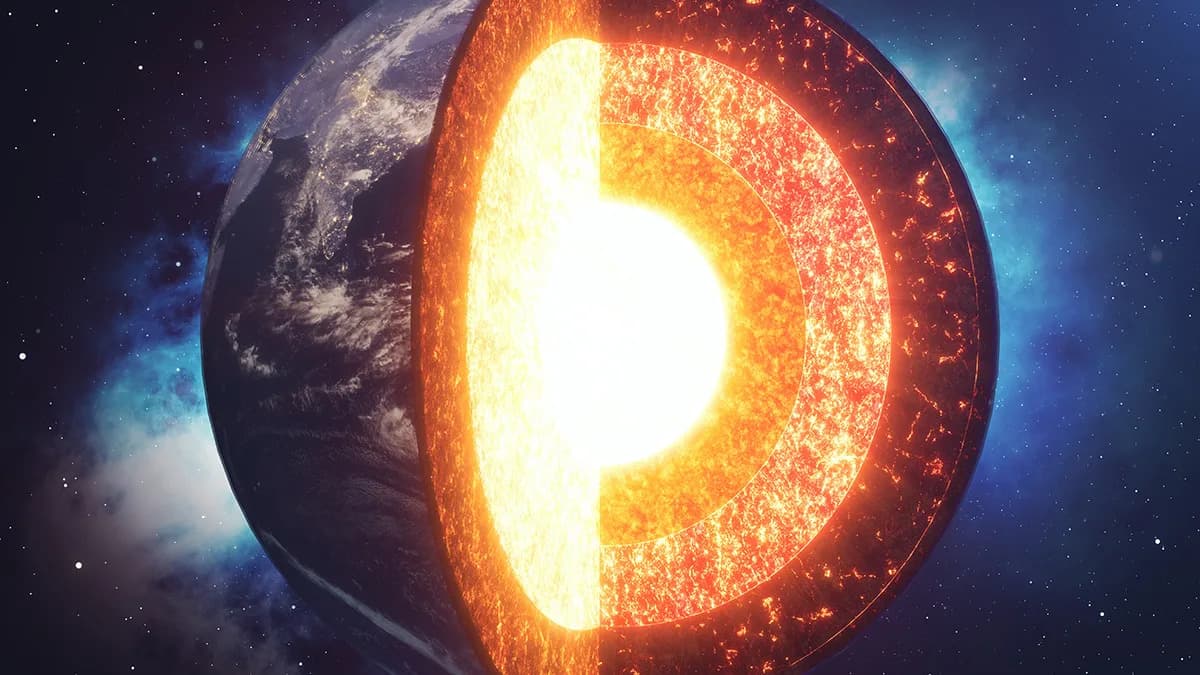
A new paper in Nature Geoscience led by Rutgers geodynamicist Yoshinori Miyazaki offers a fresh explanation for two enormous, continent-sized structures at the boundary between Earth’s mantle and core. These dense, hot masses lie roughly 1,800 miles (≈2,900 km) beneath the surface beneath Africa and the Pacific and appear in seismic records as distinct anomalies that slow or alter seismic waves.
What the structures are
Seismologists have identified two types of deep features: large-low shear velocity provinces (LLSVPs), vast irregular lumps near the lowermost mantle, and much smaller ultra-low velocity zones (ULVZs) that slow seismic waves to exceptionally low speeds. Their size and composition are inconsistent with the simple, layered picture produced by many standard models of early Earth evolution.
The new idea
Miyazaki and colleagues used geodynamic models of Earth’s early interior to test how a global magma ocean might have evolved as it cooled. Their results suggest a slow leakage of silicon- and magnesium-rich material from the core into a basal magma ocean could have "contaminated" parts of it, preventing local solidification and producing the irregular, lumpy distributions we now image as LLSVPs and ULVZs. "These are not random oddities," Miyazaki says. "They are fingerprints of Earth’s earliest history."
Why it matters for habitability
The team argues this interior contamination could have altered how Earth cooled, influenced long-term volcanic activity, and helped shape the planet's atmosphere—factors linked to the persistence of surface water and the emergence of life. In contrast, planets such as Venus and Mars appear to have followed different interior-evolution paths, which may partly explain why Venus developed a crushing CO2-rich atmosphere and Mars lost most of its air.
Caveats and next steps
The idea remains an early-stage hypothesis built on numerical models and a limited set of clues. Confirming it will require more seismic imaging, high-pressure mineral experiments, and refined simulations that connect deep-mantle chemistry with long-term thermal and volcanic evolution. If supported, the hypothesis would offer a new link between deep-Earth dynamics and planetary habitability.
Study lead: Yoshinori Miyazaki. Published in Nature Geoscience. The proposal is cautious but provocative, and scientists emphasize that further evidence is needed.