Comets form comas and tails when their ices sublimate as they warm. Astronomers have identified dozens of exocomet systems, starting with Beta Pictoris, where hundreds of transient spectral events were linked to evaporating cometary bodies. More recently, TESS observations of RZ Piscium revealed about two dozen deep dips (up to 20%) best explained by clouds from orbiting exocomets with nuclei roughly 1–7 km wide. Additionally, three interstellar visitors (1I/‘Oumuamua, 2I/Borisov and 3I/ATLAS) have passed through our solar system, supporting the idea that comets are common across the galaxy.
Exocomets Swarm Distant Stars — and Some Even Swing Through Our Solar System

I have a particular fondness for conspicuous comets. Far from their stars they are frozen solid, but as they swing inward the ices sublimate: solid turns directly to gas, forming a fuzzy coma around the nucleus and, often, an extended tail. Only a few comets grow bright enough to be seen without a telescope; most remain faint in the outer reaches of a planetary system and require powerful instruments to detect the scant sunlight they reflect.
Given that planets are common around other stars, it is natural to expect many systems also host populations of icy bodies. Our sun sits amid an enormous reservoir of small icy objects — possibly numbering as many as a trillion — so why would other stars be different? At first glance it seems hopeless to detect such distant, faint objects: the nearest stars are tens of thousands of times farther away than Neptune, making any individual exocomet essentially invisible.
Yet astronomers have identified dozens of so-called exocomet systems, and the first detections go back nearly 40 years. The young star Beta Pictoris, about 60 light-years away, provided some of the earliest clues. In the early 1980s infrared observations revealed a warm debris disk — leftover material from planet formation — and later work confirmed at least two planets in the system. By 1987 observers began noticing rapid, sporadic features in the star’s spectrum. The best explanation: small bodies from the debris disk falling inward. When these exocomets pass in front of the star, their evaporating gas absorbs light at particular wavelengths and produces the transient spectral signatures.
Subsequent monitoring of Beta Pictoris revealed hundreds of such events, enough to separate them into distinct populations analogous to comet categories in our own solar system. Remarkably, these distant cometary fragments display properties that make them seem familiar.
This year a different technique revealed another exocomet system without relying on spectroscopy. A team led by University of Colorado Boulder undergraduate Adalyn Gibson reported in Astrophysical Journal Letters that the star RZ Piscium — roughly 600 light-years away, slightly cooler than the sun and only about 50 million years old — hosts a swarm of cometary bodies. Rather than spectral lines, the researchers analyzed years of brightness measurements from NASA’s Transiting Exoplanet Survey Satellite (TESS).
Instead of periodic planet-like transits, RZ Piscium showed about two dozen deep, irregular dips in brightness; some dimmings reached as much as 20 percent, far larger than would be expected from a typical planet. The most plausible interpretation is that expanding clouds of gas released by orbiting exocomets occasionally obscure the star. Statistical modeling of the TESS data indicates the solid nuclei of these exocomets are roughly 1–7 kilometers across, a size distribution similar to comets in our Kuiper Belt.
Occasional Visitors from Interstellar Space
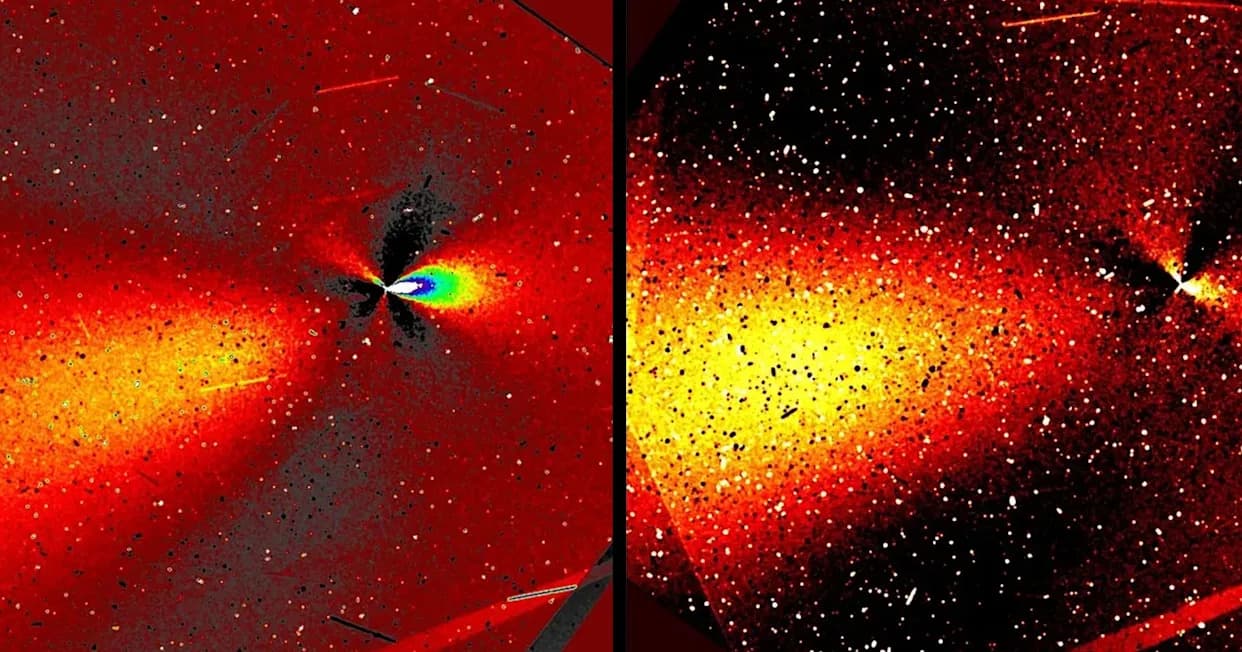
There is another, more direct way to study alien comets: sometimes they pass through our own neighborhood. Three interstellar objects have been clearly identified in recent years — 1I/‘Oumuamua (2017), 2I/Borisov (2019), and the more recent 3I/ATLAS — all moving too quickly to be bound by the sun and therefore originating beyond our system. Although each displayed some peculiarities, overall these visitors behaved much like the small ice-and-rock aggregates we call comets, plausibly ejected from their birth systems by close planetary encounters.
Statistically, there may be more than one interstellar object inside the solar system at any given time; most are simply too small and faint for current surveys to detect. Likewise, our own sun has probably cast many comets into interstellar space over billions of years, and it is pleasant to imagine that alien astronomers on a distant world might one day watch a comet we ejected sweep past their sky and recognize similarities to their own system.
Detecting exocomets — whether indirectly through spectral fingerprints, by photometric dips, or by catching interstellar visitors — shows that cometary populations are common and that many planetary systems share the messy leftovers of planet formation. That realization, and the glimpses it gives of distant systems resembling our own, is quietly comforting.
Help us improve.