Researchers reworked a key cosmological parameter after new DES and DESI observations and propose that the cosmological "constant" could vary and even become negative. Under this adjusted dark energy (aDE) model, the universe's total lifespan would be about 33 billion years, leaving roughly ~19 billion years before a potential collapse. The paper, published in the Journal of Cosmology and Astroparticle Physics, urges independent confirmation of the observations and rigorous testing of the model.
New Study Suggests the Universe Could End in a 'Big Crunch' — Lifespan Estimated at ~33 Billion Years

Universe may reverse course: a possible end in a "Big Crunch"
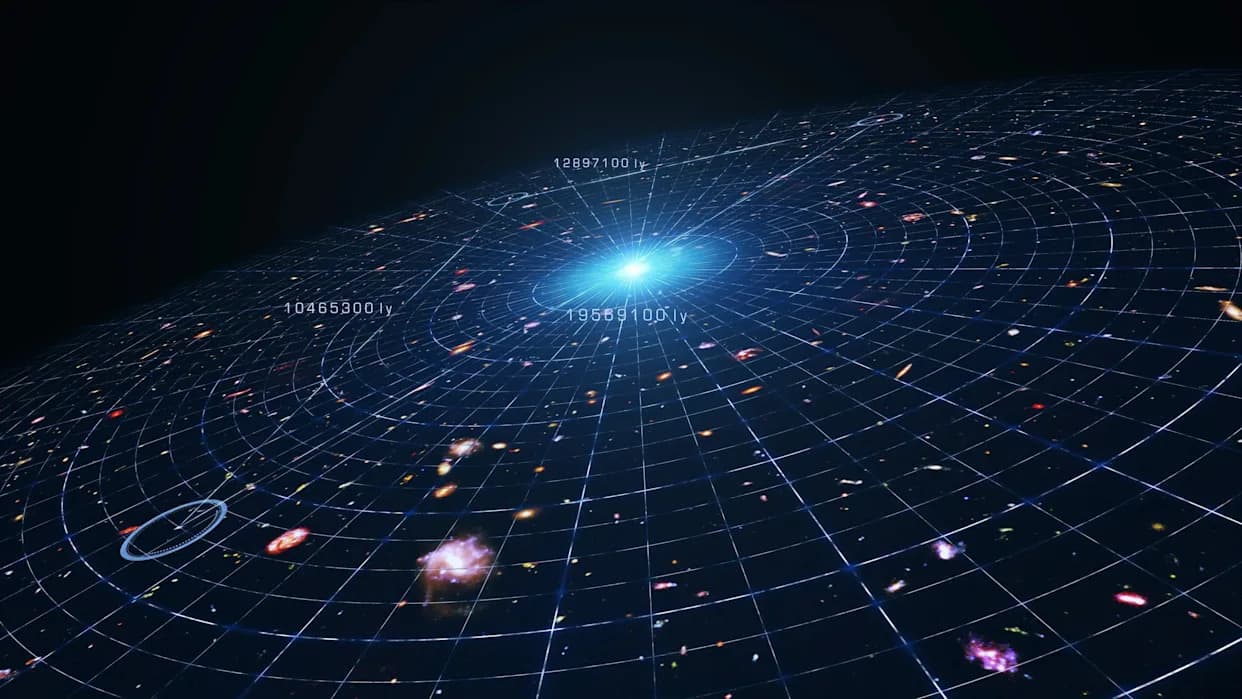
Scientists have updated a key cosmological model in response to recent observations and propose an alternative cosmic fate: rather than expand forever, the universe could eventually stop expanding and collapse in a so‑called Big Crunch. The revision centers on the behavior of the cosmological constant, the parameter often used to represent dark energy — the driver of cosmic acceleration.
For decades the cosmological constant has been treated as positive and fixed, implying accelerating expansion. New analyses combining results from the Dark Energy Survey (DES) and the Dark Energy Spectroscopic Instrument (DESI) suggest the effective value of this parameter might evolve and could weaken over time. If the sign of the cosmological constant flips from positive to negative, the large‑scale dynamics of the cosmos would reverse: acceleration would slow, expansion would stop, and contraction would follow.
The team of researchers — based in the U.S., China and Spain — incorporated a potentially negative cosmological constant into an adjusted dark energy model (the authors label it aDE). Publishing their findings in the peer‑reviewed Journal of Cosmology and Astroparticle Physics, they estimate a total cosmic lifespan of roughly 33 billion years. Given the current age of the universe (about 13.8 billion years), that corresponds to on the order of ~19 billion years until a possible collapse (some estimates in the paper give ~18.9 billion years remaining).
Important caveats: the authors emphasize that the DES and DESI results must be independently confirmed and that the aDE model requires rigorous testing. Cosmology relies on careful cross‑checks between theory and observation; a change of this magnitude in our picture of cosmic history would need reproducible, high‑quality data.
"It is crucial that the DES/DESI observation is confirmed and the aDE model is rigorously tested," the paper notes.
The study also addresses speculative scenarios such as a cyclic universe or a "Big Bounce" (a collapse followed by a new expansion). The authors call such a rebound very unlikely, though they do not entirely rule out exotic quantum effects that could lead to some form of post‑crunch transition. Even so, they caution, any post‑crunch universe would likely be very different from the one we inhabit now.
Why this matters
This proposal highlights how new, precise observations can change our theoretical picture of the cosmos. Whether the cosmological constant truly varies — and whether it will ultimately drive contraction — remains an open question. Upcoming observational campaigns, additional DES/DESI analyses, and independent measurements will determine whether this adjusted model stands up to scrutiny.
Bottom line: The idea that the universe could end in a Big Crunch is an intriguing alternative to the long‑favored endless expansion scenario. It is plausible under the revised model, but far from confirmed.
Help us improve.