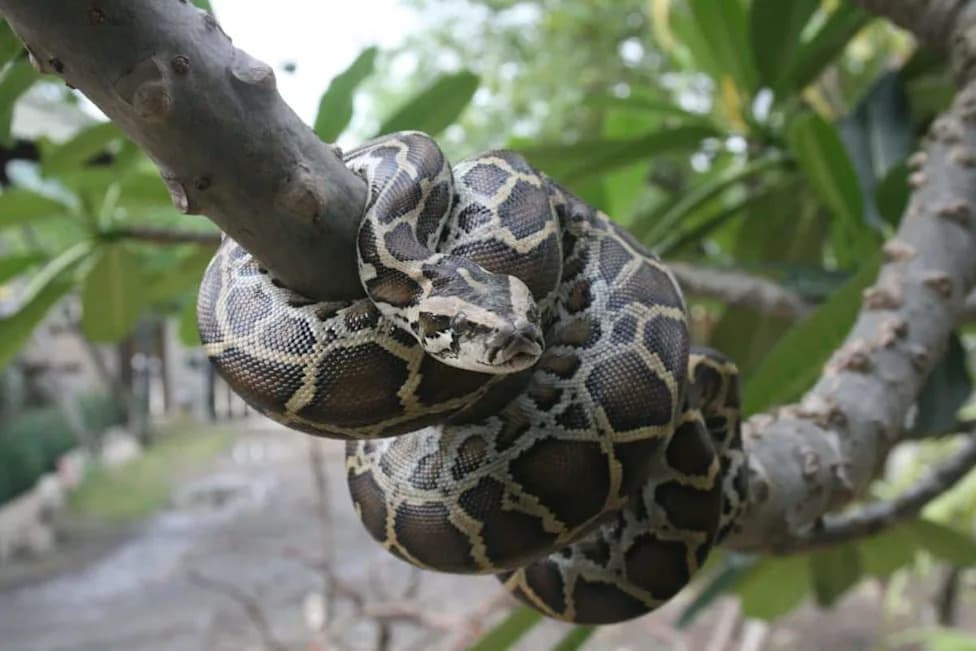
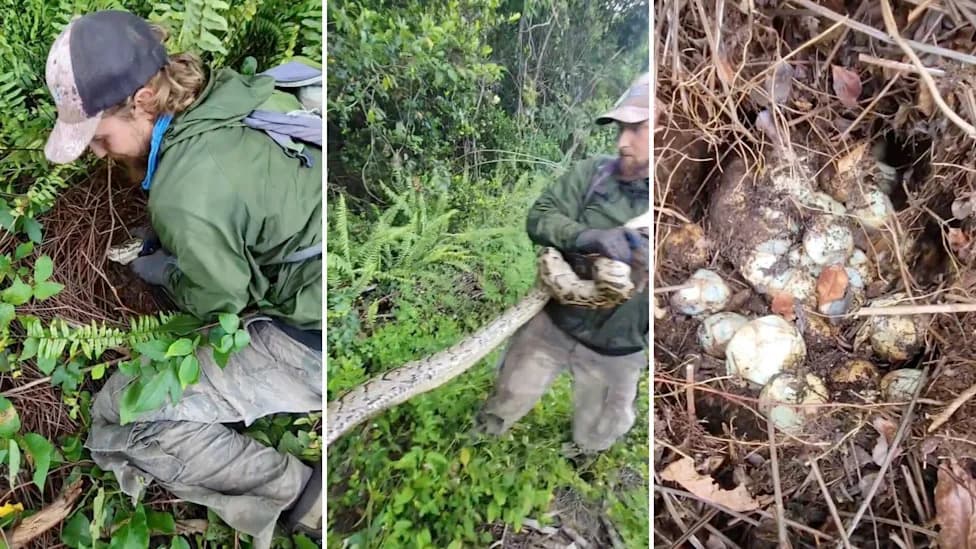
A new study recommends refining Florida's Burmese python-control efforts by prioritizing removal of large, reproductive females rather than juveniles. Researchers developed a Weighted Removal Index (WRI) using Python Elimination Program data to score captures by age, sex and season. Targeting mature females—each of which can lay about 70 eggs—should reduce population growth and slow range expansion, particularly at invasion edges. The study also suggests focusing some removal efforts in winter when captured snakes tend to be higher-impact adults.
Target Large Female Pythons to Boost Florida's Control Efforts, Study Finds
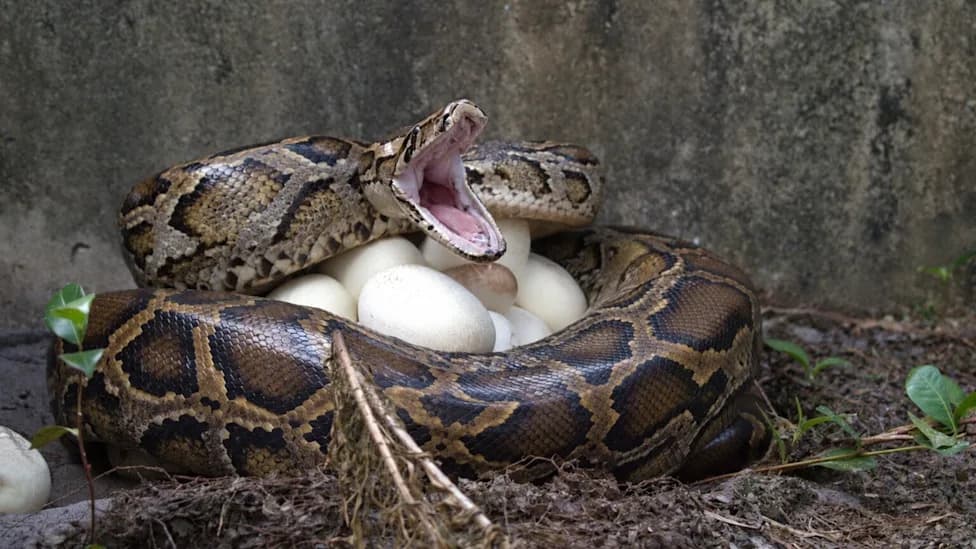
A female Burmese python coils around her clutch of eggs and displays defensively at the UF/IFAS Fort Lauderdale Research and Education Center in Davie, Florida.
Burmese pythons (Python bivittatus) remain a major invasive threat in Florida. The state permits year-round hunting and even runs an annual 10-day removal contest, yet wildlife managers estimate there are still roughly 100,000–300,000 of these predators statewide. A new study in the journal Ecological Applications argues that a more selective removal strategy could produce far greater conservation benefits than indiscriminate removals.
Researchers from the University of Florida and collaborators analyzed records from the South Florida Water Management District's Python Elimination Program to develop the Weighted Removal Index (WRI). The WRI assigns a score to each captured snake based on factors such as age, sex and seasonality, with higher scores given to individuals whose removal is likely to have the greatest long-term impact on population growth.
Why Mature Females Matter
Because juvenile python mortality is high and many adolescents never survive to reproduce, the authors recommend prioritizing the removal of large, reproductive females. An adult female typically lays about 70 eggs in a clutch, so removing breeding females—especially along the invasion's frontier—can substantially slow range expansion and reduce future population growth.
"Removing the biggest female we've ever caught is very different from removing a tiny snake that might not survive next year," said Alex Romer, an ecologist with UF's Croc Doc Wildlife Research Team.
Co-author and UF invasive-ecologist Melissa Miller added that while every captured python helps, targeting large females is likely to reduce the population most effectively. The team also notes that the timing of removals matters: although fewer snakes are captured in winter months such as January and February, those removals tend to be adults and thus score higher on the WRI.
"Incorporating this knowledge into management models…can be a game changer that can really make a difference in the battle to combat these invaders," said biologist Sergio Balaguera-Reina.
Management Implications
The study suggests a few practical changes for managers and organized removal efforts: prioritize searches for large females, focus effort on regional invasion edges to slow spread, and consider timing intensive removal events during months when captured animals have higher WRI scores. The authors present the WRI as a tool to help allocate limited resources where they will achieve the greatest ecological return.
While the WRI provides a data-driven way to prioritize removals, its success depends on consistent monitoring, accurate field assessments of size and sex, and responsible incentives for hunters and contractors. Combined with ongoing research and adaptive management, selective removal could improve the efficiency and impact of Florida's python-control programs.
Help us improve.