California Gov. Gavin Newsom signed SB 883 on Sept. 27 to strengthen oversight and emergency planning for reactive chemical storage after a GKN Aerospace tank overheated in Garden Grove and released toxic vapors, triggering an evacuation of about 50,000 people. The law bans new high-risk storage sites near homes, requires public notice and input on proposed hazardous facilities, and brings large MMA holdings under the California Accidental Release Prevention program. Trade groups raised concerns about undefined terms and prescriptive requirements, while GKN agreed to pay up to $100 million to affected residents as negotiations continue over safety and monitoring terms.
Newsom Signs SB 883 to Tighten Safety Rules for Reactive Chemical Storage After Garden Grove Leak
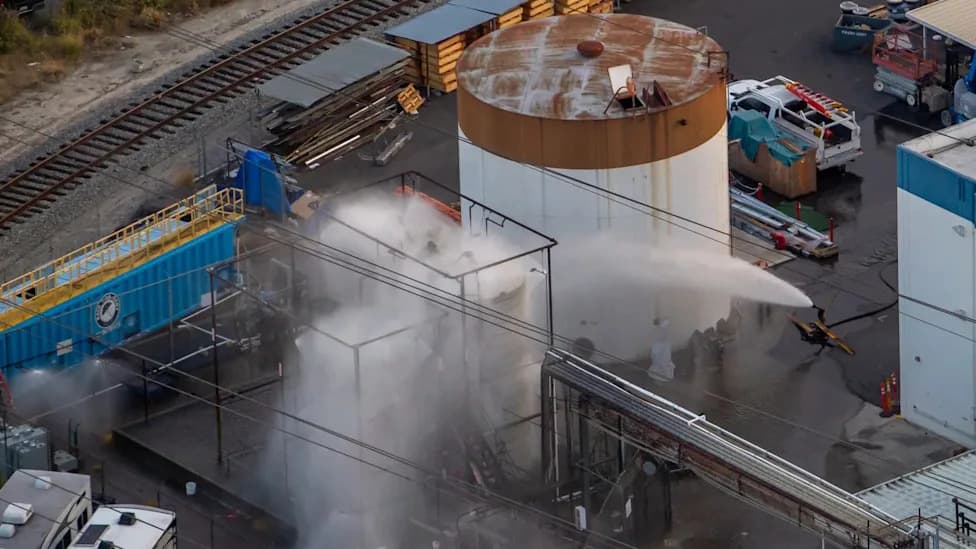
An aerial view of water being sprayed onto an overheated 34,000-gallon tank at GKN Aerospace’s manufacturing facility on May 23, 2026, in Garden Grove, California. An incident at the commercial and military aircraft component manufacturer’s plant triggered the site’s automatic sprinkler system.
California Governor Gavin Newsom signed Senate Bill 883 on Sept. 27, expanding state oversight of facilities that store reactive chemicals and strengthening emergency planning and public notification requirements.
Background
In May, a storage tank at GKN Aerospace's Garden Grove component plant containing up to 7,000 gallons of a flammable liquid overheated and released toxic vapors, prompting an evacuation of roughly 50,000 residents in the area, according to a state assembly floor analysis. The incident exposed gaps in state oversight and emergency preparedness for reactive chemical storage.
Key Provisions of SB 883
SB 883, known as the Preventing Chemical Explosions Act, was originally introduced in January and substantially revised after the Garden Grove incident. Major provisions include:
- Prohibiting new "high-risk" reactive chemical storage facilities from being sited near residential areas.
- Requiring public notice and community input before approval of proposed hazardous storage sites.
- Bringing facilities that store significant quantities of methyl methacrylate (MMA) under the California Accidental Release Prevention (CalARP) program, which focuses on preventing and reducing the impacts of accidental hazardous chemical releases.
- Mandating stronger emergency response planning and certain facility protections intended to reduce the risk of catastrophic releases.
MMA, Hazards, And Why It Matters
The material involved at the Garden Grove facility was methyl methacrylate (MMA), a monomer used to manufacture acrylics, coatings, composites and specialty aerospace and medical components. GKN uses MMA in products such as canopies and cabin windows, including parts used on some Lockheed Martin and Boeing platforms.
Health sources such as the National Library of Medicine warn that MMA can irritate the skin, eyes and mucous membranes and can affect neurological and respiratory systems. At high temperatures MMA can polymerize, increasing the risk of runaway reactions and explosions.
Reaction And Opposition
The bill's author, Sen. Tom Umberg, said in a statement:
"We were incredibly fortunate that the situation was brought under control without an explosion or reported injuries, but we cannot rely on good fortune to keep our communities safe. SB 883 addresses the gaps this incident exposed and puts stronger safeguards in place to help ensure it never happens again."
Several state and national trade groups, including the American Chemistry Council, the Supply Chain Federation and the California Manufacturers and Technology Association, opposed aspects of the law. Their concerns centered on undefined terms such as "reactive chemical storage facility" and prescriptive preapproval requirements (for example, mandatory backup cooling systems) that they argue should follow thorough investigations into the incident's root cause.
Legal Settlement And Next Steps
In August, GKN reached an agreement with the Orange County district attorney to resolve claims stemming from the leak. Under that deal, GKN will pay up to $100 million to compensate more than 50,000 residents who were evacuated. The district attorney is also negotiating to include a binding safety plan and independent monitoring of the facility as part of the final settlement.
Implications
SB 883 signals tighter regulation of reactive chemical storage in California, greater community input into siting decisions, and expanded application of CalARP to materials such as MMA. The law aims to reduce the likelihood of similar incidents and to improve emergency preparedness and public notification when accidents occur.
Help us improve.