The tenth Copernicus Ocean State Report, compiled by more than 100 scientists, warns that the world’s oceans are warming, acidifying and changing faster than expected. Oceans absorbed a record 23 zettajoules of heat in 2025 — the ninth consecutive annual record — and sea surface temperatures set records in 2023, 2024 and 2026. Rising seas, increased acidity and regional extremes (Mediterranean, Arctic, Antarctic) are already harming ecosystems and communities. The report urges sustained, long-term ocean monitoring and rapid action to prepare for further change.
“Starkest Warning Yet”: Copernicus Report Shows Rapid, Deep Changes Sweeping the World’s Oceans

The sun sets on the horizon of the Pacific Ocen on September 24, 2026 in Laguna Beach, California. - Kevin Carter/Getty Images
More than 100 international scientists are sounding what the Copernicus team calls the "starkest warning yet": the world's oceans are warming, acidifying and changing faster than many communities and ecosystems can adapt. The tenth Copernicus Ocean State Report synthesizes more than four decades of satellite, buoy and in‑water sensor observations to provide a clear, data-driven picture of accelerating ocean change.
Key Findings
Unprecedented heat uptake. Oceans absorb about 90% of the excess heat from human greenhouse gas emissions, and that heat uptake is rising rapidly. The rate of ocean warming has roughly doubled over the past 20 years. In 2025 the oceans absorbed an additional 23 zettajoules of heat — a record and the ninth straight year of new records. To convey the scale, the report compares this energy to the equivalent of 12 Hiroshima bombs detonating every second for a year, or roughly 40 times the energy the world consumed in 2025.
Sea surface temperature records. Sea surface temperatures hit record highs in 2023, 2024 and again in 2026, and these elevated temperatures are driving more frequent and longer marine heatwaves.
Rising seas and accelerating rates. Global average sea level has risen by roughly 0.15 inches (3.8 millimetres) per year since 1999 — nearly 4 inches in total — with rates accelerating since about 2012. Rising seas threaten hundreds of millions of people living on coasts and low-lying islands.
Increasing acidification. Since 1985 the oceans have become roughly 17% more acidic as they absorb increasing amounts of carbon dioxide. This 'other half' of climate change undermines the ability of shell-building species — oysters, lobsters, corals and others — to form and maintain skeletons and shells.
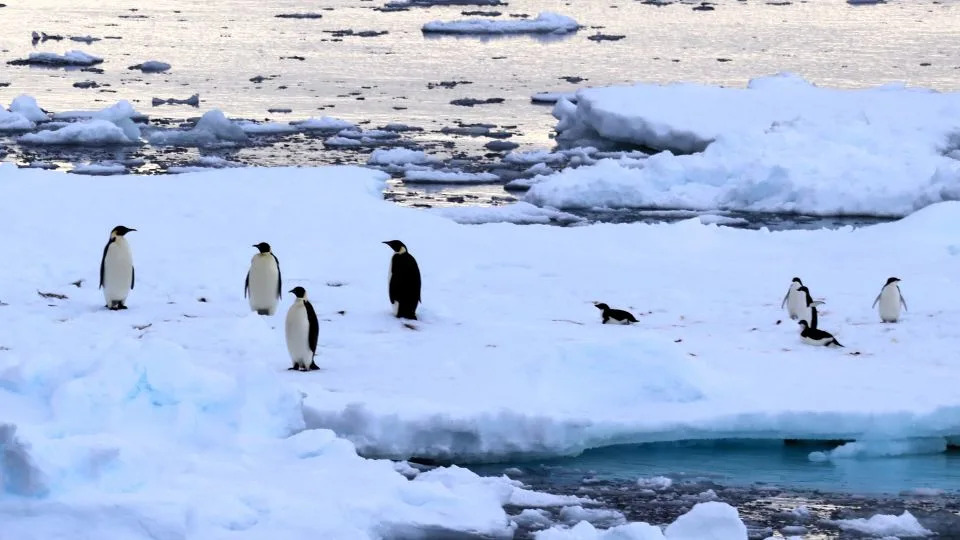
An emperor penguin (left) and Adélie penguins stand together on drifting ice on December 15, 2025 in Antarctica. - The Asahi Shimbun/Getty Images
Regional and Ecological Impacts
Some regions are under especially intense pressure. European seas experienced record marine heatwaves in 2024, including events in the Mediterranean and Black Seas that lasted more than 30 days and pushed temperatures as much as 8.3°F (4.6°C) above average. These events are not isolated; they occur on a background of sustained warming that alters habitat conditions for marine life.
The Arctic is warming rapidly: sea surface temperatures there have risen by about 7.6°F (4.2°C) over the past four decades, and average monthly sea ice declined by roughly 190,000 square miles per decade between 1979 and 2025 — an area about the size of Spain lost every ten years. In Antarctica, record-low sea ice in 2022 coincided with the first documented mass breeding failure of Emperor penguins, underscoring that ice-dependent species are already being affected.
Human Consequences
Ocean extremes have cascading effects on people and infrastructure. The report notes examples such as Storm Louis in 2024, which produced 26-foot waves on parts of Spain's coast, causing fatalities and damage, and an extreme event in Bothnian Bay that temporarily dropped sea level by about 60 inches and halted ferry services.
Small island developing states are among the most exposed: sea level rise, stronger cyclones, storm surges and coral reef decline threaten livelihoods, economies and national security. As Karina von Schuckmann of Mercator Ocean International warns, for these countries ocean change is an immediate development and security challenge.
"The ocean is transforming before our eyes: warming, rising seas and ecosystem degradation are interconnected signs of significant and long-term change," said Pierre Bahurel, Director General of Mercator Ocean International.
What the Report Urges
The authors call for sustained, long-term ocean monitoring and improved forecasting capacity so governments, communities and businesses can anticipate and prepare for continued change. "It is our responsibility to build the permanent capacity to anticipate this transformation," the report states.
Bottom line: The Copernicus Ocean State Report documents accelerating, global-scale changes in ocean heat, chemistry and ice that are already affecting ecosystems and societies. Immediate action on emissions, stronger adaptation measures for coasts and islands, and permanent ocean observing systems are central recommendations.
Help us improve.