Key findings: Mount Sinai researchers show APOE4 drives cerebrovascular damage by converting pericytes into scar-forming cells; blocking TGF‑beta reversed this effect in mice. Gilead’s investigational BCMA‑targeted CAR T-cell therapy, anitocabtagene autoleucel (anito‑cel), produced responses in all 38 Phase 1 multiple myeloma patients, with nearly 80% complete responses and favorable durability. MIT researchers used Raman microscopy to noninvasively identify biochemical "barcodes" of senescent cells in mice—an approach being adapted toward human use.
Genetic Clue Offers Hope: APOE4‑Driven Brain Vessel Damage May Be Reversed
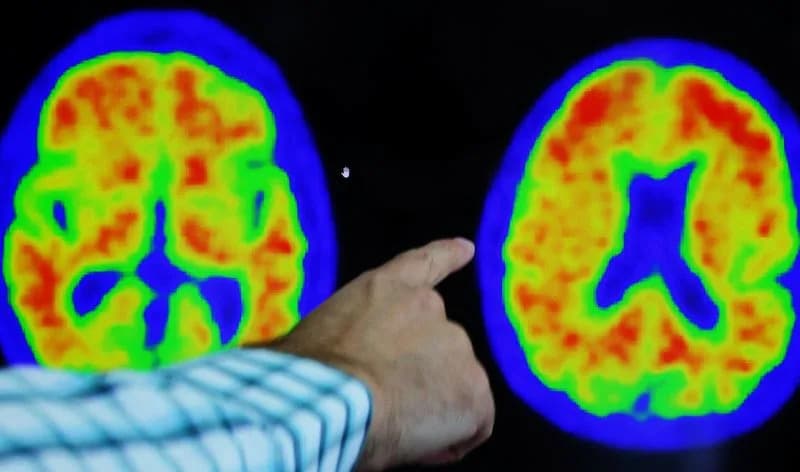
FILE PHOTO: A man points at evidence of Alzheimer’s disease on PET scans. Boston, Massachusetts, U.S., March 30, 2023. REUTERS/Brian Snyder/File Photo
By Nancy Lapid — Sept 25 (Reuters)
New research sheds light on how the strongest genetic risk factor for Alzheimer's disease—APOE4—harms the brain and points to strategies that may reverse that damage. Two related studies identify a pathway by which APOE4 transforms vessel-stabilizing pericytes into scar-forming cells, accelerating amyloid accumulation, and show that blocking TGF‑beta signaling restored vessel health in mice. The issue also highlights promising early results for a Gilead CAR T therapy in multiple myeloma and a new noninvasive method to identify senescent cells.
APOE4 and Cerebrovascular Damage
Researchers at the Icahn School of Medicine at Mount Sinai report that APOE4 not only promotes buildup of misfolded amyloid proteins but also directly damages the brain's microvessels. The team found that APOE4 causes pericytes—cells that normally stabilize capillaries—to convert into scar-forming cells that thicken vessel walls and reduce cerebral blood flow, creating conditions that worsen brain injury.
In mouse experiments, pharmacologic blockade of TGF‑beta, a signaling protein involved in tissue repair and cell behavior, preserved pericyte function and reversed APOE4-associated cerebrovascular degeneration. The findings appear across two papers published in Cell and Cell Stem Cell.
"Damage to the brain's blood vessels is not simply a late consequence of Alzheimer's disease; it is a biologically active process caused by APOE4 that may be reversible," said Joel Blanchard, a co-author of both studies.
Gilead's CAR T Therapy Shows Strong Early Responses in Multiple Myeloma
An investigational BCMA-targeted CAR T-cell therapy from Gilead, anitocabtagene autoleucel (anito‑cel), produced deep and durable responses in a Phase 1 trial of 38 patients with hard-to-treat or relapsed multiple myeloma, according to a report in The New England Journal of Medicine. All 38 patients responded, and nearly 80% achieved a complete response (no detectable cancer).
Many responses were long-lasting: more than half of treated patients showed no disease progression at two years, and 65% were alive at three years. Serious immune-related and neurological adverse events were uncommon, and no delayed neurological complications emerged in this early trial. Anito‑cel is being evaluated in larger Phase 2 and Phase 3 studies to confirm safety and efficacy.
Noninvasive Identification of Senescent Cells
A separate team used Raman microscopy—a label-free technique that maps biochemical composition—together with single-cell gene-activity analysis to identify unique biochemical "barcodes" of senescent cells in mouse models. Because earlier approaches often destroyed the cells being studied, this method allows researchers to study senescent cells intact and may accelerate efforts to detect and target them in humans.
Researchers noted that senescence has complex roles: while it contributes to age-related tissue decline, it also supports embryonic development and tissue repair. The work is part of the NIH Cellular Senescence Network.
Implications
Collectively, these studies advance understanding of mechanisms that drive aging and disease and suggest new therapeutic avenues: targeting vascular dysfunction in Alzheimer's, refining CAR T approaches for multiple myeloma, and enabling nondestructive study of senescent cells. While the APOE4 findings are compelling, therapies will require additional validation in human studies. Likewise, anito‑cel’s Phase 1 results are encouraging but must be confirmed in larger trials.
(Reporting by Nancy Lapid; Editing by Bill Berkrot)
Help us improve.