Hundreds of partisan "pink slime" websites are posing as local news outlets in battleground states ahead of the November 3 midterms, often backed quietly by political groups. The Senate Leadership Fund launched the North Carolinian and spent tens of thousands of dollars promoting its articles, which produced millions of views. Media researchers warn these networks—some potentially aided by AI—erode trust in legitimate local journalism as traditional newsrooms shrink.
‘Pink Slime’ Partisan Sites Masquerade As Local News Ahead Of US Midterms
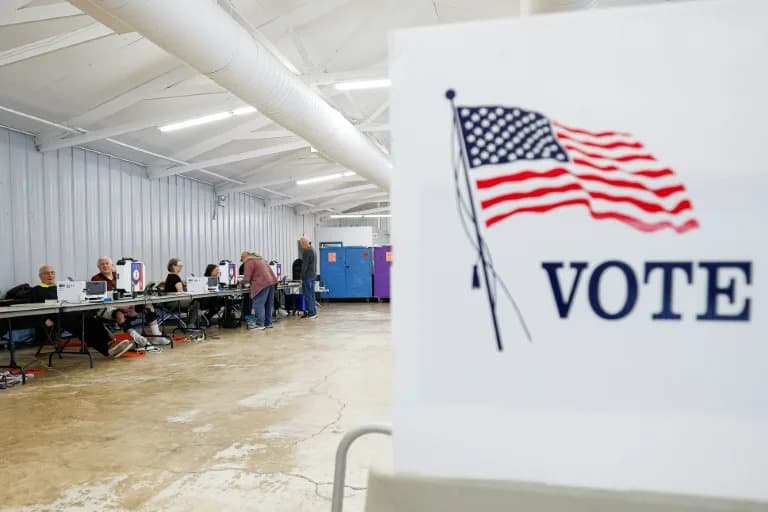
'Pink slime' outlets, many secretly backed by partisan groups, now outnumber US newspaper sites (KAMIL KRZACZYNSKI)
As Americans head to the polls, hundreds of partisan websites that mimic local news outlets—derisively called "pink slime" sites—are proliferating in battleground states. Researchers and media watchdogs say these sites often hide their political backers, amplify polarized or misleading narratives, and use paid social advertising to reach large audiences.
What Are "Pink Slime" Sites?
"Pink slime" sites present themselves as independent local news but are frequently funded or coordinated by political groups. They publish articles with clear partisan angles, sometimes produced quickly with the help of inexpensive digital tools, and boost reach through paid promotions on platforms such as Facebook and Instagram.
The North Carolinian: A Case Study
NewsGuard reports that the Senate Leadership Fund (SLF), a pro-Republican political action committee, launched a site called the North Carolinian in July. The site discloses that it was "paid for by SLF" and "not authorized by any candidate or candidate's committee," yet its coverage has focused heavily on attacking Democratic candidate Roy Cooper while promoting his Republican opponent, Michael Whatley. SLF spent between $34,700 and $46,715 promoting the site's articles on Meta platforms through late August, generating at least 3.6 million views.
Scale, Spending, And Networks
NewsGuard has identified 21 new pink slime outlets started this year, bringing the total to roughly 1,179 such sites—outpacing the 937 daily newspapers counted by Northwestern University's Local News Initiative. Two networks—One Nation (right-leaning) and the American Independent (left-leaning)—together spent at least $801,500 on Facebook and Instagram advertising to promote their content in the first eight months of the year. Popular Information reports that One Nation, an affiliate of SLF, launched six state-specific sites in key Senate contests: Georgia, Alaska, Maine, Iowa, Ohio, and New Hampshire.
Impact On Trust, AI, And Information Ecosystems
Experts warn that such outlets erode public trust in journalism by blurring the line between partisan messaging and independent reporting. The growing corpus of these articles—some of which may be generated or assisted by AI tools—also risks influencing machine-learning systems and chatbots that draw on widely available web content, potentially amplifying biased or false narratives in search results and automated responses.
Why This Is Happening
The surge of pink slime sites coincides with a sharp decline in local journalism: many newspapers have shut down or cut staff amid economic pressures, creating "news deserts"—more than 212 U.S. counties were flagged last year as lacking locally based news outlets. This gap leaves audiences more vulnerable to sites that pose as local media while serving partisan aims.
Expert Views
"These sites seem to take money from campaigns or political operatives and write pieces that are biased or have some sort of angle, with this veneer of a legitimate news site," said Kevin DeLuca of Yale's Institution for Social and Policy Studies. "They have the potential to make people believe things that are not true without understanding where the information is coming from."
News organizations, researchers, and platform auditors say greater transparency about funding and stricter ad-labeling practices are needed to help readers distinguish between genuine local journalism and politically driven pseudo-news operations.
Help us improve.