Senate Minority Leader Chuck Schumer condemned President Trump's plan to mail $500 refunds to nearly 1 million people who bought coverage on Healthcare.gov, calling the amount a "complete slap in the face" that covers only about 1.6% of a three‑day hospital stay. The White House says checks will go out in October to enrollees in 30 states, arguing prior user fees were passed on to consumers. Experts say the one‑time rebate offers limited relief as nearly 20 million Americans rely on the ACA marketplace and continue to face recurring premium increases.
Schumer Slams Trump's $500 Obamacare Rebate as a 'Complete Slap in the Face'; Experts Call It a One‑Time Band‑Aid
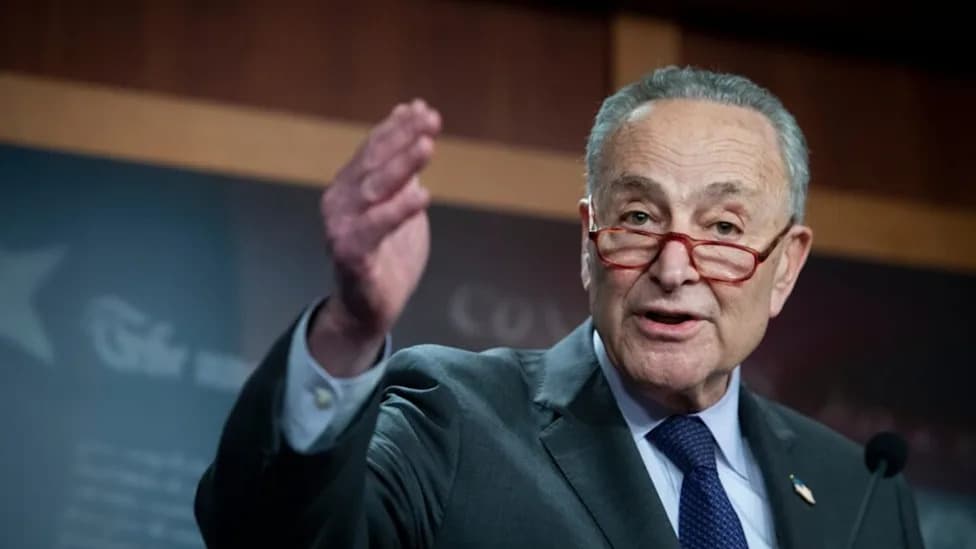
A person in a suit and red glasses speaks at a podium, gesturing with one hand. (Credit: Image via Shutterstock)
Senate Minority Leader Chuck Schumer (D‑N.Y.) sharply criticized President Donald Trump's plan to send $500 refunds to roughly 1 million people who were allegedly overcharged on the federal Affordable Care Act marketplace, calling the payment a "complete slap in the face" to working Americans.
Schumer posted on X that the $500 rebate is "truly insulting," noting it amounts to only about 1.6% of the cost of a typical three‑day hospital stay. He accused the administration of repeatedly betraying hardworking Americans and urged the president to negotiate with Democrats to restore enhanced ACA tax credits as a more durable solution to rising health costs.
"$500? A complete slap in the face to hardworking Americans this administration has betrayed time and time again. A mere 1.6% of the cost of a 3‑day hospital stay. Truly insulting. If Donald Trump wanted to lower health care costs, he'd sit down with Democrats and restart the…" — Chuck Schumer, Sept. 10, 2026
In a video announcement, the White House said it will mail $500 checks in October to nearly 1 million people in 30 states who bought coverage through Healthcare.gov, the federal marketplace for ACA plans. The administration framed the payments as returning money to consumers who were "wrongly ripped off," arguing that user fees charged to insurers under the prior administration were passed through to consumers via higher premiums.
Who Is Covered (And Who Is Not)
The White House fact sheet lists the 30 states slated to receive rebates: Alabama, Alaska, Arizona, Arkansas, Delaware, Florida, Hawaii, Indiana, Iowa, Kansas, Louisiana, Michigan, Mississippi, Missouri, Montana, Nebraska, New Hampshire, North Carolina, North Dakota, Ohio, Oklahoma, Oregon, South Carolina, South Dakota, Tennessee, Texas, Utah, West Virginia, Wisconsin, and Wyoming.
Several states that operate their own exchanges are not included. The New York Times noted exclusions such as California, Colorado, Connecticut, the District of Columbia, Georgia, Illinois, Idaho, Kentucky, Maine, Maryland, Massachusetts, Minnesota, Nevada, New Jersey, New Mexico, New York, Pennsylvania, Rhode Island, Vermont, and Washington. (There is a reporting inconsistency worth noting: North Carolina appears on the White House list but was listed among exclusions in some reporting.)
Expert Reaction
Health‑policy experts say the one‑time payment provides limited relief amid broader premium increases and the expiration of enhanced federal subsidies.
- Jonathan Oberlander, a professor at the University of North Carolina, told CNBC the $500 rebate is an ineffective "band‑aid" and may be aimed at deflecting criticism about rising health costs.
- Chris Meekins, an analyst at Raymond James, told MarketWatch that while $500 is meaningful to individuals, it will not erase likely double‑digit premium increases; about 1 million people could receive the rebate, while nearly 20 million Americans rely on the ACA marketplace.
What This Means
Officials say the payments will reach eligible households in October, but experts and advocates argue that addressing escalating premiums and gaps in subsidies will require policy changes rather than a one‑time check. The announcement has intensified debate over the future of marketplace subsidies, the structure of user fees, and bipartisan approaches to lowering health‑care costs.
Note: This article condenses the original report to focus on the policy announcement, state coverage, expert analysis, and the wider political debate. Promotional content unrelated to the news has been removed for clarity.
Help us improve.