Short summary: Preclinical research suggests mebendazole may have anti-cancer activity and Johns Hopkins holds a 2021 patent for a specific mebendazole form, but experts stress there is no clinical proof it cures cancer. Larger human trials are needed to confirm when, at what dose, and for which cancers the drug might help. Self-medication carries risks, including drug interactions and the need for blood monitoring.
Mebendazole and Cancer: Johns Hopkins Patent Spurs Claims — What the Evidence Really Shows
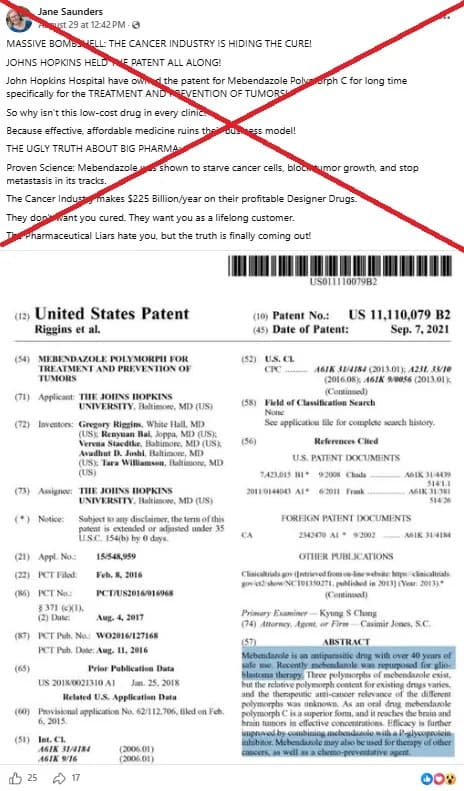
Screenshot of a Facebook post taken September 11, 2026
Laboratory and animal studies have shown that the antiparasitic drug mebendazole can damage cancer cells in some models, and a 2021 U.S. patent for a specific molecular form (mebendazole polymorph C) held by Johns Hopkins researchers has fueled social media claims that the drug is a hidden “cure.” Experts say those claims overstate the science: promising preclinical results do not equal proven clinical benefit in people.
What the Patent Covers
The 2021 patent granted to Johns Hopkins researchers describes a particular crystal form of mebendazole (polymorph C) that appears to be absorbed better and reach higher concentrations in blood and tumors in laboratory studies. The lead inventor, Gregory Riggins, and his team licensed the technology to a company, but the licensed product has not yet been advanced into large human clinical trials.
What the Science Actually Shows
Preclinical studies — including cell culture and animal work — indicate mebendazole can interfere with cancer cell growth in certain models, especially some brain-cancer models where improved absorption matters. However, those laboratory advantages require confirmation through larger, well-designed clinical trials to determine whether the drug helps people, which cancers it might help, appropriate dosing, and how it should be combined with standard treatments.
Gregory Riggins, Johns Hopkins: It is possible it is not effective. Small studies suggest high doses are safe and tolerable and may have a reasonable chance of benefit, but larger trials are needed.
Patents, Incentives and Misinterpretation
Intellectual property experts note that a patent does not prove therapeutic effectiveness. Secondary patents that tweak dosage, crystal form, or delivery can both delay generics and provide companies with incentives to invest in the expensive research required to test a therapy in people. The existence of a patent is a legal and commercial fact, not scientific proof of a cure.
Safety Concerns and Practical Advice
Researchers warn against self-medicating. Potential issues include dangerous interactions with certain antibiotics, the need for regular blood tests to monitor liver function and blood counts, and the risk of delaying effective, evidence-based care. Health professionals emphasize that there is currently no accepted clinical evidence that mebendazole provides a significant benefit in treating human cancers.
Keith Stewart, Princess Margaret Cancer Centre: Self-medicating with unproven drugs may expose patients to harm and could delay or interfere with evidence-based care.
Bottom line: Mebendazole is a promising repurposing candidate based on preclinical work and an interesting patented formulation exists, but claims that a patent equals a hidden cure are misleading. Larger clinical trials in humans are necessary to establish safety, dose, and benefit before the drug should be used as a cancer treatment.
Help us improve.