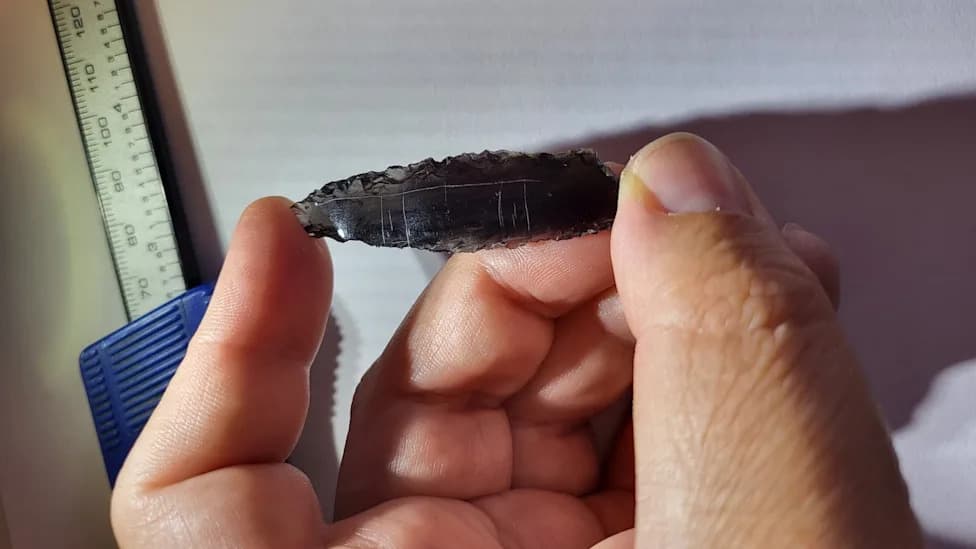
Archaeologists at Obi-Rakhmat in Uzbekistan discovered tiny microlithic projectile points dated to about 80,000 years ago. The blades are too narrow for Neanderthal spears and resemble small arrow tips linked to Homo sapiens elsewhere. Authors argue the finds imply an earlier Homo sapiens presence in Central Asia and possible early use of bow-and-arrow technology, though further corroboration is needed.
Tiny 80,000-Year-Old Arrowheads in Uzbekistan Could Rewrite Early Human Migration

Ancient Arrowheads Upend Human HistoryMatt Champlin - Getty Images
Archaeologists working at Obi-Rakhmat, a rock shelter about 4,000 feet up in the Tian Shan Mountains of northeastern Uzbekistan, have uncovered exceptionally small stone projectile points that may force a major revision of when Homo sapiens first occupied Central Asia.
In a 2025 paper published in PLOS One, researchers reported blades from the site's deepest layers that differ from characteristic Neanderthal implements and instead resemble microlithic arrow technology associated with Homo sapiens. In a 2026 follow-up post for The Conversation, the team argued that these finds indicate modern humans may have been present in Central Asia around 80,000 years ago — roughly 35,000 years earlier than many conventional estimates of a direct expansion from Africa.
What was found: The deepest deposits at Obi-Rakhmat yielded unretouched triangular microlithic projectile points. The pieces are extremely small — about half an inch (a little over 1 cm) across and weighing only a few grams — and several show microscopic impact marks consistent with use as projectile tips.
Why it matters: The shape and dimensions of the microliths make them far too narrow and light to have been reliably mounted on Neanderthal-style thrusting spears or large spear shafts. Instead, the researchers argue these points were designed for arrow-like shafts, implying bow-and-arrow or similar small-projectile technology.
Comparative evidence: The team notes parallels with microlithic points from early Homo sapiens sites in South Africa dated to more than 77,000 years ago and with much later small arrowheads found in places such as France's Rhone Valley. The assemblage at Obi-Rakhmat also includes more robust retouched points — 15 to 20 times heavier and several times thicker than the microliths — indicating a deliberate range of weapon types rather than a single default design.
"According to the fundamental principles of hunting weapon design, these micro points are too narrow for having been fitted to anything other than arrow-like shafts," the authors write, emphasizing the careful production techniques and meticulous preparation observed in the microlithic pieces.
Interpretation and caution: If accepted, the Obi-Rakhmat sequence would push back the timing of Homo sapiens' presence deep in the Eurasian interior and suggest that small-projectile technology arrived in regions inhabited by Neanderthals earlier than previously believed. However, such a reinterpretation will require corroboration from additional dated sites and further analysis to rule out alternative explanations, such as convergent technological development or complex exchange networks.
Publication and authors: The primary report appeared in PLOS One (2025); the findings and implications were discussed further by co-authors Hugues Plisson (University of Bordeaux) and Andrey Krivoshapkin (Institute of Archaeology & Ethnography, Russian Academy of Sciences) in a 2026 post for The Conversation.
Bottom line: The tiny points from Obi-Rakhmat provide compelling evidence that small projectile technology — and possibly early bow-and-arrow use by Homo sapiens — reached Central Asia far earlier than commonly assumed, with important consequences for our understanding of early human dispersal and interactions with Neanderthals.
Help us improve.