The URV team developed a one‑hour n‑hexane batch extraction (45°C, 60 minutes, 35 mL hexane per g) that recovers about 90% of the oil from spent coffee grounds compared with Soxhlet. The optimized extract contains only 0.3% non‑FAME impurities versus 3.9% for Soxhlet, and the mild treatment preserves cellulose and hemicellulose while increasing lignin concentration—making the defatted solids suitable for further biorefinery processes.
New One‑Hour Method Recovers 90% of Oil from Spent Coffee Grounds for Cleaner Biodiesel
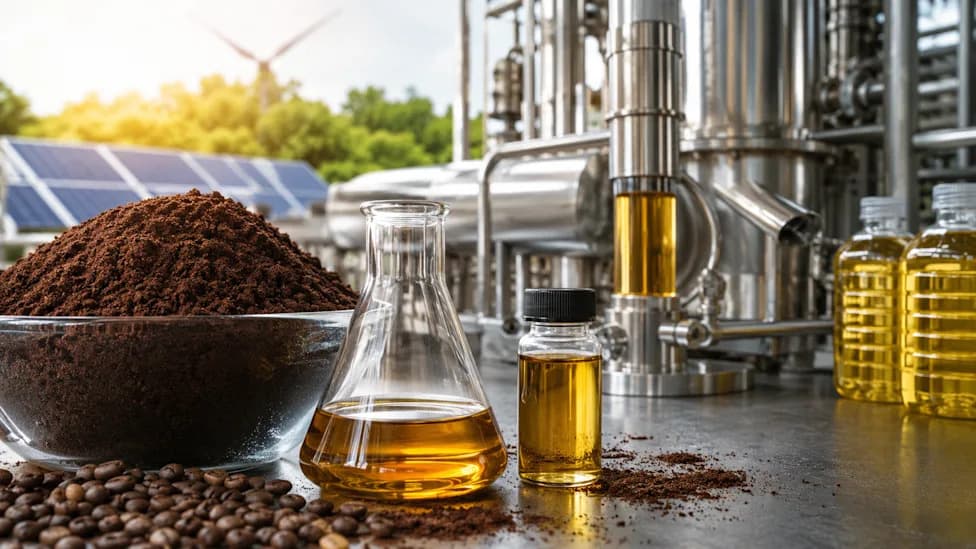
Coffee grounds biodiesel could become cleaner and more efficient through a one-hour oil extraction process that preserves useful biomass. (CREDIT: Wikimedia / CC BY-SA 4.0)
Researchers at Universitat Rovira i Virgili (URV) have developed a gentle, one‑hour hexane extraction that recovers roughly 90% of the oil from spent coffee grounds while preserving the remaining biomass for further conversion. The process produces a cleaner oil suitable for biodiesel feedstock and leaves cellulose, hemicellulose and lignin largely intact for downstream biorefinery uses.
How the study was done
The URV team tested 27 combinations of temperature, extraction time and solvent-to-dry‑grounds ratio using n‑hexane as the solvent, repeating each test to produce 54 observations. Cafeteria-sourced, roasted Coffea arabica grounds were dried, sieved to particles below 500 µm and characterized before extraction.
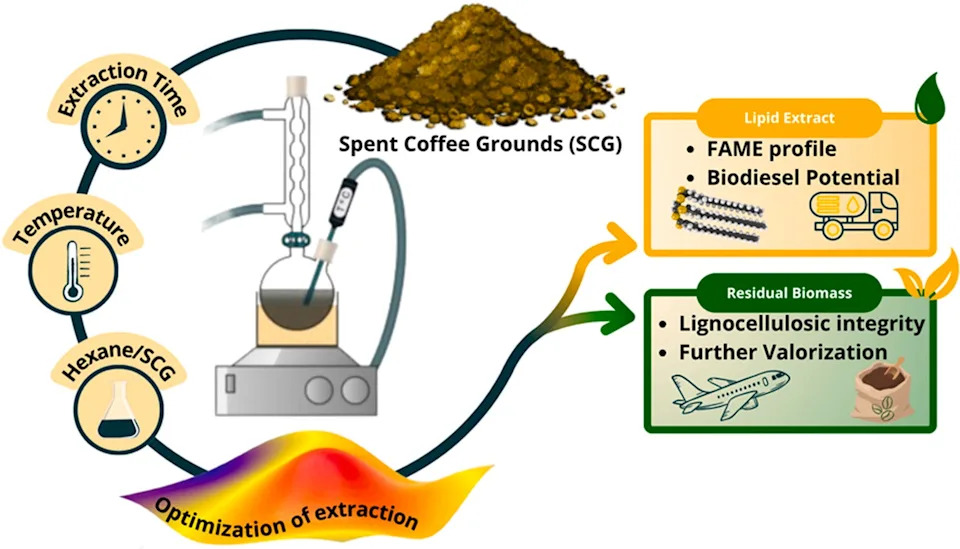
Graphical abstract of the biodiesel extraction process. (CREDIT: Jorge F. Romero et al, Biomass and Bioenergy)
Optimized conditions and performance
Lead results identify 45°C, 60 minutes and 35 mL hexane per gram of dry residue as the optimal batch conditions. Under these settings the method recovered about 90% of the oil obtained from a Soxhlet benchmark extraction, but in only one hour compared with 24 hours for Soxhlet. Soxhlet produced a crude oil yield of 16.6% of the dry grounds in the study.
Temperature had the largest effect: yields rose from 25°C to 45°C as solvent viscosity dropped and oil diffused more readily through the porous matrix. However, operating near hexane's boiling point (≈68.7°C) reduced yields—particularly on longer (90‑minute) runs—likely due to a solvent–oil mismatch under those harsher conditions. Recovery also improved up to about 60 minutes and then plateaued, suggesting equilibrium is reached within an hour. Solvent ratio showed diminishing returns above the optimal 35 mL/g.
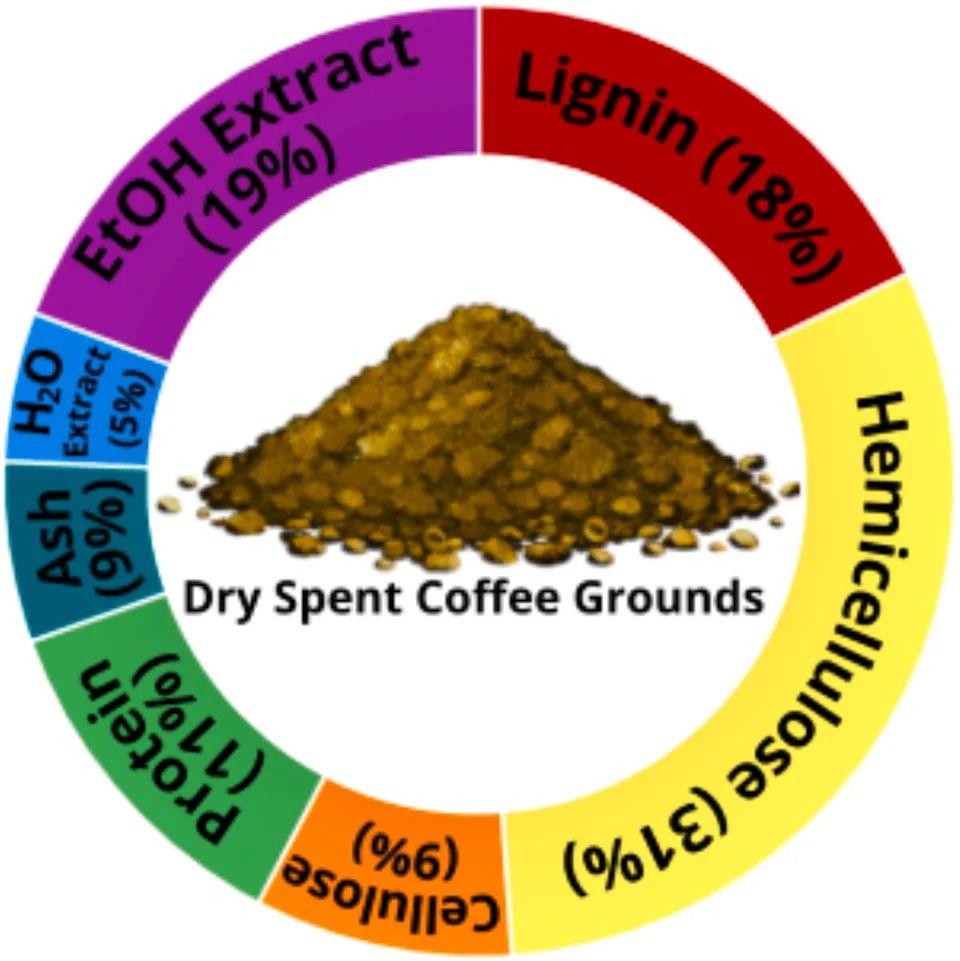
Major compositional fractions of dried spent coffee grounds (%, w/w DSCG). (CREDIT: Jorge F. Romero et al, Biomass and Bioenergy)
Oil quality and composition
The optimized method produced oil with much fewer non‑convertible impurities: only 0.3% non‑FAME material compared with 3.9% in the Soxhlet extract. The dominant fatty acids were stable across conditions: linoleic acid ~44%, palmitic acid ~35%, oleic acid ~8% and stearic acid ~7%. Higher temperatures did not cause widespread thermal breakdown of these fatty acids, although some more severe runs modestly increased unidentified material (up to ~1.7%).
Preserving the solid fraction for a sequential biorefinery
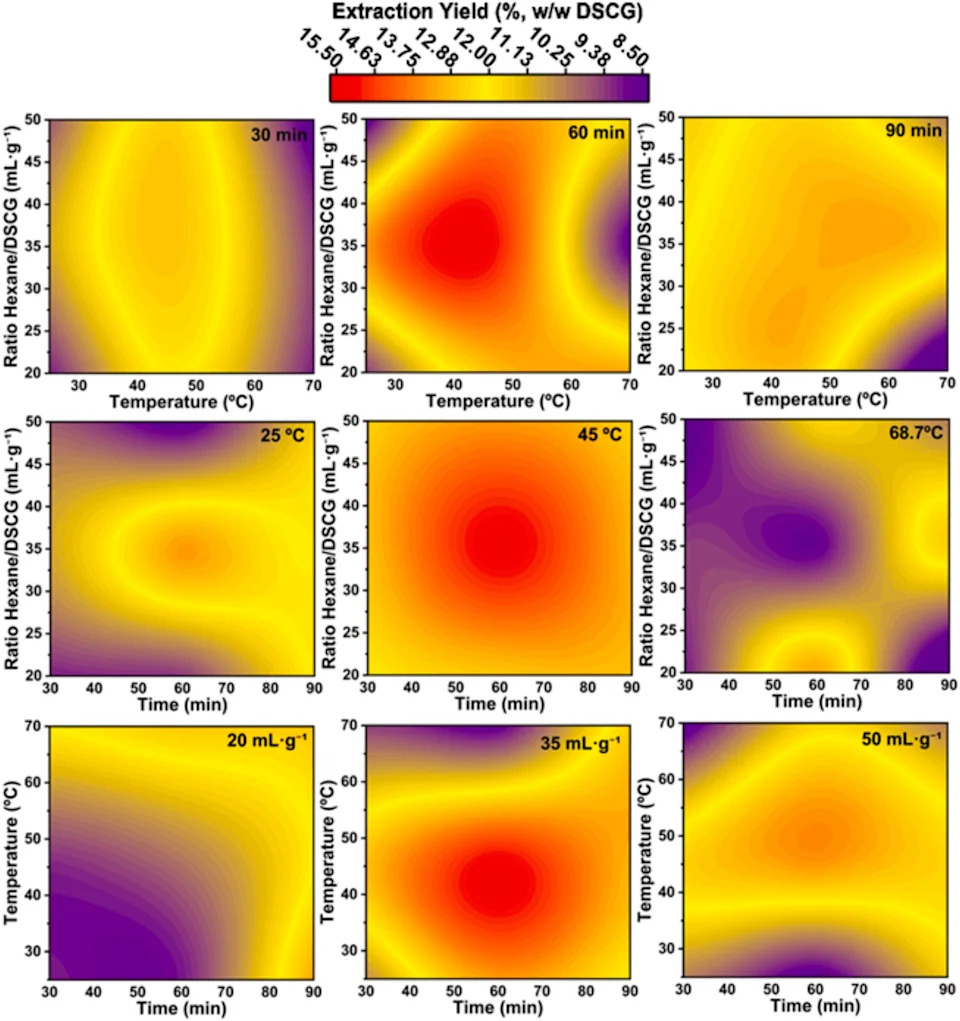
Contour map matrix of DSCG extraction yield across the experimental space, with one extraction variable fixed per row. (CREDIT: Jorge F. Romero et al, Biomass and Bioenergy)
The starting dry grounds contained about 8.8% cellulose, 30.9% hemicellulose and 17.9% lignin (ash ~6.2%). The optimized extraction preserved cellulose and hemicellulose and yielded a defatted solid with lignin concentrations above 20%—higher than levels observed after more aggressive Soxhlet or ultrasound treatments. Preserving this plant matrix is important because fats can block access to sugars and lignin; a mild oil removal acts as a useful pretreatment without damaging structure.
The defatted grounds could be routed to biochemical processes (bioethanol, lactic acid, polyhydroxyalkanoates) or thermochemical routes and the lignin could provide precursors for sustainable aviation fuel or phenolic chemicals.
Comparison with microwave and ultrasound methods
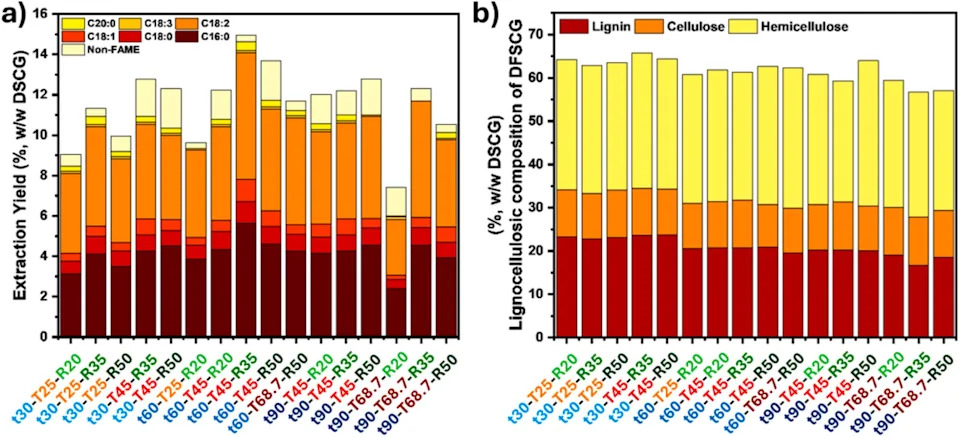
Batch extraction of SCG: a) fatty acid methyl ester (FAME) composition and non-FAME fraction of SCG extractive obtained under different conditions, and b) lignocellulosic composition of the spent coffee grounds defatted under different conditions (DFSCG). (CREDIT: Jorge F. Romero et al, Biomass and Bioenergy)
Microwave-assisted extraction achieved 12.5% oil in 5 minutes and 14.7% in 20 minutes; ultrasound reached 12.5% in 15 minutes and 14.3% in 30 minutes. Both accelerate early mass transfer but slowed as equilibrium was approached. Neither method matched the optimized batch process in oil purity, overall efficiency, energy demand or scalability, and both produced larger non‑oil fractions.
Why it matters
Global coffee production is large and generates millions of tonnes of spent grounds annually—estimates in the study note more than 6 million tonnes of spent grounds each year, with roughly 15% lipids by mass. Converting this abundant waste into cleaner biodiesel feedstock while retaining a usable solid fraction helps reduce landfill methane, adds value to waste streams and provides a nonfood, second‑generation feedstock for high‑energy‑density fuels important in heavy transport and aviation.
Availability
The full study is published in the journal Biomass and Bioenergy.
Help us improve.