Penn State researchers found that most of the fat in ice cream production waste can be recovered cheaply, primarily by centrifugation. Tests on waste from Perry's Ice Cream showed batch fat content from 1.8% to 10.3% and centrifugation recovered about 95% of the fat. Short enzyme treatments sometimes aided separation, but longer treatments and higher temperatures did not improve recovery and could reduce purity. A techno-economic model estimated a break-even price near $0.40 per kilogram, with higher fat content and larger-scale processing improving profitability.
Penn State Study: Recovered Fat From Ice Cream Waste Could Be Recycled — And May Be Profitable
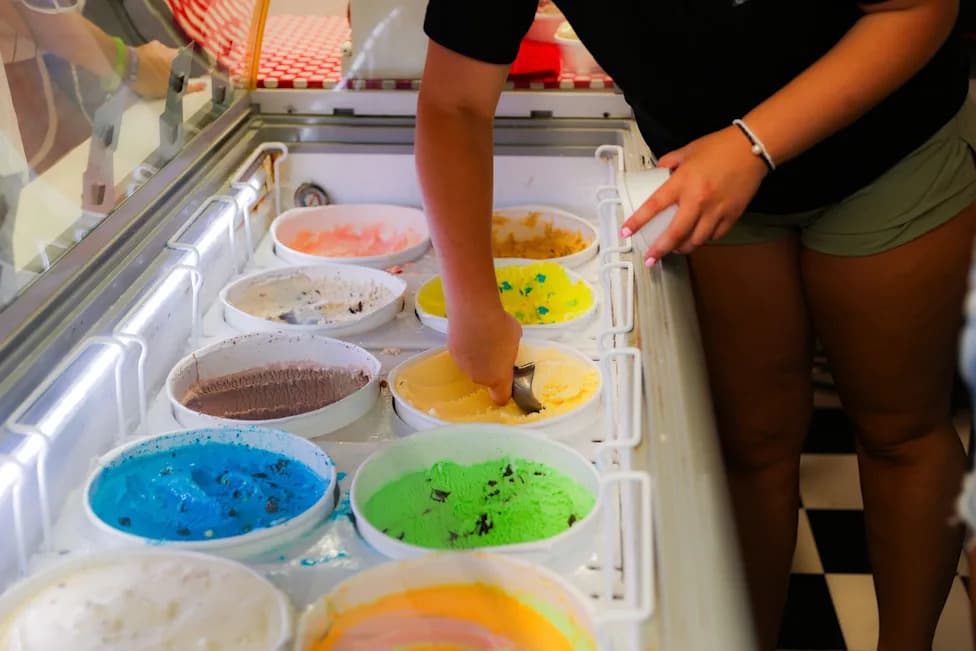
The many flavor at an ice cream shop (Image by Daniel Purcell, Shutterstock)
About 5 percent of the ingredients used to produce ice cream become waste — rejected batches or material lost during equipment cleaning, according to the International Dairy Foods Association. That waste represents millions of pounds of nutrient-rich product and millions of dollars in lost value each year.
Researchers in Penn State's College of Agricultural Sciences report that a large share of the fat in that waste can be recovered at a potentially economical cost. The reclaimed fat could substitute for choice white grease (a pork-derived fat commonly used in animal feed) or be further refined into ingredients for pharmaceuticals, cosmetics and other products. The findings are published in Cleaner Engineering and Technology.
How They Did It
The team obtained frozen ice cream waste from Perry's Ice Cream in Akron, New York. Each production batch supplied roughly 90 pounds of waste; fat content in the four batches tested ranged from 1.8% to 10.3%. Because ice cream waste is typically three to five times higher in fat than raw cow's milk, it is a promising feedstock for recovery.
Key Results
Simple centrifugation handled most of the separation work: the untreated control processed by centrifugation recovered about 95% of the fat and improved fat purity relative to the original waste. Short enzyme treatments (1–2 hours) sometimes helped separation, but longer enzymatic exposure, elevated temperatures and extensive proteolysis did not increase total fat recovered and could reduce fat purity. In pH tests, strongly alkaline conditions (around pH 11) separated fat more effectively than acidic conditions.
“You might expect enzymes to be essential for breaking up the emulsion, but our study found that you don't necessarily need them,” said Yi Zhang, Frederik Sr. and Faith E. Rasmussen Career Development Professor in Food Science at Penn State.
Economics and Scale
To evaluate commercial potential, co-author Rui Shi and colleagues developed a techno-economic model that incorporated the recovery steps into industrial processing. The model estimated a minimum (break-even) selling price of roughly $0.40 per kilogram for the recovered fat. Selling above that price could yield profit, and profitability improves with higher fat concentration in incoming waste and with larger-scale processing.
Implications
Recovering fat from ice cream waste could reduce food-industry losses, create a usable feedstock for animal feed or higher-value industries, and improve sustainability by keeping nutrients in the value chain. The study suggests that relatively simple equipment (centrifuges) and modest process adjustments could make recovery both technically feasible and economically attractive, especially at scale.
Bottom line: Much of the fat in ice cream manufacturing waste can be reclaimed cheaply and may be saleable at a price that yields profit, particularly when incoming waste is rich in fat and recovery is scaled up.
Help us improve.