The pearly razorfish is protogynous—born female and later turning male when social conditions permit. Heavy seasonal fishing removes dominant males, prompting earlier sex changes and reducing average size and age in fished populations (reserves: ~6.85 in and 4 years; fished areas: ~1 in smaller and ~2 years old). DNA from 120 fish revealed nearly 300 differences in chemical marks between reserve and fished sites, suggesting fishing may leave molecular signatures. Year-round marine reserves help preserve larger fish, natural behaviors, and genetic diversity that can replenish fished areas.
How Fishing Changes Sex, Size and DNA in Pearly Razorfish — Why Marine Reserves Matter
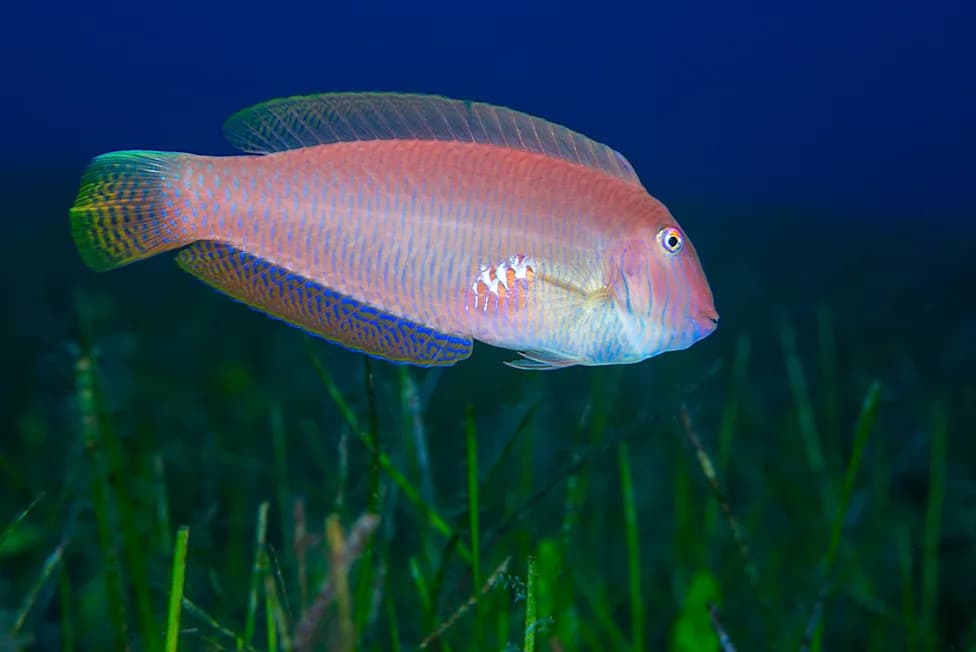
A pearly razorfish hunts in sea grass in the Canary Islands.Sergio Hanquet, Nature Picture Library
The pearly razorfish is a small, social wrasse whose life history and behavior make it uniquely vulnerable to human fishing. New research comparing protected marine reserves with fished areas shows that heavy, seasonal harvesting removes large dominant males, triggers earlier sex change among females, reduces average size and age, and may leave detectable chemical marks on DNA.
Life Cycle and Social Structure
Pearly razorfish are protogynous hermaphrodites: individuals start life as females and can later transition to males. A dominant male defends a territory and a harem of females, providing protection and social stability that suppresses premature sex change among females. These social dynamics help maximize reproductive output because larger, older females produce far more eggs than smaller, younger ones.
Fishing Pressure and Population Changes
In parts of the Balearic Islands these fish are a seasonal delicacy. Local fishing rules ban harvest during the peak mating season, but when the season reopens (commonly after September 1) demand surges and prices can spike to lobster-like levels. The razorfish's curious behavior—approaching moving objects and bait—means dominant males, being the largest and most aggressive, are often caught first. In some locations up to 60% of the local population can be taken within a few days.
A study led by Margarida Barcelo-Serra and published in Philosophical Transactions of the Royal Society B found stark contrasts between no-take reserves and heavily fished areas: razorfish in reserves averaged about 6.85 inches (≈17.4 cm) and four years old, while those in fished sites averaged roughly an inch shorter and about two years of age. Removing big males causes many females to transition earlier, reducing the time they spend as large, highly fecund females.
Molecular Signals Linked to Fishing
The research team analyzed fin DNA from 120 individuals to look for molecular differences associated with fishing pressure. Kees van Oers and colleagues reported nearly 300 differences in chemical marks on DNA between fish from reserves and those from fished areas. These marks—epigenetic-like chemical modifications—appear on genes that in other fish species relate to energy metabolism, neuronal excitability and immune regulation. The authors caution that these signals are small, affect a tiny fraction of the genome, and require further work to determine their functional significance in pearly razorfish.
"We found almost 300 differences in chemical marks on the DNA that are unlikely to be a consequence of the difference in average age," said Kees van Oers.
Why Marine Reserves Help
Marine protected areas (MPAs) serve multiple roles: they allow individuals to live longer and grow larger, preserve natural social and mating behaviors, and maintain greater molecular diversity. Because razorfish release eggs and sperm into the water and larvae drift for weeks (about a month) before settling, healthy reserve populations can seed adjacent fished zones with larvae. That connectivity allows reserves to act as genetic and demographic reservoirs that support wider population resilience.
Implications and Outlook
The study highlights that fishing alters more than headcounts: it can change life-history patterns and leave molecular marks on survivors. Independent experts, including Soojin Yi and Malin Pinsky, note the findings are intriguing but call for more research to confirm causation and to clarify the functional effects of the DNA marks. For local communities that value razorfish both culturally and economically, the results underscore a conservation trade-off: continued fishing supports livelihoods and traditions but risks shrinking and weakening local populations over time.
Bottom line: Protecting continuous, no-take zones appears to preserve larger, older fish and molecular diversity, helping sustain pearly razorfish populations and the ecological processes they depend on.
Help us improve.