Heavy rains from Cyclone Senyar triggered landslides across Sumatra's Batang Toru Ecosystem, killing an estimated 58 Tapanuli orangutans — about 7% of the species' global wild population. The event also killed over 1,000 people and damaged roughly 8,300 hectares of forest. Researchers used satellite imagery and density maps to estimate losses, while conservationists warn that deforestation and industrial projects have increased landslide risk and call for urgent protection and funding.
Climate-Driven Landslides Kill Nearly 10% Of Endangered Tapanuli Orangutans, Study Finds
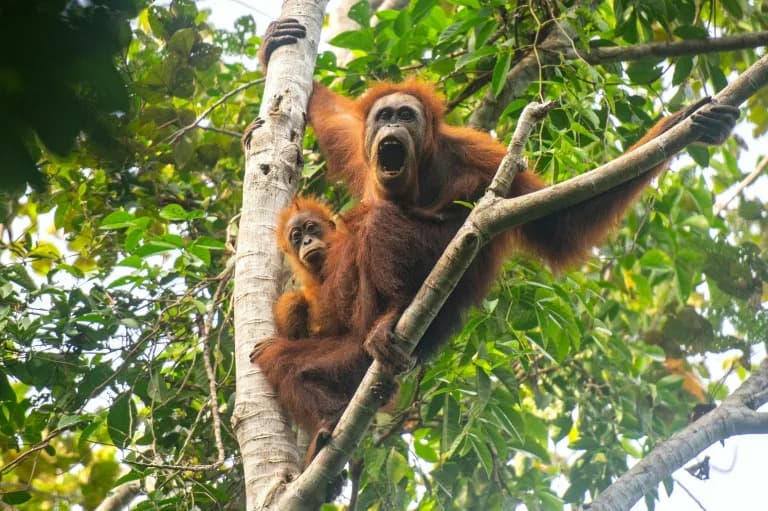
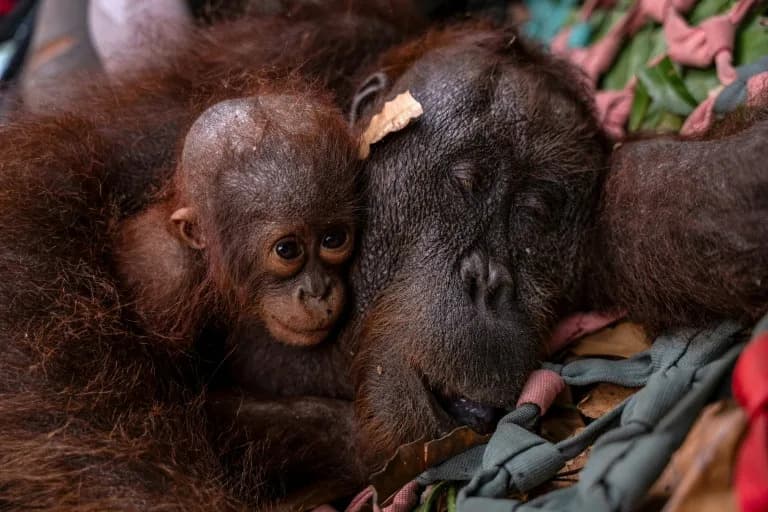
Fewer than 800 Tapanuli orangutans remain in the wild, scientists say (Handout)(Handout/Orangutan Information Centre/AFP)
Climate-driven landslides on Indonesia's Sumatra island wiped out an estimated 58 Tapanuli orangutans in a single extreme weather event, pushing the world's rarest great ape closer to extinction, researchers say.
A study published in Current Biology found that heavy rains during Cyclone Senyar last November triggered mudslides across the Batang Toru Ecosystem — home to the largest remaining Tapanuli population — killing roughly 11% of the animals in the affected area and about 7% of the species' global wild population. Fewer than 800 Tapanuli orangutans remain in the wild.
"This level of loss is substantial for a species with such a small total population," said Erik Meijaard, chief scientist at Borneo Futures.
In addition to wildlife losses, the floods and landslides killed more than 1,000 people and destroyed critical food sources and shelter for surviving orangutans. Scientists used satellite imagery to map landslide scars across the Batang Toru Ecosystem and estimated that about 8,300 hectares of forest — more than 11% of the area — were affected. Researchers overlaid those maps with orangutan density models to derive the mortality estimate of 58 individuals.
"The loss of an estimated 58 Tapanuli orangutans to a single climate-induced landslide event is a devastating demographic shock to the world's rarest great ape," said Jatna Supriatna of Indonesia University.
Conservationists warn that industrial projects — including a contested hydroelectric dam and a proposed gold mine — and widespread deforestation have squeezed Tapanuli orangutans into higher-elevation habitats that are less suitable and more landslide-prone. Mighty Earth reported that Sumatra lost about 4.4 million hectares of forest between 2001 and 2024, making steep terrain more vulnerable to erosion and slope failure.
Scientists and activists are calling on Indonesian authorities to permanently protect the Batang Toru Ecosystem and on international partners to provide immediate biodiversity-recovery financing to prevent the first modern extinction of a great ape species.
Help us improve.