The University of Exeter used five Earth system models to test whether stratospheric aerosol injection (SAI) — injecting sulfur dioxide into the stratosphere to reflect sunlight — could help the Amazon retain carbon under very high CO2. Models indicate SAI could lower global temperatures by ~2.2°C compared with a high-emissions pathway and increase Amazon land carbon storage by about 10.8% versus the worst-case scenario. However, SAI changes rainfall patterns, carries serious regional risks and uncertainties, and does not remove CO2; the authors stress it is no substitute for emissions cuts and anti-deforestation efforts.
Could Stratospheric Aerosols Protect the Amazon? New Models Suggest Possible Benefits — With Big Caveats

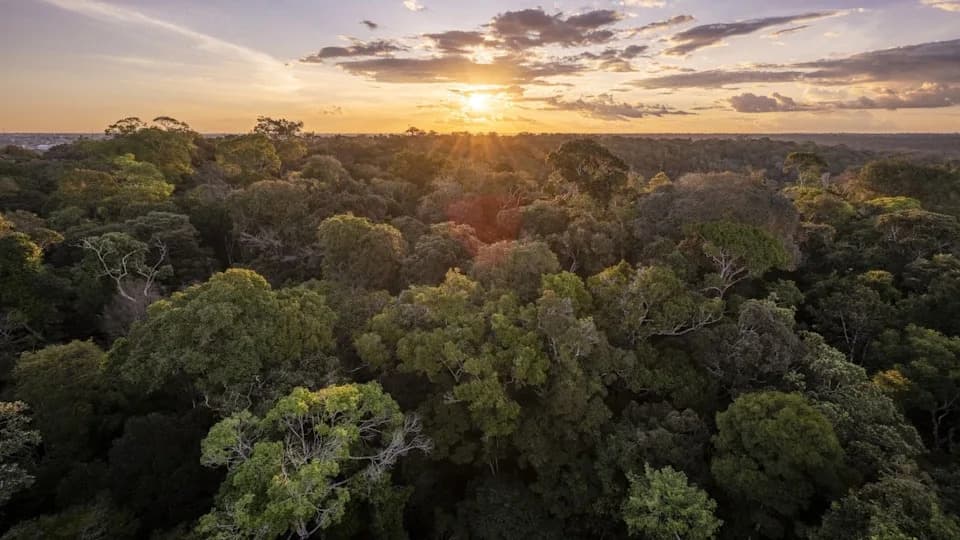
Scientists found that stratospheric aerosol injection may help the Amazon rainforest store more carbon and resist climate damage. (CREDIT: Shutterstock)
As global temperatures climb, scientists are revisiting bold ideas once deemed science fiction. A new multi-model study led by researchers at the University of Exeter asks whether stratospheric aerosol injection (SAI) — intentionally injecting sulfur dioxide into the stratosphere to reflect sunlight — could help the Amazon rainforest retain carbon and remain more productive under extreme warming.
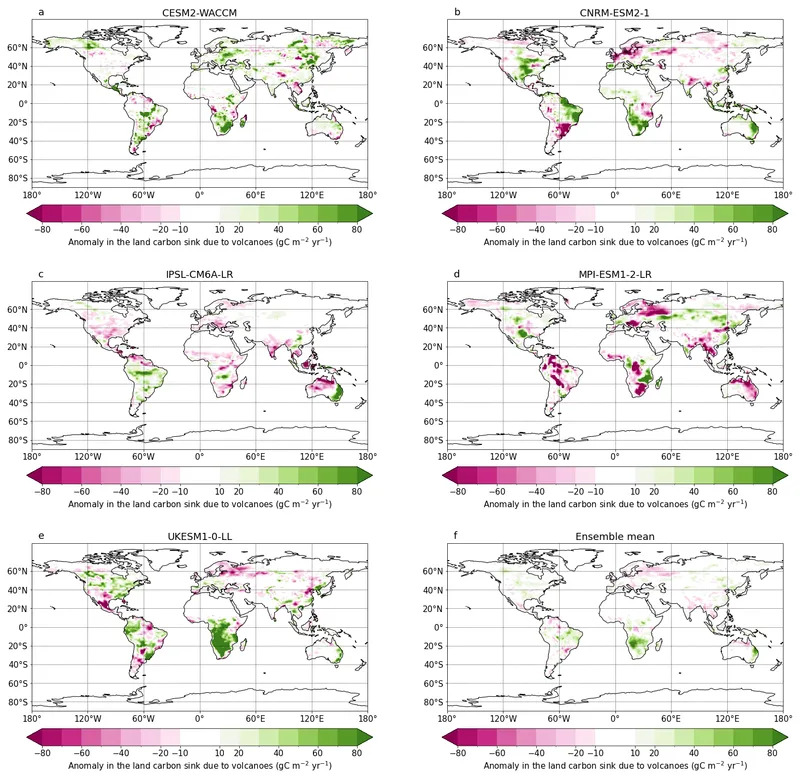
Maps showing the anomaly in the land carbon flux due to volcanoes for five models. (CREDIT: Earth System Dynamics)
Study Design and Methods
The peer-reviewed paper, published in Earth System Dynamics, uses five state-of-the-art Earth system models to compare three scenarios: a high-emissions future (SSP585), a moderate-mitigation pathway (SSP245), and a high-CO2 pathway coupled with continuous SAI from 2020–2100 (G6sulfur). The SAI intervention was tuned to bring global temperatures in the high-CO2 case down to levels similar to the moderate pathway.
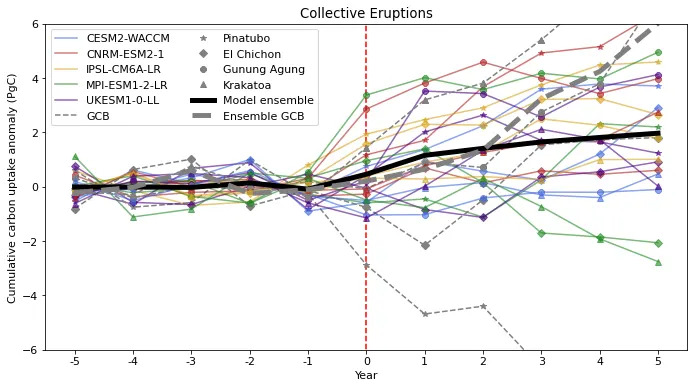
Timeseries showing the evolution of the cumulative land carbon uptake anomaly (relative to the average of the five years before the eruption) in the five years before and after a large volcanic eruption. (CREDIT: Earth System Dynamics)
Key Findings
Across four of the five models, SAI produced net gains in land carbon storage, with the largest benefits in tropical forests including the Amazon. In the multi-model comparison Amazon land carbon storage rose roughly 10.8% compared with the high-emissions SSP585 case and about 8.6% relative to the moderate SSP245 run. Overall, SAI reduced global mean temperature by about 2.2°C compared with the high-emissions scenario, keeping century-end warming near ~3.5°C rather than ~6°C.
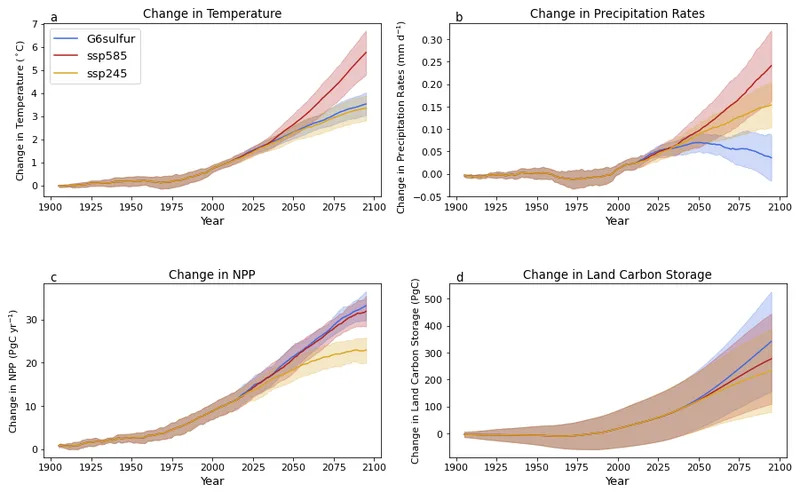
Timeseries showing the evolution of the decadal means, calculated over a 10-year sliding window, of (a) surface temperature, (b) precipitation, (c) net primary productivity, and (d) land carbon storage anomalies relative to the pre-industrial period (1850–1900) with time from 1900 to 2100. (CREDIT: Earth System Dynamics)
The apparent benefit stems mainly from cooler temperatures limiting heat stress on vegetation and reducing soil respiration (which returns carbon to the atmosphere). Elevated CO2 in the experiments also increased plant water-use efficiency, helping trees tolerate modest declines in rainfall in some regions.
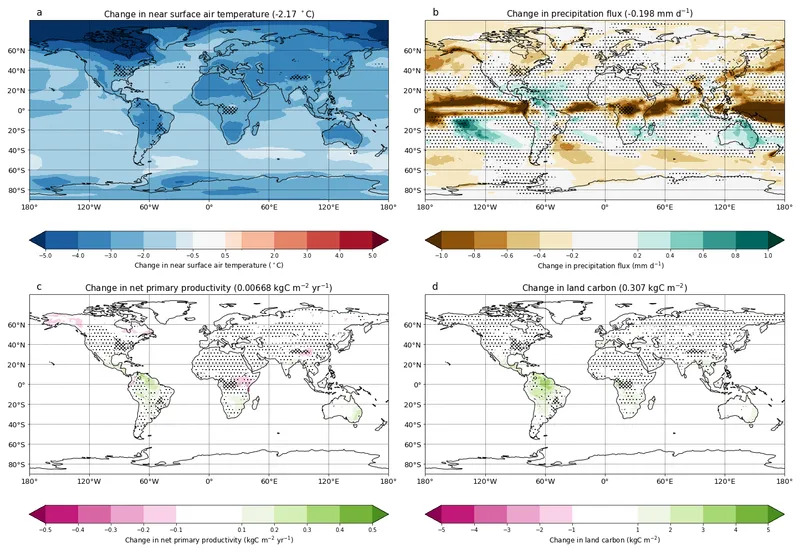
Maps showing the model ensemble mean of the difference between the 2090–2100 means of G6sulfur and SSP585 for (a) surface temperature (°C), (b) precipitation (mm d−1), (c) net primary productivity (), and (d) land carbon storage (kg C m−2). (CREDIT: Earth System Dynamics)
Hydrology and Regional Trade-offs
SAI altered precipitation patterns: global rainfall decreased by roughly 6.4% versus the high-emissions case. Some tropical regions became drier while others grew wetter. Notably, certain simulations showed reduced rainfall and lower ecosystem productivity in parts of Indonesia and central Africa, which could raise wildfire risk and strain water and food systems.
Risks, Uncertainties, and Ethical Concerns
The authors emphasize that SAI does not remove atmospheric CO2 — it only masks some warming. Major concerns include the termination effect (rapid, damaging warming if SAI were abruptly stopped while greenhouse gases remain high), incomplete model representation of processes (groundwater shifts, cloud microphysics, effects of diffuse light), and political, ethical and governance challenges surrounding deliberate climate intervention.
“Surprisingly, in these three scenarios, we find that the Amazon rainforest is most productive in the scenario with SAI geoengineering,” said Professor Peter Cox, co-author and Director of Exeter’s Global Systems Institute.
Conclusions
The Exeter study provides evidence that SAI could reduce some climate risks for vulnerable ecosystems like the Amazon by limiting extreme warming and associated carbon losses. However, the technique carries significant regional trade-offs, scientific uncertainties and governance dilemmas. The authors and commentators stress that aggressive emissions cuts and reduced deforestation remain the most reliable long-term protections; geoengineering might only be considered as an emergency, temporary measure if mitigation fails.
Findings are available in the journal Earth System Dynamics.
Help us improve.