Leaders of Indonesia and Australia signed a bilateral security treaty in Jakarta intended to deepen cooperation and build on prior agreements from 1995 and 2006. Australian Prime Minister Anthony Albanese called the pact a "watershed moment," while analysts describe it as largely symbolic and unlikely to include mutual-defense obligations. The treaty arrives amid rising regional tensions and follows a 2024 defense cooperation accord focused on practical military collaboration. Albanese is on his fifth official visit to Indonesia and will meet President Prabowo through Sunday.
Indonesia and Australia Sign New Security Treaty Aimed at Deepening Ties
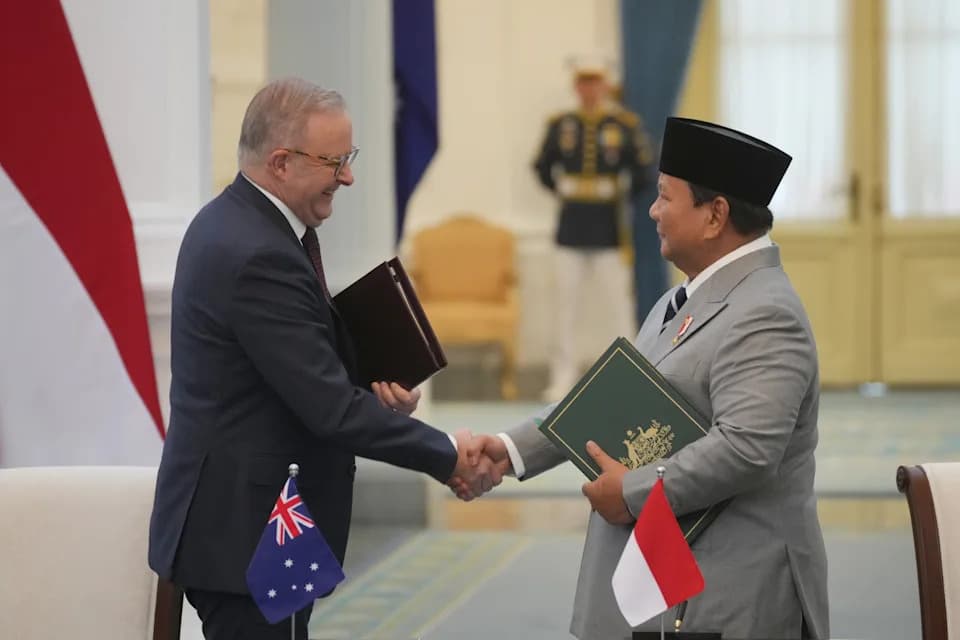
Australian Prime Minister Anthony Albanese, left, shakes hands with Indonesian President Prabowo Subianto at the end of a document signing ceremony at Merdeka Palace in Jakarta, Indonesia, Friday, Feb. 6, 2026. (AP Photo/Achmad Ibrahim)null(ASSOCIATED PRESS)
JAKARTA, Indonesia (AP) — Leaders of Indonesia and Australia signed a new bilateral security treaty on Friday, a move both governments say will strengthen cooperation between the two often-testy neighbors.
The pact was formalized in Jakarta roughly three months after Australian Prime Minister Anthony Albanese and Indonesian President Prabowo Subianto announced in Sydney that substantive negotiations had concluded. Officials say the treaty is intended to build on earlier security arrangements, notably agreements from 1995 and the 2006 Lombok Treaty (expanded in 2014).
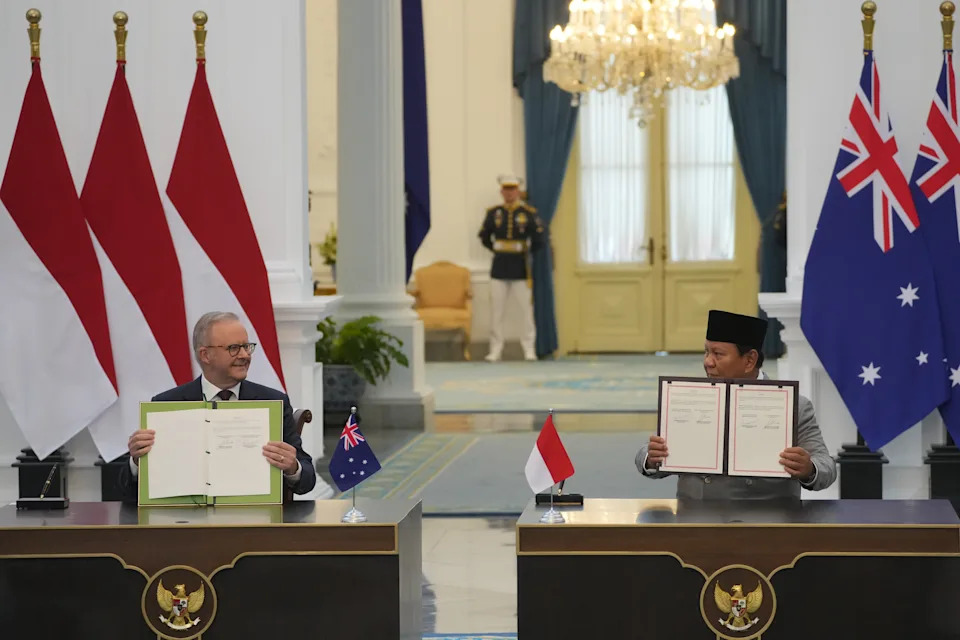
Australian Prime Minister Anthony Albanese, left, and Indonesian President Prabowo Subianto show documents they just signed during their meeting at Merdeka Palace in Jakarta, Indonesia, Friday, Feb. 6, 2026. (AP Photo/Achmad Ibrahim)(ASSOCIATED PRESS)
Albanese described the pact as a "watershed moment" in relations with Australia’s closest major neighbor. In a statement before arriving in Jakarta, he said the agreement extends existing security and defense cooperation and reflects a relationship "as strong as it has ever been." He traveled with Foreign Minister Penny Wong, who called the treaty the most important step in the partnership in three decades.
Analysts say the treaty is particularly important to Australia amid rising regional tensions with China. Observers also note the new agreement is likely to echo elements of the 1995 security understanding reached between then-Prime Minister Paul Keating and Indonesia’s then-president Suharto — who was later connected to President Prabowo by family ties. That 1995 accord obliged both countries to consult on security matters but was terminated by Indonesia in 1999 after Australia led a peacekeeping mission in East Timor.
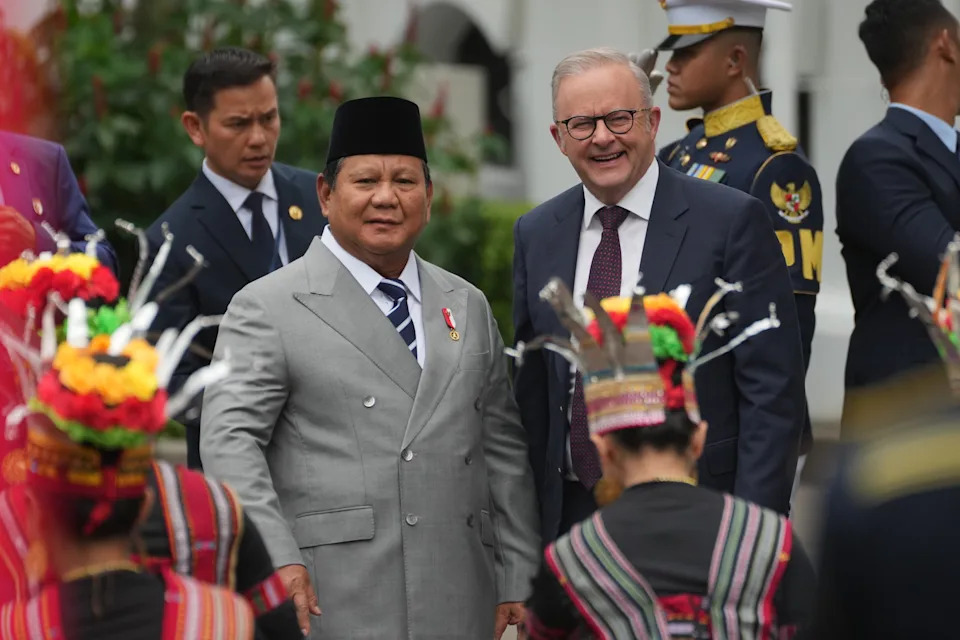
Australian Prime Minister Anthony Albanese, right, is greeted by Indonesian President Prabowo Subianto upon arrival for their meeting at Merdeka Palace in Jakarta, Indonesia, Friday, Feb. 6, 2026. (AP Photo/Achmad Ibrahim)(ASSOCIATED PRESS)
Indonesia and Australia rebuilt security ties over the following decade, culminating in the 2006 Lombok Treaty, which both sides later expanded. A separate 2024 defense cooperation accord focused more explicitly on practical military collaboration.
Susannah Patton, senior fellow at the Lowy Institute, said the new treaty's text has not been published and appears mainly to signal a political commitment to consult. "It is largely symbolic," she said, contrasting it with the 2024 defense accord that emphasized concrete military cooperation. Patton added the treaty likely sits below Australia’s alliance with the United States in terms of legal obligations and is unlikely to include a mutual defense clause — a step she said would be politically unacceptable to a non-aligned Indonesia.
Despite its symbolic nature, Patton described the pact as a significant diplomatic success for Albanese, noting that it would have been difficult to foresee such an agreement with a traditionally non-aligned Indonesia. She suggested Canberra benefited from President Prabowo’s willingness to pursue leader-driven agreements that depart from past Indonesian foreign policy norms.
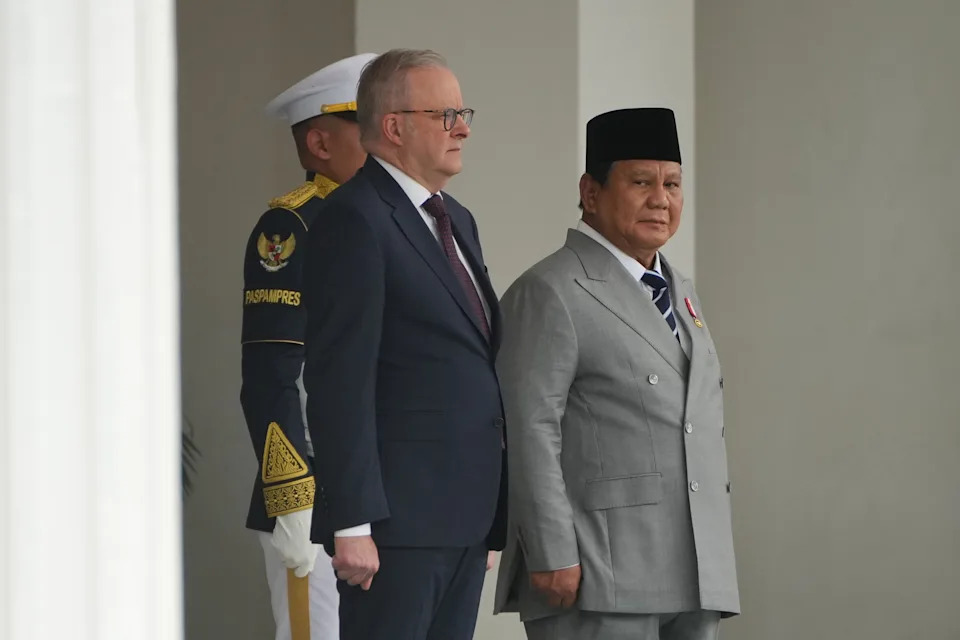
Australian Prime Minister Anthony Albanese, left, stands with Indonesian President Prabowo Subianto during a welcoming ceremony prior to their meeting at Merdeka Palace in Jakarta, Indonesia, Friday, Feb. 6, 2026. (AP Photo/Achmad Ibrahim)(ASSOCIATED PRESS)
Albanese framed the visit as his fifth official trip to Indonesia during his term and part of a broader effort to expand cooperation beyond security into trade, investment, education and development. He is scheduled to meet President Prabowo and other Indonesian officials through Sunday before returning to Australia.
Although Indonesia — an archipelagic nation of roughly 275 million people — is often described as one of Australia’s most important neighbors and strategic partners, the relationship has seen periodic tensions. Recent disputes have included allegations that the Australian Signals Directorate monitored private calls of former Indonesian leaders, Indonesia’s execution of Australian nationals convicted of drug offenses, and incidents involving people smuggling.
___
Associated Press writer Rod McGuirk in Melbourne contributed to this report.
Help us improve.