A federal judge in Oregon issued a preliminary injunction restricting ICE from making warrantless arrests unless agents have probable cause to believe a person will flee. The order responds to a proposed class-action challenging practices critics describe as "arrest first, justify later." Testimony included Victor Cruz Gamez, who said he was detained three weeks despite a valid work permit and a pending visa. Judge Mustafa Kasubhai criticized some agent conduct as "violent and brutal" and warned of due-process erosion.
Federal Judge Blocks Warrantless ICE Arrests In Oregon Unless There Is A Risk Of Escape
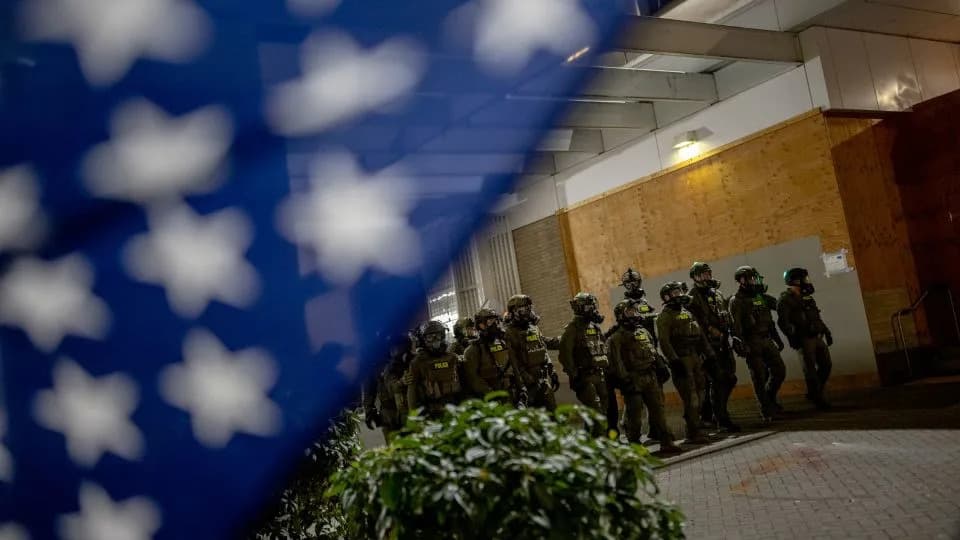
Federal law enforcement officers walk backwards into a US Immigration and Customs Enforcement (ICE) facility in Portland, Oregon, on October 6, 2025. - Stephen Lam/San Francisco Chronicle/Getty Images
Portland, Oregon — A federal judge has temporarily barred U.S. Immigration and Customs Enforcement (ICE) agents in Oregon from making warrantless arrests except when they have probable cause to believe a person is likely to flee.
Preliminary Injunction Limits Arrests During Sweeps. U.S. District Judge Mustafa Kasubhai granted a preliminary injunction in a proposed class-action lawsuit challenging Department of Homeland Security practices that have resulted in arrests of immigrants encountered during intensified enforcement operations. Plaintiffs and civil-rights groups have criticized these tactics as "arrest first, justify later."
Agency Guidance And Allegations. Last week, Acting ICE Director Todd Lyons issued guidance stressing that agents should obtain an administrative arrest warrant signed by a supervisor before detaining someone, unless the agent develops probable cause to believe the person is likely to escape from the scene. At the hearing, plaintiffs presented evidence that ICE agents in Oregon have carried out sweeps and made arrests without such warrants or any determination that escape was likely.
Individual Testimony Highlights Human Impact. One plaintiff, Victor Cruz Gamez, a 56-year-old grandfather who has lived in the United States since 1999, testified that he was arrested and held in immigration custody for three weeks despite having a valid work permit and a pending visa application. His testimony was used to illustrate the real-world consequences of warrantless arrests during enforcement operations.
Judge’s Concerns About Conduct And Due Process. Judge Kasubhai sharply criticized actions by some agents in Oregon, noting incidents in which officers drew firearms while detaining people for civil immigration violations and describing those encounters as "violent and brutal." He warned that such tactics risk denying due process to individuals swept up in raids.
"Due process calls for those who have great power to exercise great restraint," Kasubhai said. "That is the bedrock of a democratic republic founded on this great constitution. I think we're losing that."
Legal Team And Next Steps. The proposed class-action was brought by the nonprofit law firm Innovation Law Lab. The injunction is preliminary; further hearings will determine whether a permanent injunction should be issued as the case proceeds. The ruling does not bar ICE from making arrests when supervisors sign administrative warrants or when agents develop probable cause that a person will flee.
Context. Civil-rights groups across the country have raised concerns about similar enforcement tactics amid expanded deportation efforts under the Trump administration, arguing they can harm families, undermine trust in law enforcement, and violate constitutional protections.
Help us improve.