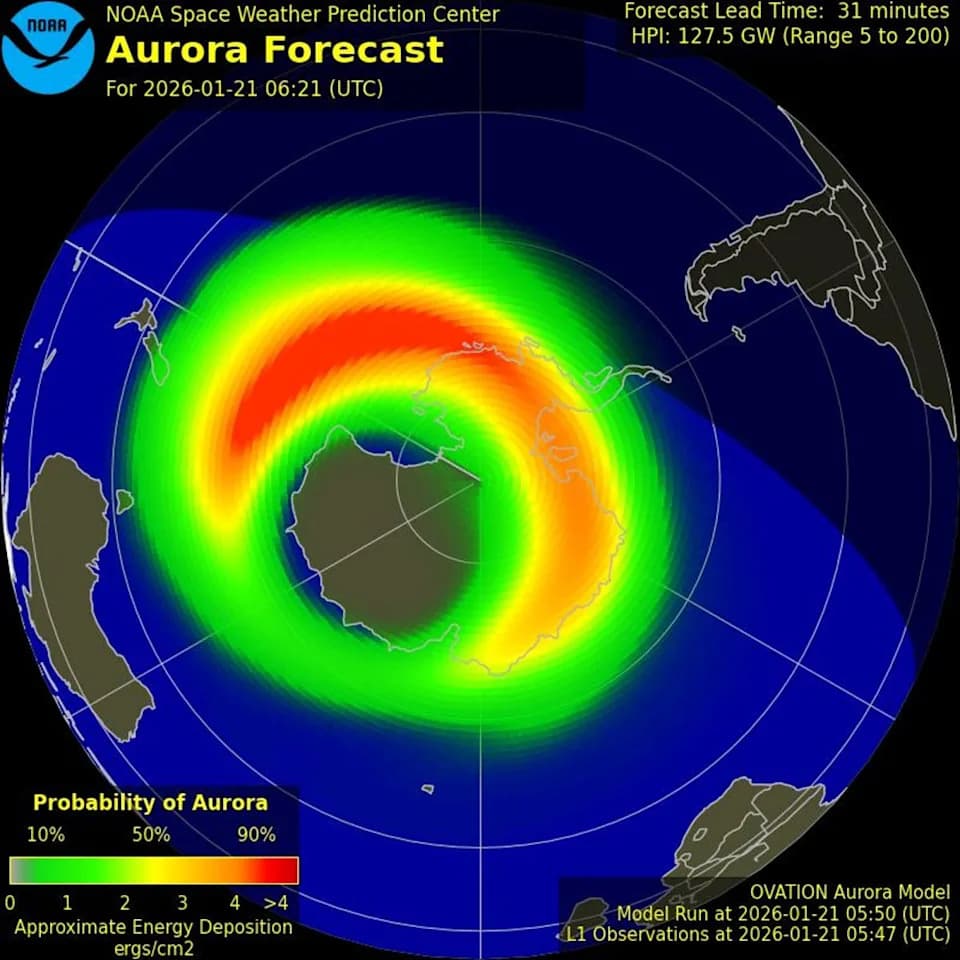
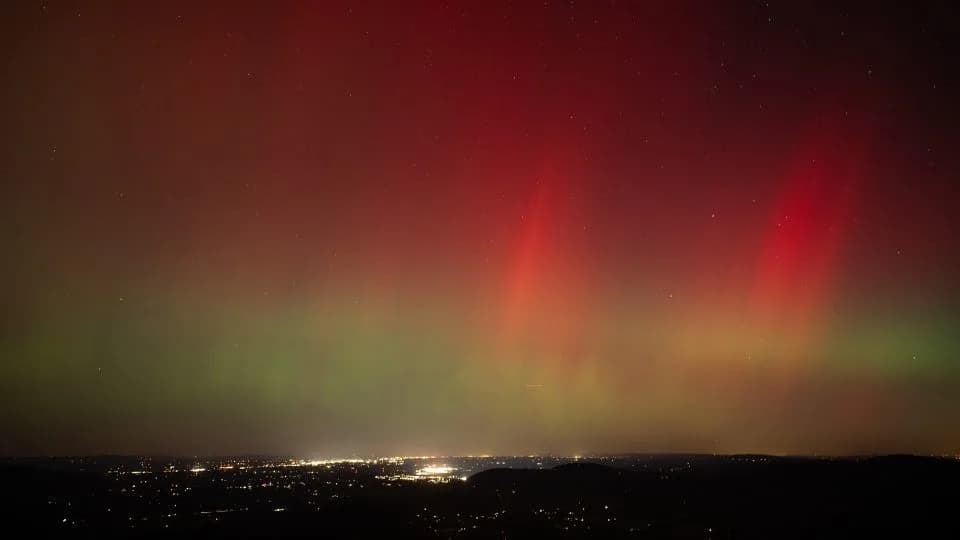
A faint purple-red aurora was photographed over Cambará do Sul, Brazil, on Jan. 19 during a major geomagnetic storm. Astrophotographer Egon Filter captured the short-lived glow, seen inside the South Atlantic Anomaly where Earth's magnetic field is weaker. Spaceweather.com suggested a possible SAR arc, but solar physicist Tamitha Skov favors a diffuse equatorial aurora interpretation based on the glow's altitude and geometry. Scientists say the sighting is consistent with the Sun's increasing activity as the solar cycle intensifies.
Rare Purple-Red Aurora Lights Up Southern Brazil During Strong Geomagnetic Storm

The southern lights captured from Brazil on Jan. 19. | Credit: Egon Filter
A rare purple-red aurora briefly appeared over Cambará do Sul in Brazil's Rio Grande do Sul state on Jan. 19, during the peak of a powerful geomagnetic storm. Astrophotographer Egon Filter was in the right place at the right time and captured the fleeting display.
Filter photographed a faint, diffuse glow high in the southern sky. Auroras generally occur at high latitudes near Earth's magnetic poles, so sightings this far north in the Southern Hemisphere — roughly between 27° and 33° south latitude for Rio Grande do Sul — are highly unusual.
"For an aurora to be visible at low latitudes, a very violent and exceptional solar storm is necessary," Filter told Space.com. He added that the glow appeared while he was watching the southern sky, and that it vanished after only a few minutes: "I took a few more pictures and, after a few minutes, it had already disappeared."
The brief display occurred inside the South Atlantic Anomaly (SAA), a region where Earth's magnetic field is weaker and more disordered than elsewhere, according to spaceweather.com. The SAA typically suppresses focused auroral curtains by scattering and weakening the particles that would normally produce bright, discrete aurora; auroras there tend to be faint and diffuse.
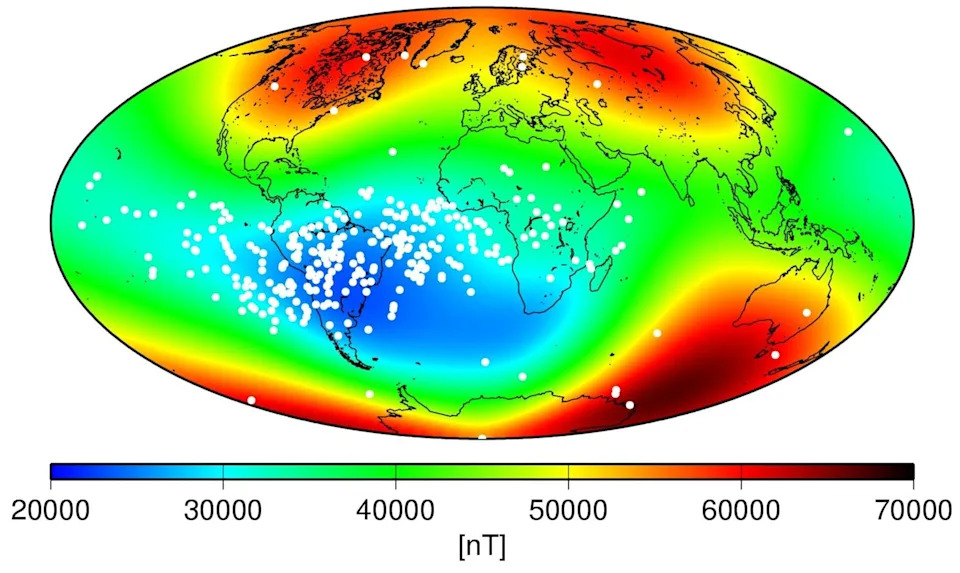
This global map reveals the South Atlantic Anomaly, a vast region where Earth's magnetic field is unusually weak. The white dots show where the TOPEX/Poseidon satellite's electronics were disrupted by increased radiation as it passed through this vulnerable zone above South America and the South Atlantic. | Credit: ESA/DTU Space
Possible Explanations
Spaceweather.com suggested the glow might have been a stable auroral red (SAR) arc — a faint, diffuse band that can form when energy from Earth's ring current leaks into the upper atmosphere during intense geomagnetic storms. SAR arcs have been recorded at lower latitudes during strong storms.
Tamitha Skov, solar physicist: "What makes this particular observation more remarkable is that it is observed high in the sky over Brazil and not near the southern horizon."
Skov told Space.com that the geometry and altitude of the sighting favor an interpretation as a diffuse equatorial aurora penetrating through the SAA rather than a horizon-hugging SAR arc. "It is aurora, but it is diffuse (not discrete) and it comes from a different source than we typically associate with the auroral zone," she said.
Context: The Sun's Increasing Activity
Skov and other scientists note this sighting is consistent with the Sun returning to a more active posture as the solar cycle ramps up. Recent solar activity is approaching levels typical across multiple solar cycles, making occasional low-latitude auroras more likely during strong geomagnetic storms.
This event is a reminder that intense space weather can produce spectacular — and brief — displays in places where auroras are normally never seen.
Editor's Note: If you photograph the northern or southern lights or other sky phenomena and would like to share your images with Space.com readers, send photos, comments, and your name and location to spacephotos@space.com.
Help us improve.