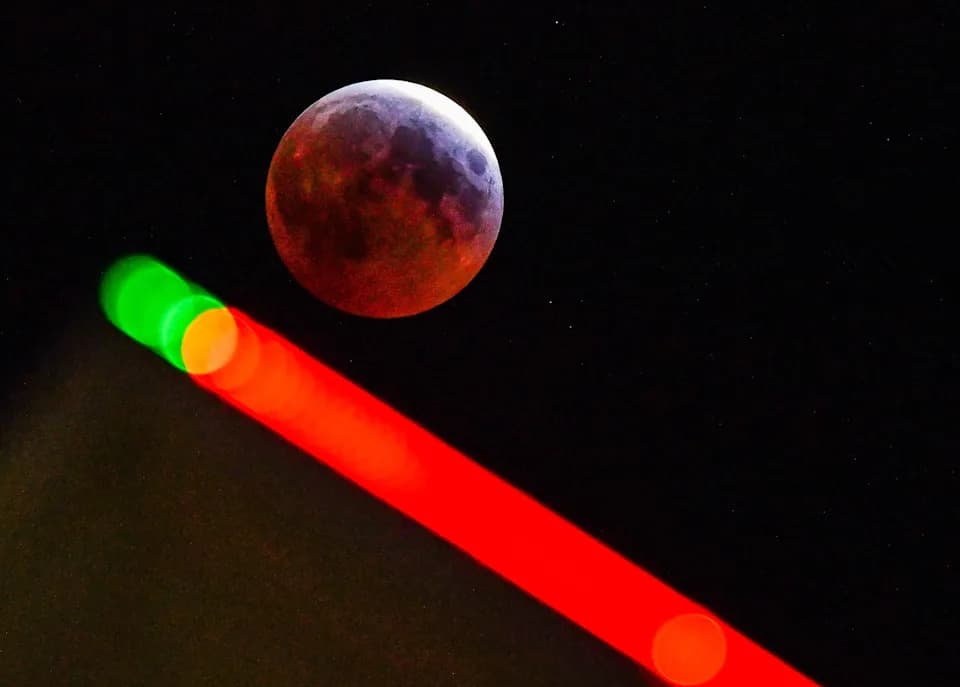
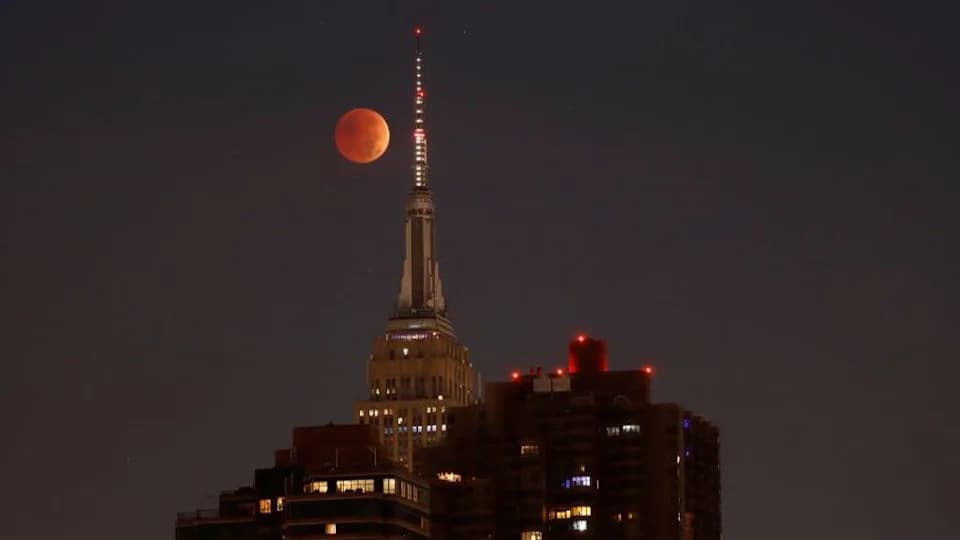
The Full Moon occurs when Earth lies nearly between the Sun and Moon, fully lighting the Moon's Earth-facing hemisphere. The next Full Moon is the Worm Moon at 6:38 a.m. EST on March 3, 2026, which coincides with a total lunar eclipse. This guide lists every 2026 Full Moon (Eastern times), identifies Super and Blue Moons, provides reference sky timings for Feb. 2–7 at 40°N, 90°W, and includes the year's principal lunar phase dates.
2026 Full Moon Calendar: Dates, Traditional Names, and Eclipse Highlights (Eastern Times)
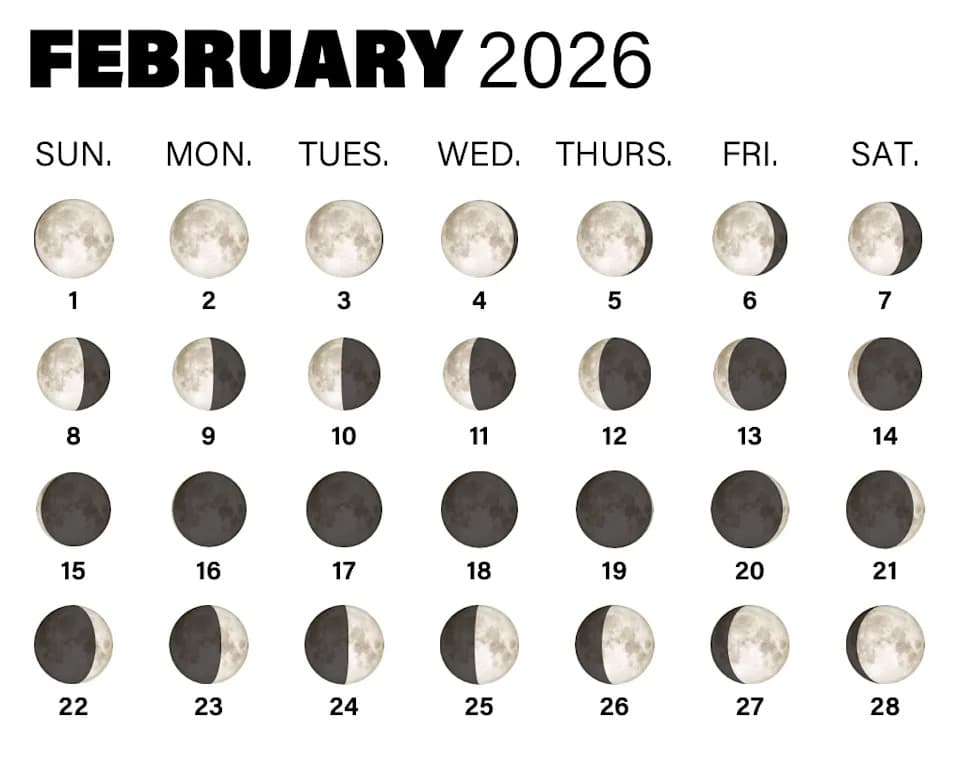
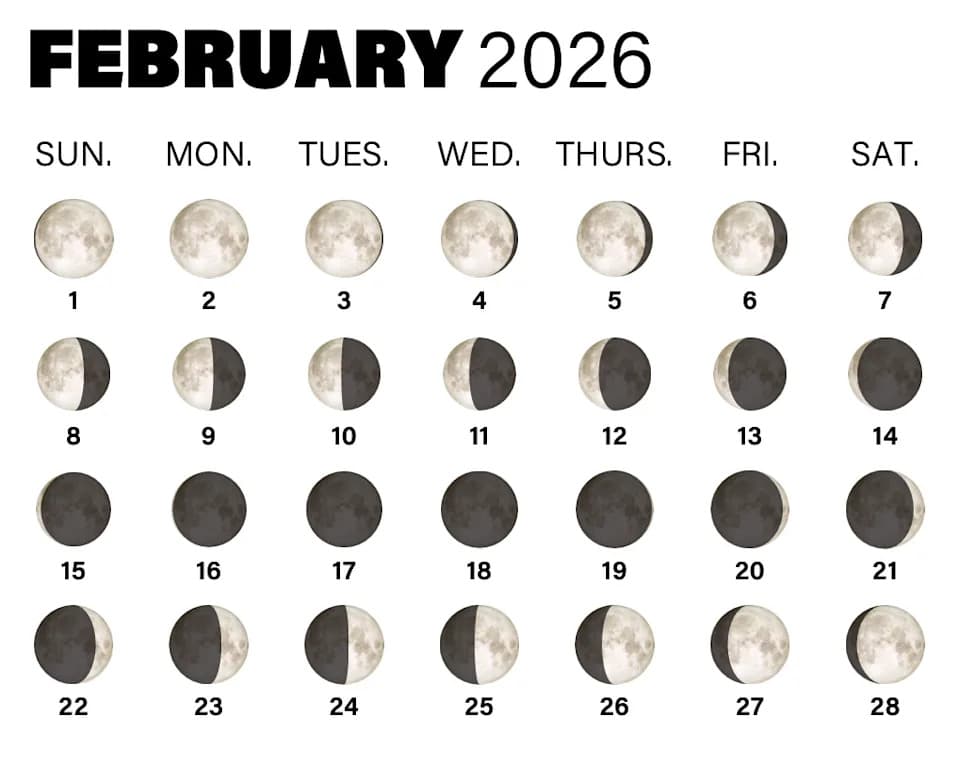
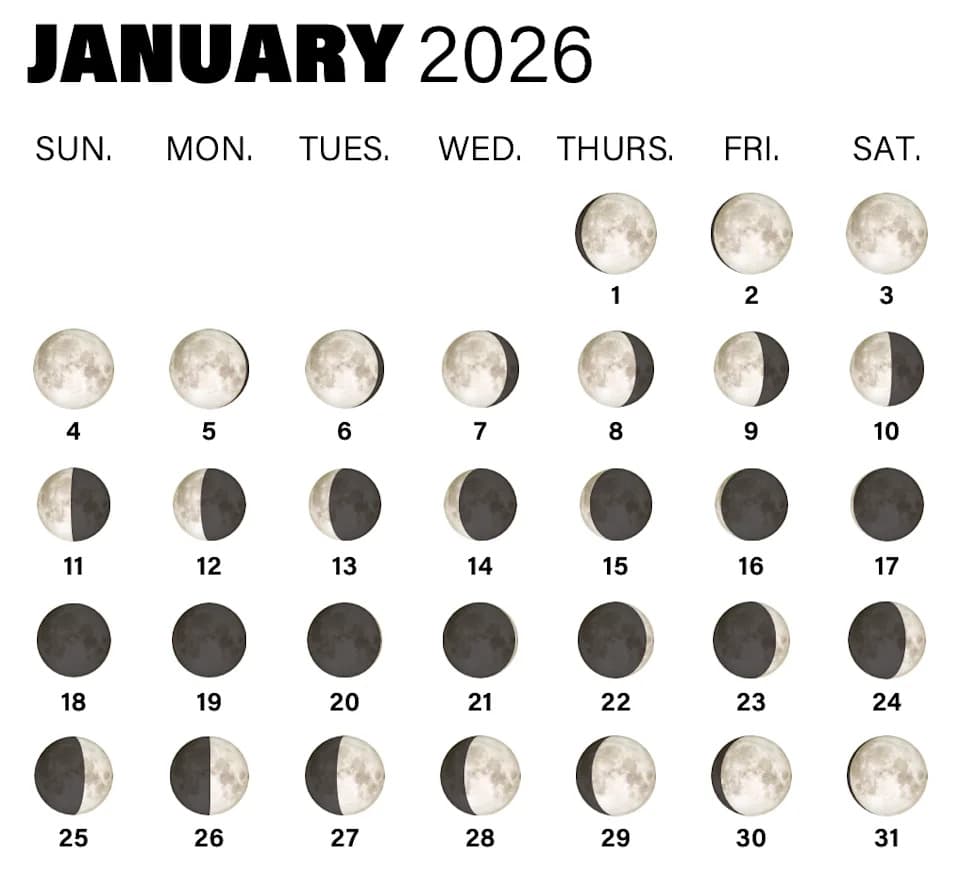
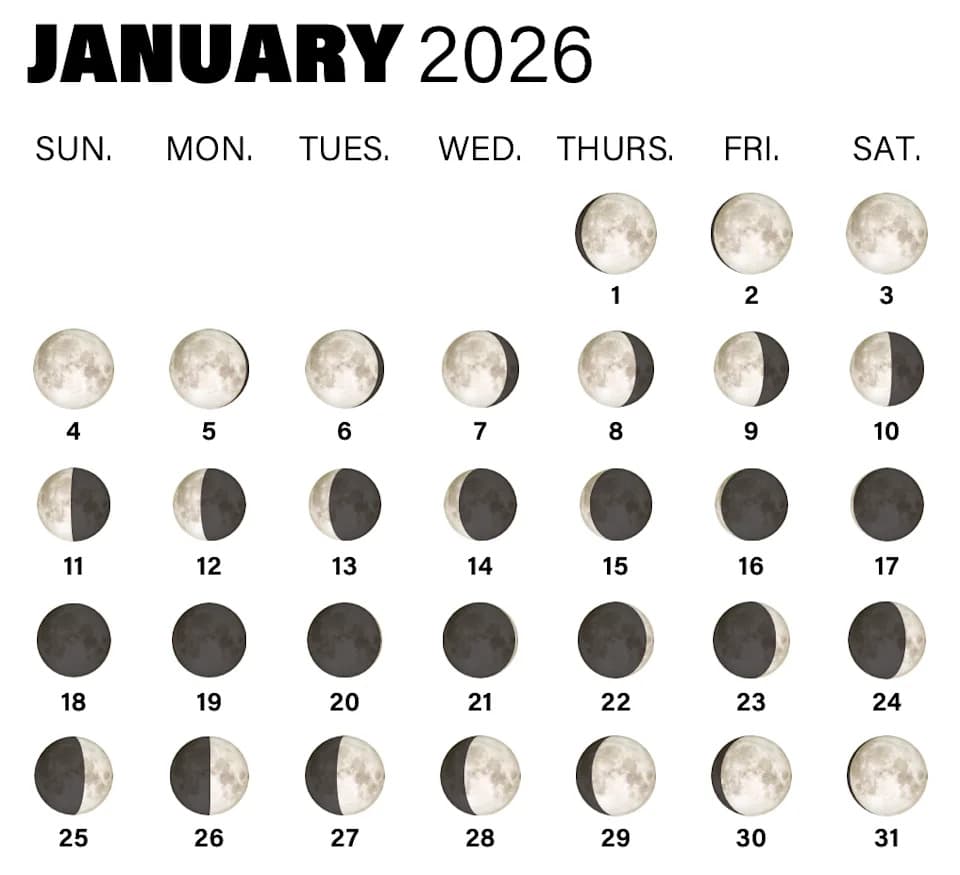
Note: Moon phases in the calendar vary in size due to the distance from Earth and are shown at 0h Universal Time. Credit: Astronomy: Roen Kelly
The Full Moon occurs when Earth lies nearly between the Sun and the Moon, illuminating the hemisphere of the Moon that faces us. Because the Moon orbits Earth, the angle at which sunlight strikes its surface changes continuously, producing the familiar sequence of lunar phases.
Next Full Moon
The next Full Moon in 2026 is the Worm Moon, reaching peak fullness at 6:38 a.m. EST on Tuesday, March 3, 2026. That night also includes a total lunar eclipse. Exact visibility of the eclipse depends on your location and local moonrise/moonset times.
Complete 2026 Full Moon Schedule (All Times Eastern)
- Saturday, Jan. 3 — 5:03 a.m. — Wolf Moon*
- Sunday, Feb. 1 — 5:09 p.m. — Snow Moon
- Tuesday, March 3 — 6:38 a.m. — Worm Moon | Total lunar eclipse
- Wednesday, April 1 — 10:12 p.m. — Pink Moon
- Friday, May 1 — 1:23 p.m. — Flower Moon
- Sunday, May 31 — 4:45 a.m. — Blue Moon (second Full Moon in May)
- Monday, June 29 — 7:57 p.m. — Strawberry Moon
- Wednesday, July 29 — 10:36 a.m. — Buck Moon
- Friday, Aug. 28 — 12:19 a.m. — Sturgeon Moon | Partial lunar eclipse
- Saturday, Sept. 26 — 12:49 p.m. — Corn Moon
- Monday, Oct. 26 — 12:12 a.m. — Hunter’s Moon
- Tuesday, Nov. 24 — 9:54 a.m. — Beaver Moon*
- Wednesday, Dec. 23 — 8:28 p.m. — Cold Moon*
* Indicates a Full Moon near lunar perigee commonly labeled a Super Moon.
Reference Daily Sky Times (40° N, 90° W — Local Time)
Below are daily sunrise, sunset, moonrise, moonset and illumination details for the reference location 40° N, 90° W. Unless otherwise noted, other times above are Eastern.
Monday, February 2
The waning gibbous Moon passes about 0.4° due north of Regulus (in Leo) at 10:00 p.m. EST. This close pairing is visible across much of the U.S. as Leo rises in the east around local astronomical evening. Western Africa and parts of North America may see an occultation (or grazing occultation) of Regulus; in the U.S. the event window is roughly 8:40–10:05 p.m. EST. See specialized maps (for example, In-The-Sky.org) for location-specific visibility.
Sunrise: 7:07 a.m. — Sunset: 5:21 p.m. — Moonrise: 6:27 p.m. — Moonset: 7:43 a.m. — Moon Phase: Waning Gibbous (98%)
Tuesday, February 3
Sunrise: 7:06 a.m. — Sunset: 5:22 p.m. — Moonrise: 7:37 p.m. — Moonset: 8:08 a.m. — Moon Phase: Waning Gibbous (94%)
Wednesday, February 4
Sunrise: 7:05 a.m. — Sunset: 5:23 p.m. — Moonrise: 8:43 p.m. — Moonset: 8:31 a.m. — Moon Phase: Waning Gibbous (88%)
Thursday, February 5
Sunrise: 7:04 a.m. — Sunset: 5:24 p.m. — Moonrise: 9:48 p.m. — Moonset: 8:53 a.m. — Moon Phase: Waning Gibbous (81%)
Friday, February 6
Sunrise: 7:03 a.m. — Sunset: 5:26 p.m. — Moonrise: 10:51 p.m. — Moonset: 9:14 a.m. — Moon Phase: Waning Gibbous (72%)
Saturday, February 7
Sunrise: 7:02 a.m. — Sunset: 5:27 p.m. — Moonrise: 11:55 p.m. — Moonset: 9:37 a.m. — Moon Phase: Waning Gibbous (63%)
About Lunar Phases, Special Names, And Tides
The canonical sequence of lunar phases is: New Moon, Waxing Crescent, First Quarter, Waxing Gibbous, Full Moon, Waning Gibbous, Last Quarter, and Waning Crescent. The synodic month—the interval from one Full Moon to the next—lasts about 29.5 days. Although the Full Moon is an instant of exact alignment, the Moon appears essentially full to casual observers for roughly three days centered on that instant.
Traditional Full Moon Names
- Wolf Moon (January) — From winter wolf howls.
- Snow Moon (February) — For heavy winter snowfall.
- Worm Moon (March) — Earthworms reappear as the ground thaws.
- Pink Moon (April) — For spring pink wildflowers.
- Flower Moon (May) — Celebrating abundant blooms.
- Strawberry Moon (June) — Peak strawberry harvest season.
- Buck Moon (July) — Bucks begin growing new antlers.
- Sturgeon Moon (August) — Historically good sturgeon fishing.
- Corn Moon (September) — Corn-harvest timing.
- Hunter's Moon (October) — Linked to autumn hunting.
- Beaver Moon (November) — Beavers prepare for winter.
- Cold Moon (December) — Evocative of deep winter chill.
Special Moon Types
- Super Moon — A Full Moon near lunar perigee (closest approach to Earth), appearing slightly larger and brighter; Jan. 3, Nov. 24 and Dec. 23 are noted as Super Moons in 2026.
- Blue Moon — The second Full Moon in a single calendar month; occurs May 31, 2026.
- Black Moon — An informal term for certain New-Moon configurations (e.g., second New Moon in a month or the third of four New Moons in a season).
- Harvest Moon — The Full Moon nearest the autumnal equinox, often providing extended evening moonlight valuable historically for harvest work.
Full Moons And Tides
The Moon's gravity raises Earth's tides. During Full and New Moons the Sun, Earth and Moon are roughly aligned, producing stronger-than-average spring tides with higher high tides and lower low tides due to combined gravitational effects.
2026 Principal Lunar Phase Dates
New / First Quarter / Full / Last Quarter
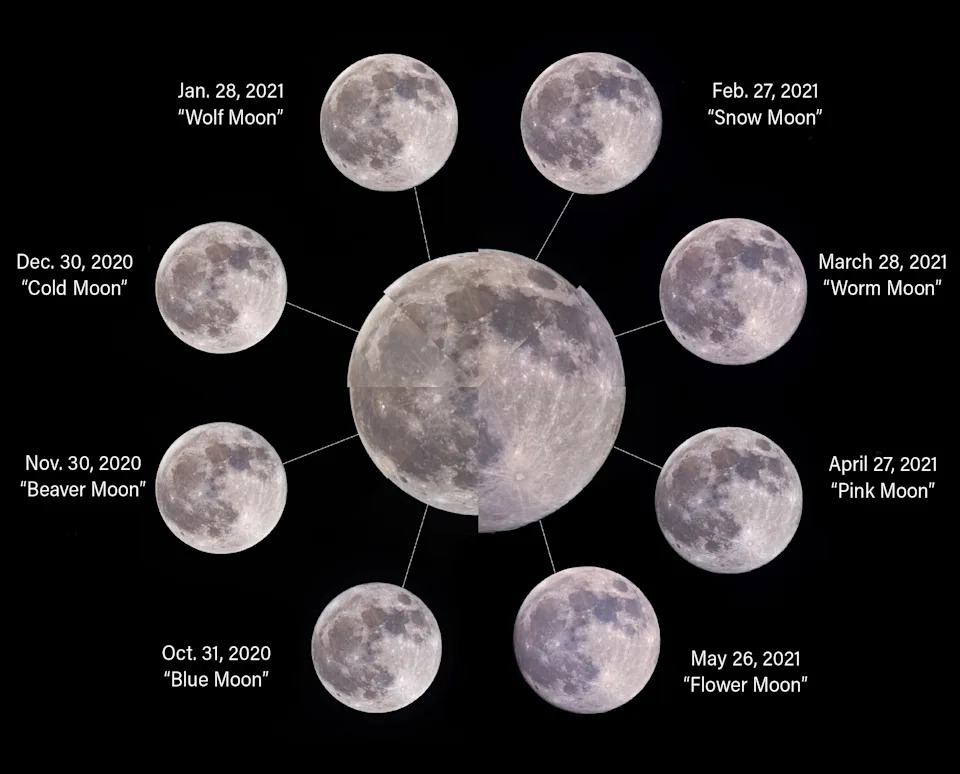
A composite of each month’s Full Moon in 2020 and 2021. Credit: Soumyadeep Mukherjee
Jan. 3 / Jan. 10 / Jan. 18 / Jan. 25
Feb. 1 / Feb. 9 / Feb. 17 / Feb. 24
March 3 / March 11 / March 18 / March 25
April 1 / April 10 / April 17 / April 23
May 1 / May 9 / May 16 / May 23
May 31 / June 8 / June 14 / June 21
June 29 / July 7 / July 14 / July 21
July 29 / Aug. 5 / Aug. 12 / Aug. 19
Aug. 28 / Sept. 4 / Sept. 10 / Sept. 18
Sept. 26 / Oct. 3 / Oct. 10 / Oct. 18
Oct. 26 / Nov. 1 / Nov. 9 / Nov. 17
Nov. 24 / Dec. 1 / Dec. 8 / Dec. 17
Dec. 23 / Dec. 30
Note: Times and local visibility for eclipses and moonrise/moonset can be refined by observatory calculators and local astronomical guides. For maps and location-specific occultation details, consult dedicated tools such as In-The-Sky.org or your regional astronomy center.
Help us improve.