The upcoming Bangladeshi election — the first since Sheikh Hasina’s 2024 ouster — pits the BNP and Jamaat‑e‑Islami against one another under an interim government led by Nobel laureate Muhammad Yunus. The Awami League has been barred after Hasina’s conviction in connection with a deadly 2024 crackdown. India, Pakistan and China each have distinct stakes: India seeks a cooperative, stable government; Pakistan is pursuing renewed ties and strategic influence; and China prioritises stability to protect its investments and projects.
Bangladesh Vote: How India, China and Pakistan Could Be Reshaped by the Outcome
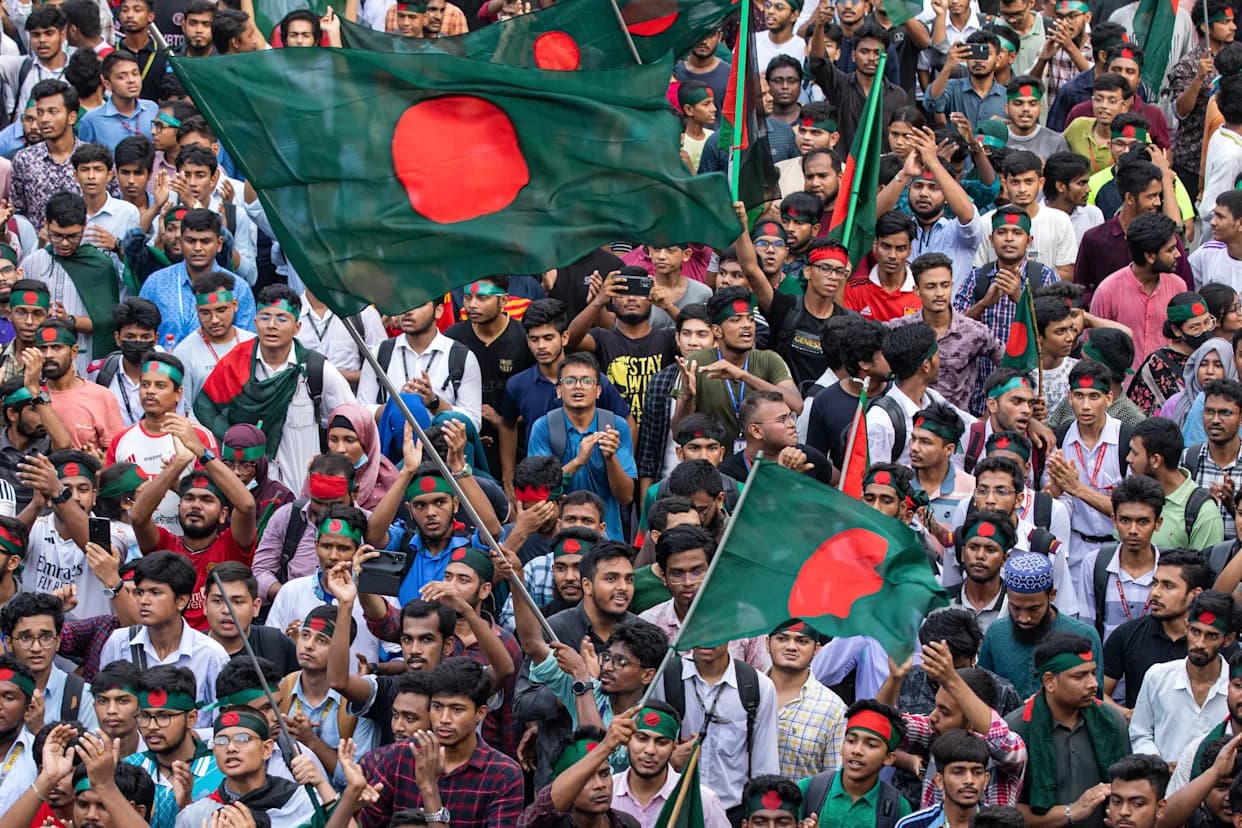
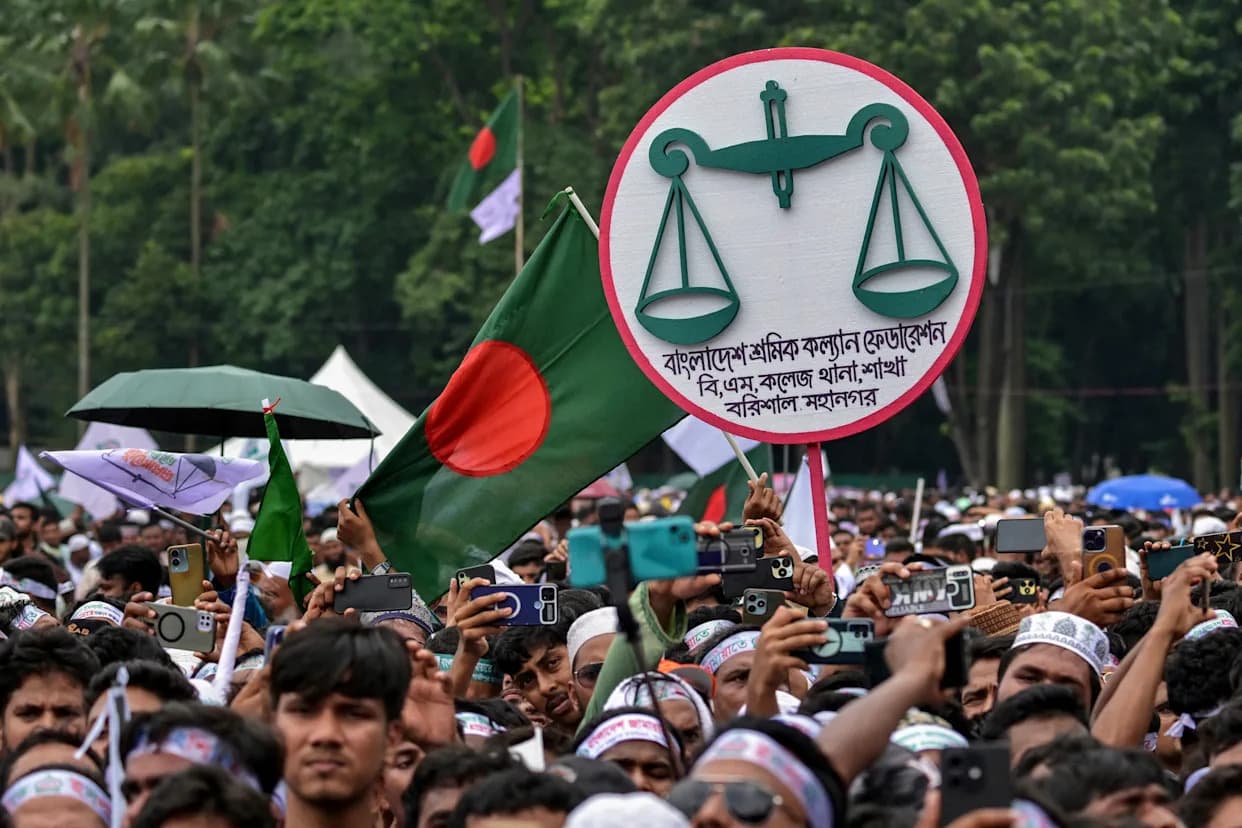
Students and other activists carry Bangladesh's national flag during a protest march in Dhaka, Bangladesh, [File: Rajib Dhar/AP]
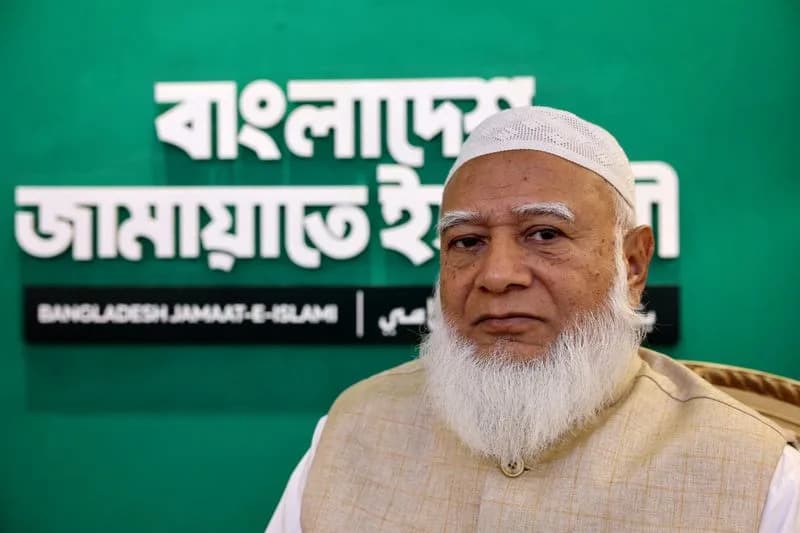
Bangladesh is holding its first national election since the dramatic removal of Prime Minister Sheikh Hasina and her Awami League party in 2024. An interim administration led by Nobel laureate Muhammad Yunus is overseeing the vote, and the principal contenders are the Bangladesh Nationalist Party (BNP) and Jamaat‑e‑Islami. The Awami League has been barred from participating after the International Crimes Tribunal (ICT) convicted Hasina in absentia over the violent 2024 crackdown on student protests that left roughly 1,400 people dead.
Why Neighbours Are Watching
Bangladesh sits at a geopolitical crossroads in South Asia. Any change in Dhaka’s government could alter trade flows, security alignments, and regional influence — particularly for India, Pakistan and China, each of which approaches the election with distinct priorities.
Stakes For India
New Delhi historically regarded Dhaka as a strategic partner. Before Hasina’s ouster, India was Bangladesh’s largest Asian trading partner: between April 2023 and March 2024 India exported about $11.1bn in goods to Bangladesh and imported roughly $1.8bn. Relations have since cooled — partly because Hasina sought refuge in India and was not extradited — and both countries have imposed restrictions on trade by land and sea amid heightened tensions.
Analyst view: “Bilateral relations with India have reached a historic low,” said Khandakar Tahmid Rejwan of Independent University, Bangladesh.
Despite rancour, New Delhi has continued diplomatic outreach and is most comfortable with a BNP‑led government rather than an Islamist‑dominated administration. Indian policymakers worry that a government influenced by anti‑India actors could complicate regional security cooperation, migration and connectivity projects.
Stakes For Pakistan
Islamabad has moved to warm ties with Dhaka since Hasina’s removal. Pakistani leaders met Yunus repeatedly in 2024, and Islamabad has pushed to restore trade, flights and defence ties. Under Yunus, Bangladesh and Pakistan resumed direct trade and restarted direct flights after years of suspension. Analysts say Pakistan’s engagement is partly diplomatic and strategic — intended to raise New Delhi’s security concerns and to cultivate influence in a country historically shaped by the 1971 war.
Stakes For China
Beijing has steadily deepened economic and strategic engagement with Bangladesh. The Yunus interim government has secured about $2.1bn in Chinese investments, loans and grants and has courted further Chinese infrastructure financing. China has engaged pragmatically with multiple Bangladeshi parties and is focused on stability to protect its projects and investments.
Domestic Dynamics And International Fallout
The campaign is playing out against sharp domestic divisions. Hasina has rejected the legitimacy of the election, arguing that a ballot that excludes her party cannot heal national fractures. Anti‑India sentiment surged after her ouster, and recent incidents — including the killing of 2024 protest leader Osman Hadi and a fatal mob attack on a Hindu man in Bhaluka amid related protests — have heightened communal and diplomatic tensions.
The cricket dispute has become a flashpoint: Bangladesh asked the ICC to move its World Cup fixtures from India; the ICC expelled Bangladesh from the tournament in response, and Pakistan announced it would not play its scheduled match against India in solidarity. Such moves demonstrate how sport can mirror and amplify diplomatic rifts.
What To Watch
- Which party wins a clear parliamentary majority and whether the result is widely accepted domestically and internationally.
- How the new government balances ties with India, Pakistan and China — whether it pursues a pragmatic hedge or a more ideological alignment.
- Whether foreign investment and major infrastructure projects (including Chinese financing) remain secure amid political transition.
- Potential humanitarian and minority‑rights concerns and how they affect Bangladesh’s diplomatic standing.
In short, the election’s outcome matters not only for Bangladesh’s internal future, but for the strategic calculations of its neighbours. India seeks a predictable, cooperative Dhaka; Pakistan sees an opportunity to regain influence; and China wants stability to safeguard its economic footprint. Whatever the result, Dhaka’s foreign policy is likely to remain pragmatic — balancing relationships with multiple powers while prioritising national interests.
Help us improve.