Six years after former President Donald Trump sought to overturn the 2020 election results, that effort continues to reshape the contest to become Georgia’s next governor. Renewed scrutiny of the 2020 vote — including an FBI search last week of a Fulton County election office seeking records tied to the contest — has put election disputes back at the center of the campaign debate.
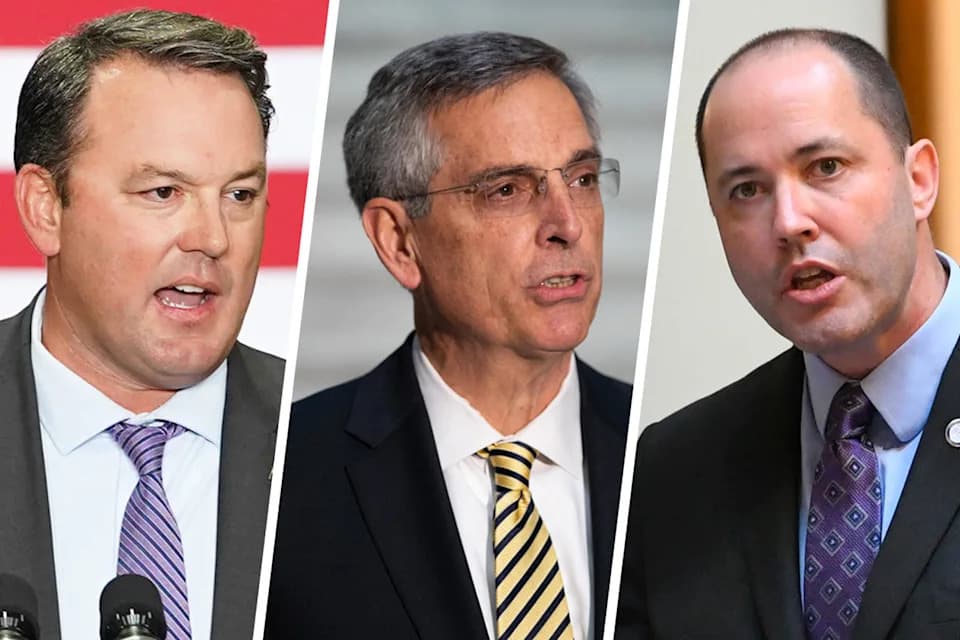
Lieutenant Governor Burt Jones, who was part of an alternate slate of presidential electors that cast votes for Trump after Joe Biden carried Georgia in 2020, has the former president’s endorsement and has repeatedly made the 2020 results a focal point of his campaign. Jones has called for investigations into perceived irregularities and recently asked the state Senate Ethics Committee to question Secretary of State Brad Raffensperger about unsigned tabulation tapes from a batch of Fulton County ballots — an omission Raffensperger has called a "clerical error."
Raffensperger and Attorney General Chris Carr, both Republican statewide officials, are also running for governor. Each drew Mr. Trump’s ire in 2020 after refusing demands to overturn the state’s results: Raffensperger declined pleas to "find" more votes, and Carr publicly said there was no evidence of widespread voter fraud. Both were targeted by Trump-backed challengers in later primaries but prevailed.
FBI Search Reignites 2020 Questions
The Justice Department-affiliated search of the Fulton County election facility revived attention to the 2020 race in Georgia, although investigators have not disclosed the full scope of the probe. Fulton County has long been a focus of post-election litigation and conspiracy claims pushed by Trump and his allies. There remains no credible evidence of widespread voter fraud in Georgia or nationally in 2020.
"This is all about trying to appeal to the Republican primary voters, of whom the large majority are still very much supportive of Trump," said Alan Abramowitz, a political scientist at Emory University. "How you appeal to the Republican primary electorate is by trying to demonstrate that you remain loyal to the president."
Electoral Dynamics And General Election Risk
Analysts say emphasizing 2020 can help a GOP candidate win the Republican primary by energizing Trump-aligned voters, but the same strategy may be a liability in a general election. Abramowitz noted that a nominee who leans heavily into 2020 grievances could hand Democrats an opening to focus on bread-and-butter issues such as cost of living and jobs.
Georgia remains competitive: the nonpartisan Cook Political Report with Amy Walter currently rates the governor’s race a "toss up." The state has elected Democratic U.S. senators in recent cycles but has not chosen a Democratic governor since 1998.
Voices From Both Parties
Democratic candidates have criticized the ongoing focus on the 2020 election as a distraction. Former Atlanta Mayor Keisha Lance Bottoms said the renewed attention is troubling for democracy and detracts from voters' everyday concerns. Former DeKalb County CEO Mike Thurmond and former state Sen. Jason Esteves likewise attacked the prominence of 2020-era disputes in the campaign.
Former Republican Lt. Gov. Geoff Duncan, who defended Georgia’s 2020 results and later left the GOP to run as a Democrat, called Jones’s approach "a diversion tactic" and a product of Trump’s continuing influence.
Jones was part of Trump’s alternate electors in 2020 but was not charged by a state special prosecutor investigating election interference. His frequent references to the 2020 contest, combined with Trump’s endorsement, make him a significant figure in the GOP primary — and a potential general-election vulnerability if the race turns on those themes.
This article was originally published on NBCNews.com.