The decommissioned Russian Luch/Olymp satellite (NORAD 40258) appears to have fragmented in a graveyard orbit after optical imagery from S2A Systems showed the craft breaking apart and tumbling. Observers reported the breakup at 06:09 GMT on Jan. 30. Astrophysicist Jonathan McDowell says an external debris impact is a plausible cause, though improper passivation cannot be entirely ruled out. The incident raises concerns about the debris environment around GEO and the long-term risks to nearby satellites.
Decommissioned Russian 'Inspector' Satellite Appears To Break Apart In Graveyard Orbit, Raising Space Debris Alarm
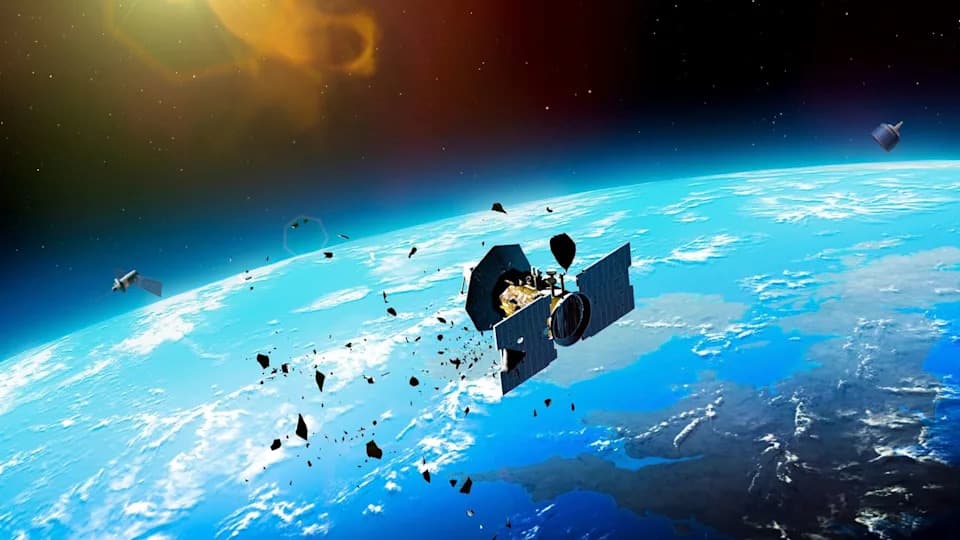
An illustration of satellites breaking up in Earth orbit. | Credit: Mark Garlick/Science Photo Library/Getty Images
A Russian satellite once used to inspect other spacecraft appears to have fragmented while in a graveyard orbit hundreds of miles above the geostationary belt, ground-based imagery indicates. The event—detected by Swiss space situational awareness firm S2A Systems—raises fresh concerns about the debris environment near geostationary orbit (GEO) and the higher graveyard region.
What Happened
The vehicle, identified as Luch/Olymp (NORAD catalog number 40258), was launched in 2014 and used in the past to approach and assess other satellites in GEO. It was officially retired and maneuvered into a designated graveyard orbit several hundred miles above GEO in October 2025. Optical imagery and subsequent tracking show the craft apparently breaking apart and beginning to tumble, with multiple fragments observed nearby. Observers reported the breakup at about 06:09 GMT on Jan. 30.
Possible Cause And Implications
Astrophysicist and satellite tracker Jonathan McDowell told Space.com that the pattern of fragments is consistent with an external debris impact. He noted that when satellites are retired they are typically passivated—venting remaining fuel and disconnecting batteries—to reduce the likelihood of internal explosions, which makes an external collision a plausible explanation.
"The distribution of pieces looks like an impact rather than a classic internal explosion," McDowell said, while adding that a failure to properly passivate the spacecraft cannot be completely ruled out.
Either scenario is concerning. A collision would indicate that damaging debris exists at or above GEO levels, a region long assumed to be less cluttered than low Earth orbit. Even debris in graveyard orbits can remain dangerous for decades, posing collision risk to other retired or active assets and complicating operations for geostationary satellites that support communications, navigation, and weather services.
Context
The Luch/Olymp vehicle is one of two Russian inspector satellites known to have approached other nations’ spacecraft in geostationary orbit. Russia launched a second similar satellite in 2023. In recent years, Russia, the United States, and China have all deployed satellites capable of close-proximity inspection, operations that raise both operational and security questions in addition to increasing the potential for accidental collisions.
What Comes Next: Tracking organizations will continue cataloging fragments to assess collision risk and to determine whether the debris remains confined to the graveyard region or could drift back toward GEO. The event underscores the need for continued monitoring, improved debris mitigation, and international coordination on space safety practices.
Help us improve.