Oregon State University researchers conducted a three-month 2022 survey near Klamath, California, using 285 hair snares and 135 remote cameras across ~150 square miles. Genetic analysis identified 46 coastal (Humboldt) martens (28 males, 18 females). The study found martens most often on snowy forested ridgetops, in ravines and along riverbanks, and confirmed that dense canopy, large trees and coarse woody debris are important habitat features. The species remains endangered and faces threats from rodenticides, vehicles, disease and habitat loss, and results were published in Global Ecology and Conservation.
Elusive Coastal (Humboldt) Marten Photographed: OSU Study Identifies 46 Individuals and Reveals Key Habitat Needs
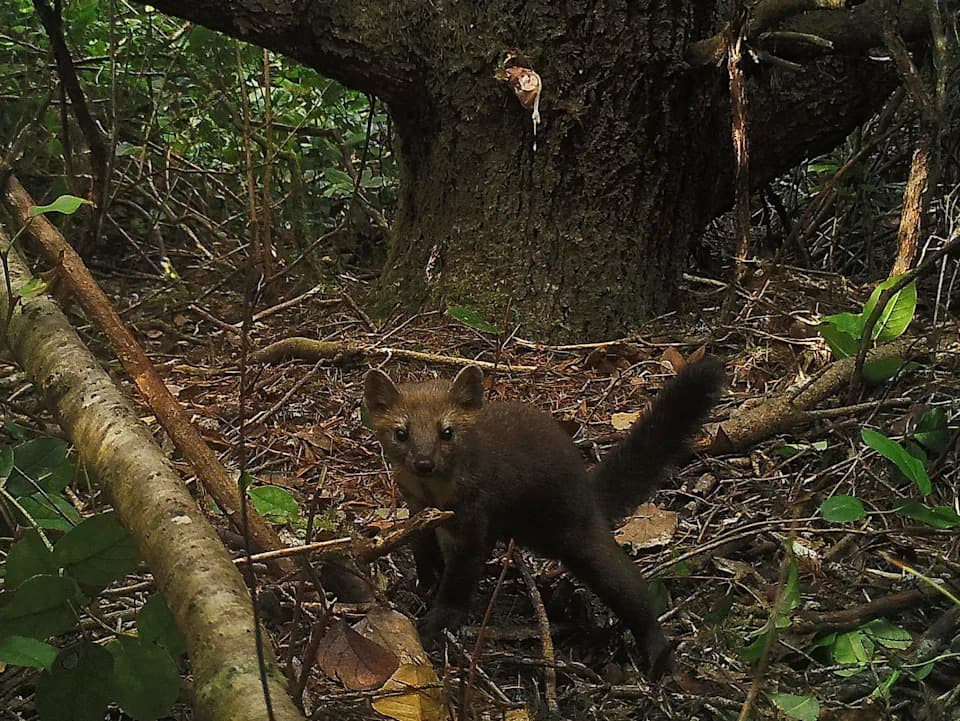
A coastal marten in Oregon in October 2015. / Credit: Mark Linnell/U.S. Forest Pacific Northwest Research Station and Oregon State University via AP(Oregon State University Institute for Natural Resources)
Researchers at Oregon State University have published new field data on the coastal marten (also called the Humboldt marten), a small, ferret-sized forest carnivore that was nearly driven to extinction in the 20th century.
Study Overview
Field teams from OSU's Institute for Natural Resources spent three months in 2022 surveying martens near Klamath, California. Using non-invasive methods — 285 hair snares and 135 remote cameras deployed across roughly 150 square miles — the researchers collected presence records and genetic samples to better estimate population size and habitat use.
Key Findings
Genetic analysis of collected hair samples identified 46 individual martens within the study area, including 28 males and 18 females. The animals were most often detected on forested ridgetops that receive regular snow, and in sheltered microhabitats such as ravines and riverbanks.
Study leader Erika Anderson, a faculty research assistant at OSU, said the results reinforce that coastal martens favor dense canopy cover, large-diameter trees and abundant hollow logs. These elements of coarse woody debris provide essential cover for hunting and refuge from predators, she noted. The team’s work on how dense forest structure influences martens was recently published in the journal Global Ecology and Conservation.
Conservation Context
The coastal marten is federally protected under the Endangered Species Act. Only four isolated populations are known to remain — two in northwestern California and two in western Oregon, according to the U.S. Fish and Wildlife Service. Martens were thought to be extinct until a small population was rediscovered in northern California in 1996. Today, ongoing threats include historical trapping and logging impacts, plus current risks from rodenticides, vehicle strikes, disease and habitat loss.
OSU wildlife ecologist Sean Matthews emphasized that even with these new data, fundamental questions remain about the species' distribution and trends: 'There is still a lot we don’t know about where coastal martens persist, how many there are across their range, and whether populations are increasing,' he said.
These new findings improve baseline population estimates for the Klamath area and highlight habitat features that should be prioritized in conservation and forest management planning. Continued monitoring using non-invasive methods will be critical to guide recovery actions for this rare and charismatic carnivore.
Help us improve.