The Justice Department and federal courts are being stretched by a rapid increase in habeas petitions from detained immigrants after intensified immigration enforcement. More than 400 petitions have been filed in Minnesota since Jan. 1 — versus about 125 for all of last year — and courts near the border report similar spikes. U.S. attorneys have reassigned staff to handle the caseload, judges have criticized the government’s lack of preparation, and officials have sought help from other districts.
Immigration Enforcement Surge Overwhelms Federal Courts and DOJ, Judges Warn
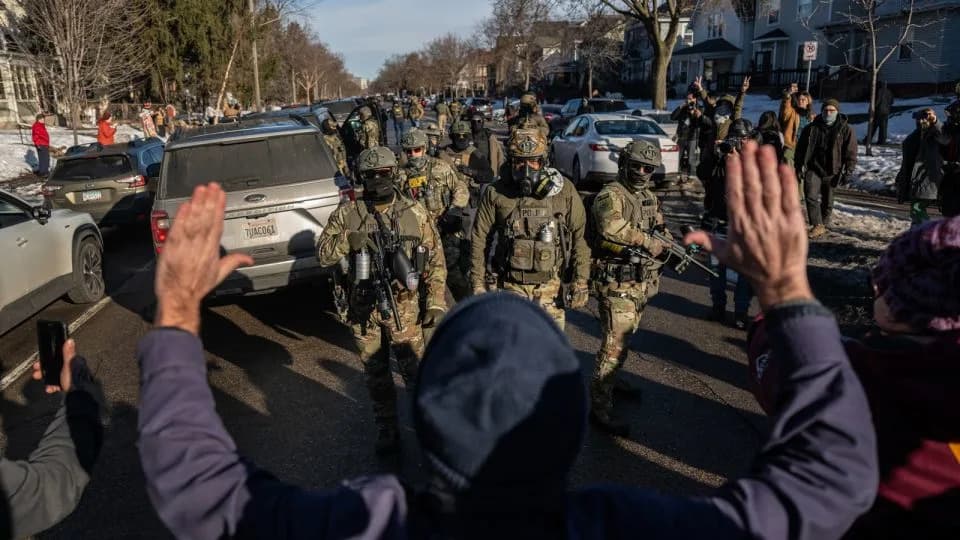
Demonstrators and onlookers confront federal law enforcement agents during a raid in south Minneapolis on January 13. - Victor J. Blue/Bloomberg/Getty Images
The Justice Department and the federal judiciary are struggling to keep pace with a sudden surge of habeas corpus petitions filed by immigrants held in detention — a direct consequence of the Trump administration’s expanded immigration enforcement and recent operational surges.
Spike In Habeas Filings
Court dockets and attorneys say the number of detainees filing habeas petitions — legal challenges to their detention heard in the federal district where they are held — has spiked sharply in Minnesota and parts of Texas in recent weeks. Since Jan. 1, more than 400 detainees have filed habeas petitions in Minnesota alone, compared with just over 125 filings for all of last year.
Operation Metro Surge And Transfers
The pressure increased after the administration deployed more than 3,000 Homeland Security border and immigration officers to the Twin Cities as part of the Operation Metro Surge. Authorities have also moved detainees arrested in Minnesota and elsewhere to federal detention facilities near the U.S.-Mexico border, contributing to filings across multiple districts.
Justice Department And Courts Stretched
U.S. Attorney’s offices and federal courts report being forced to reassign civil and criminal prosecutors to handle habeas caseloads. Justin Simmons, U.S. Attorney for the Western District of Texas, told the Fifth Circuit that his office has shifted already-limited resources to respond to these petitions full time.
"The cases are just getting sent to whatever attorneys can handle the workload within the district," said Jacqueline Watson, an Austin-based immigration attorney and board member of the American Immigration Lawyers Association. "The volume slows down already scarce court resources."

Patrick Schiltz serves as the chief United States district judge of the US District Court for the District of Minnesota. - US District Court for the District of Minnesota
“To respond to this wave of habeas petitions, the U.S. Attorney’s Office has been forced to shift its already limited resources from other pressing and important priorities.” — Justin Simmons
Policy Changes And Legal Response
Officials say a Department of Homeland Security policy change last summer narrowed eligibility for bond hearings in immigration court, increasing the number of detained people who turn to federal district courts for emergency habeas relief. In many of these cases, judges must decide within days whether a detainee should be released or receive a bond hearing.
Federal judges have sharply criticized the government’s lack of preparedness. Chief Judge Patrick Schiltz wrote that the government "decided to send thousands of agents to Minnesota to detain aliens without making any provision for dealing with the hundreds of habeas petitions and other lawsuits that were sure to result." In one order, Schiltz faulted the U.S. Attorney’s Office for struggling to comply with court orders in a case involving a man who had been in ICE custody since early January and had not received a bond hearing for three weeks: "The Court’s patience is at an end."
What Officials Are Doing
According to reporting and internal DOJ discussions, some U.S. attorneys have suggested coordinating with DHS about enforcement practices, and DOJ has requested that other Midwestern U.S. Attorney’s offices send attorneys to Minnesota to help handle the surge. Still, one source familiar with internal deliberations said simply adding lawyers may not be enough to absorb the sudden workload.
Attorneys with the ACLU and other immigrant-rights groups are representing dozens of detainees and say they are seeing unprecedented enforcement activity. "The scale we’re talking about is not what we’ve ever seen before," said My Khanh Ngo, an ACLU attorney working on many habeas cases.
Reporting note: Several attorneys and court records were cited in coverage of these developments. DOJ spokespeople did not respond to requests for comment on the surge in immigration-related habeas petitions.
Help us improve.