The mysterious "Baghdad battery" — a clay jar with a copper vessel and iron rod found in Iraq — has sparked renewed debate. Independent researcher Alexander Bazes reconstructed the vessel and reports experiments that produced about 1.4 volts, suggesting the jar's porous clay and an electrolyte could form a makeshift galvanic cell. Other archaeologists, including William Hafford, argue the jars were ritual containers for prayers, pointing to nearby finds that favor a ceremonial explanation. The original artifact is missing, so reconstructions and interpretation remain uncertain.
Could the 2,000-Year-Old 'Baghdad Battery' Have Actually Been a Working Cell?
Wilhelm König
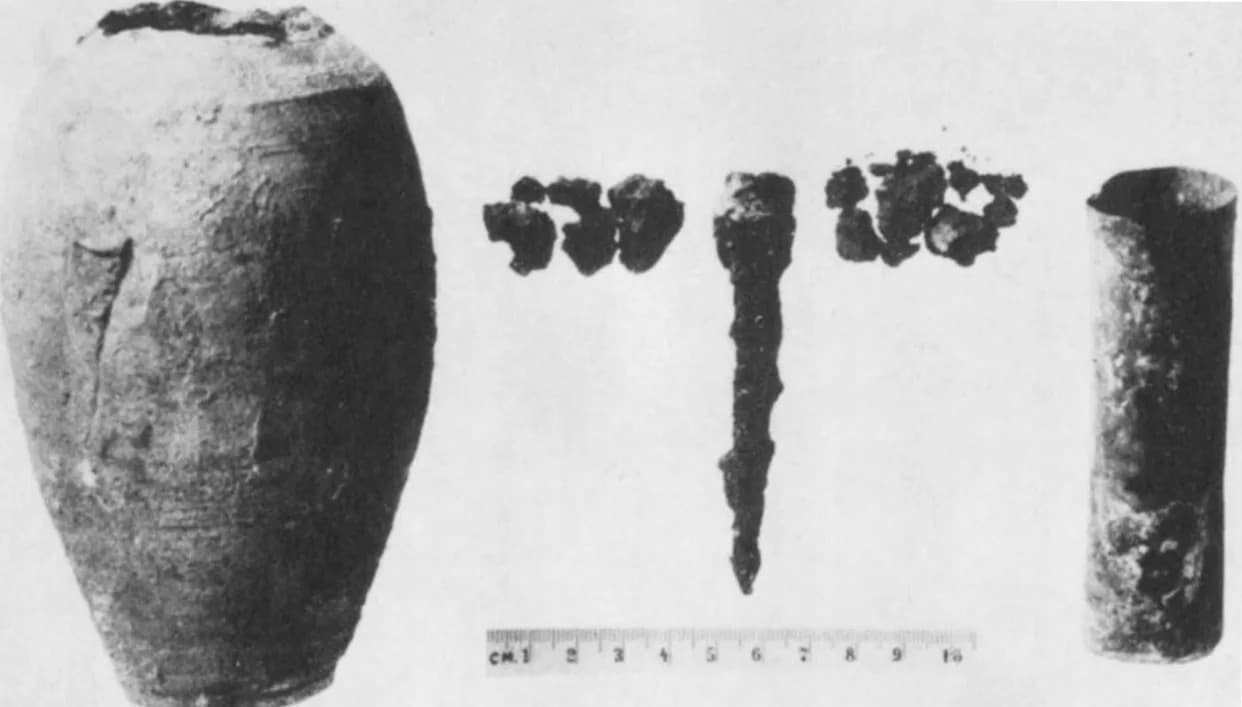
Fragments of a curious artifact recovered in Iraq nearly a century ago have reignited debate over whether ancient people deliberately created a crude electrical device. Commonly called the "Baghdad battery," the find is reconstructed as a clay jar that once housed a copper vessel with an iron rod at its center. Some researchers suggest that this arrangement — whether accidental or intentional — could have acted like a simple galvanic cell, centuries before Alessandro Volta formalized the concept in the West.
New Reconstruction, Renewed Claims
A recent study highlighted by Chemistry World revisits the battery hypothesis. Independent researcher Alexander Bazes reconstructed the vessel from photographs and descriptions and ran experiments that, he says, produced roughly 1.4 volts — about the voltage of a modern AA cell. Bazes proposes the jar's porous clay could have acted as a separator between an internal electrolyte (possibly lye) and the outside air, creating an outer cell that worked in series with an inner copper-iron cell.
“If this artefact were truly a battery — and I could be wrong of course — then my experiment shows the most effective and convenient way it could have been used as one,” Bazes told Chemistry World.
What Bazes Does — And Doesn't — Claim
Bazes argues his tests show more power than earlier skeptics assumed, but he stops short of saying the artifact was used for sustained power. He also rejects fringe claims that the copper vessel was intended for electroplating jewelry. Instead, he suggests a ritualized use: placing a folded prayer inside the jar and watching it corrode could have been perceived as visible evidence that an "energetic influence" passed through the text.
Skeptics And Ritual Context
Not all specialists accept the battery interpretation. University of Pennsylvania archaeologist William Hafford, who has studied the object and related finds, argues the jars were likely ritual containers for prayers (often sealed with bitumen and buried). He notes nearby discoveries, including a similar jar containing ten copper vessels — far too many to function as a conventional battery — and suggests the iron pieces may simply have been nails used in ritual practice rather than electrodes.
“You would drop the prayer through the neck of the jar, seal it with bitumen and then bury it with a ritual,” Hafford told Chemistry World. “They were usually buried in the ground because you were giving them to the chthonic deities.”
Limitations And Open Questions
Interpretation is hampered by the fact the original artifact has been missing since the 2003 U.S. invasion of Iraq; reconstructions rely on photos, descriptions and fragmentary records. Even if Bazes' setup can generate short bursts of voltage, questions remain about the device's durability, practical uses, and whether people of the time would have recognized or intentionally exploited electrochemical effects.
In short, the ‘‘Baghdad battery’’ remains an intriguing puzzle at the intersection of experimental archaeology and ritual history. The new experiments reopen the possibility of an electrical explanation, but the ritual-container interpretation continues to offer a strong, context-driven alternative.
Help us improve.