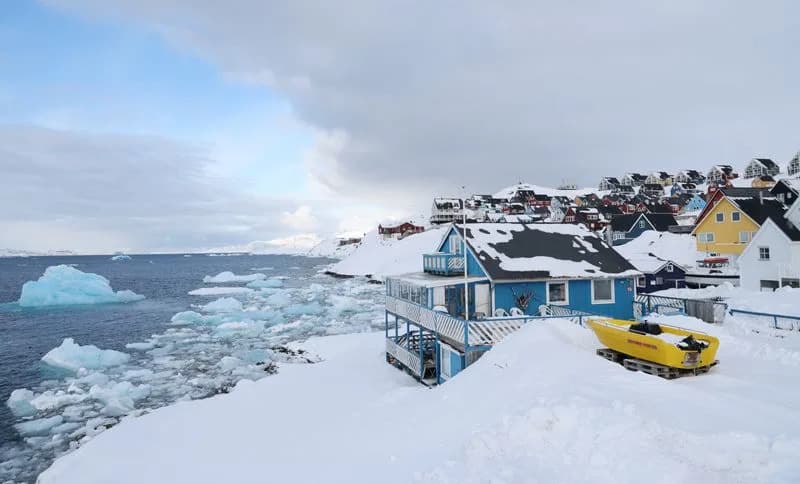
President Trump’s Davos speech included several misleading claims about NATO and Greenland. NATO invoked Article 5 after the September 11, 2001 attacks and allied countries joined U.S. forces in Afghanistan, contradicting the claim that the alliance gave the U.S. “nothing.” Data show the U.S. accounted for roughly 63% of NATO defense spending in 2024 (about 72% in 2016) and provided roughly 16% of NATO’s administrative budget in 2025. The NATO 2% benchmark measures national defense spending and was revised in 2025 to 3.5% for core defense plus an additional 1.5% for broader security costs.
Fact Check: Trump’s False Claims at Davos — NATO, Greenland and the Numbers
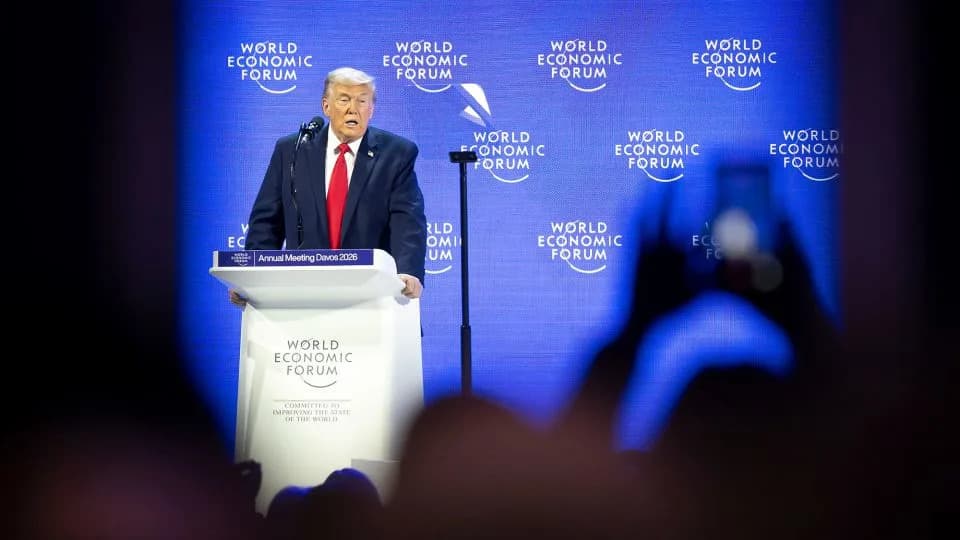
President Donald Trump speaks during the 56th annual meeting of the World Economic Forum, WEF, in Davos, Switzerland, Wednesday, Jan. 21, 2026. - Laurent Gillieron/Keystone/AP
President Donald Trump’s remarks at the World Economic Forum in Davos included multiple inaccurate and misleading statements — most notably about NATO and Greenland. This fact check reviews his key claims about what the U.S. gets from NATO, how NATO spending works, and his long‑running suggestion that the United States should acquire Greenland.
What Trump Said About NATO Benefits
Trump said: “So what we have gotten out of NATO is nothing, except to protect Europe from the Soviet Union and now Russia. I mean, we’ve helped them for so many years. We’ve never gotten anything.” That characterization is incorrect. NATO has delivered tangible military, political and strategic benefits to the United States. Most notably, NATO invoked Article 5 — the alliance’s collective defense clause — after the al Qaeda terrorist attacks of September 11, 2001. Member countries formed a coalition to fight in Afghanistan alongside U.S. forces, and many NATO partners sustained casualties during that campaign; Denmark, for example, lost more than 40 service members, one of the alliance’s highest per‑capita losses.
How Much the U.S. “Pays” for NATO
Trump repeated the long‑standing claim that, before his presidency, the United States paid for “virtually 100%” of NATO. That is not supported by the data. NATO figures show U.S. defense spending accounted for about 63% of total NATO defense expenditure in 2024 and about 72% in 2016 (the year before Trump’s first term began). Those shares are large but far from 100%.
Separately, NATO’s civilian (administrative) budget is shared under a cost‑share formula: the U.S. provided roughly 16% of that budget in 2025 and about 22% in 2017. Those numbers reflect contributions to the alliance’s own operating budget, not the total military spending of member states.
“Paying Their Bills” and the 2% Guideline
Trump has often framed NATO’s defense guideline as if allies owed money to the United States. The alliance’s 2% target refers to each member’s domestic defense spending as a share of gross domestic product; it does not create invoices owed to the U.S. All NATO members were spending money on defense before Trump’s return to office — non‑U.S. NATO members spent about $292 billion in 2016 and an estimated $482 billion in 2024, according to NATO figures.
While many allies were slow to meet the 2% guideline, the trend has been upward: four NATO members met the 2% target in 2016, eight did so in 2020, and by 2024 a majority (18 of the 31 countries subject to the guideline) were at or above 2%.
Changes To The Guideline
In 2025 NATO revised its spending framework: the alliance raised the benchmark for “core” defense spending to 3.5% of GDP and added an additional 1.5% target to cover a broader array of security‑related expenditures that the original 2% metric did not explicitly include.
On Greenland
Trump once again referenced Greenland, the self‑governing Danish territory he suggested the United States should buy. The proposal has been widely rejected by Danish and Greenlandic officials; after an earlier 2019 proposal, both governments firmly dismissed the idea as unrealistic and politically unacceptable.
Bottom line: Many of Trump’s Davos statements overstated or misstated facts about NATO’s costs and benefits. NATO has been an operational partner to the United States in wartime, the U.S. share of alliance defense spending is substantial but well below 100%, and the 2% guideline is a domestic‑spending target rather than a bill owed to the United States. The Greenland purchase idea remains politically and diplomatically implausible.
This article will be updated as warranted.
Help us improve.