The US administration's suggestion that Washington might try to acquire Greenland — home to the US-operated Pituffik Space Base — has prompted strong support for Denmark from European capitals and Canada. Analysts warn that any US seizure of Greenland would be unprecedented and would test Article 5, which requires unanimous agreement to invoke collective defence. Historically, NATO has faced several near-conflicts between members — the Cod Wars, the 1974 Cyprus crisis and the 1995 Turbot War among them — and has survived deep political rifts over Suez, Vietnam, Kosovo, Iraq and Libya. Greenland now represents a fresh stress-test for alliance unity.
Greenland and NATO: How Close Have Allies Come To Fighting Each Other?

INTERACTIVE-Where is Greenland basic history-1766595219
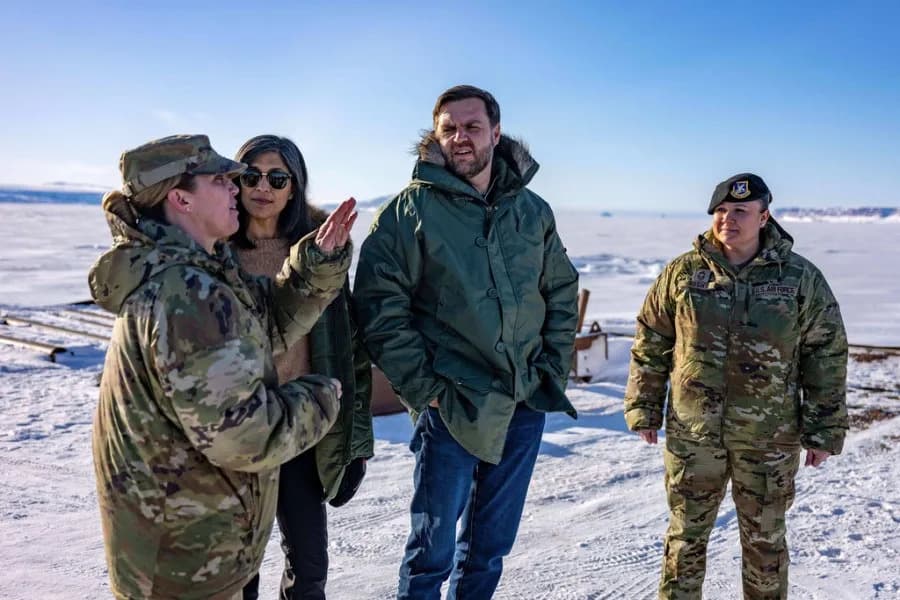
The Trump administration's renewed suggestion that the United States might acquire or even use military force to secure Greenland — a semi-autonomous territory of Denmark that hosts the US-operated Pituffik Space Base — reignited questions about NATO unity and the practical limits of the alliance's collective-defence pledge.
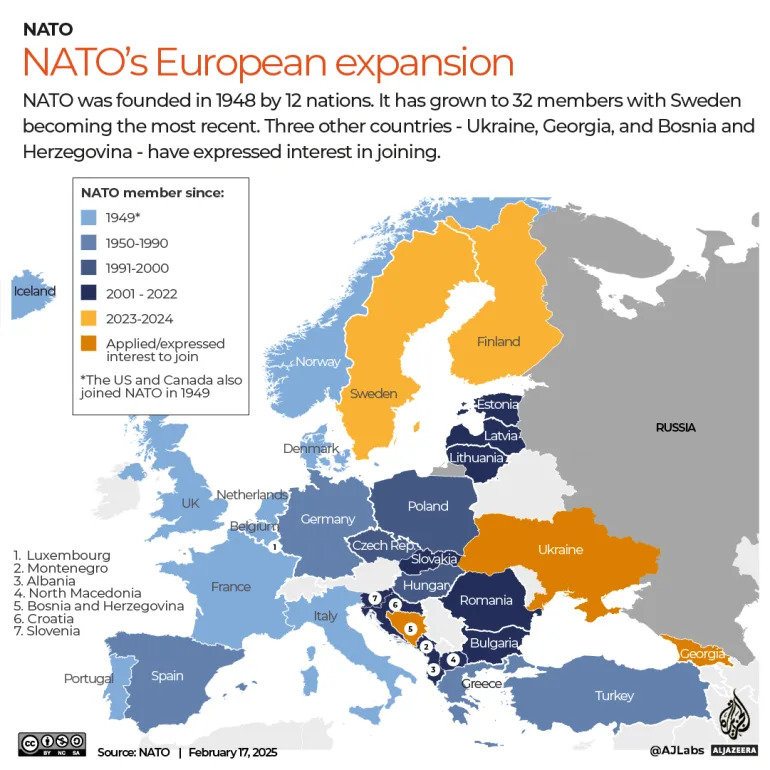
[Al Jazeera]
Both Denmark and the United States are founding NATO members. European capitals and Canada quickly rallied around Copenhagen, warning that any attempt to seize Greenland would be unprecedented and would pose serious legal and political problems for the alliance. Analysts note that such a dispute would test Article 5, the treaty clause that treats an armed attack on one member as an attack on all.
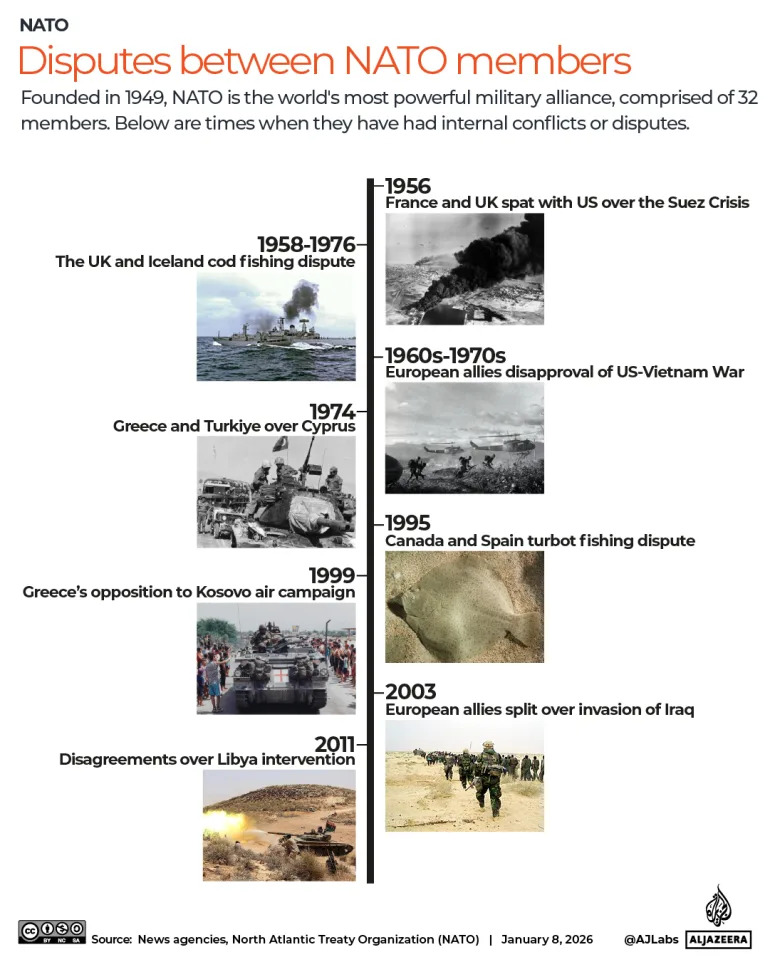
(Al Jazeera)
Article 5 requires unanimous consent to be invoked. That unanimity is central to NATO solidarity but also creates a dilemma: if two members are in conflict, the alliance cannot realistically vote to go to war with itself. To date, Article 5 has been invoked only once — after the 11 September 2001 attacks on the United States.
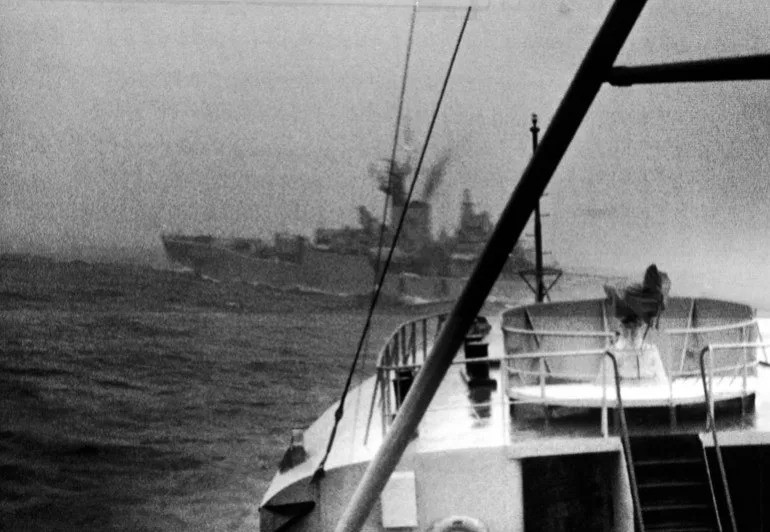
Royal Navy frigate HMS Brighton criss-crosses in front of gunboat Thor off the coast of Iceland during an incident where Thor cut the trawling wires of a British trawler, which occurred during a dispute known as the ‘Cod Wars’. Date unknown [AP Photo]
Close Calls Inside NATO: A Historical Timeline
1958–1976 — The Cod Wars (UK and Iceland)
The Cod Wars were a sequence of fisheries disputes between the United Kingdom and Iceland over North Atlantic fishing rights. The confrontations included naval manoeuvres, ramming incidents and tense diplomacy. Concern in NATO and Washington about losing the Keflavik airbase — vital for tracking Soviet submarines — helped push a diplomatic resolution in 1976, when Iceland secured a 200-mile maritime limit that later influenced the global standard.
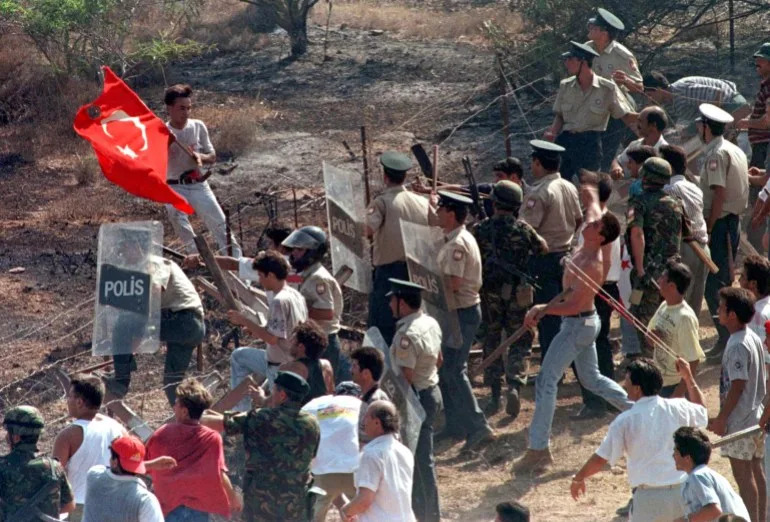
Turkish Cypriots hurling stones against Greek Cypriots entering the buffer zone in Derinya, while the Turkish Cypriot police using shields try to stop them during a clash between Turkish and Greek Cypriots [Reuters]
1974 — Cyprus Crisis (Greece and Turkey)
Turkey's 1974 intervention in Cyprus, following a Greek-backed coup on the island, brought Greece and Turkey perilously close to direct conflict. In protest at NATO's handling of the crisis, Greece withdrew from NATO's integrated military command from 1974 to 1980. During the Cold War the alliance managed to prevent a full-scale war between the two strategically important members.

Turbot is a flatfish known for its delicate flavour and firm white flesh, often considered a culinary delicacy [File: Bas Czerwinski/AP Photo]
1995 — The Turbot War (Canada and Spain)
Canada imposed enforcement measures to protect depleted fish stocks, prompting clashes with Spanish fishing vessels outside Canada's exclusive economic zone. After Canadian authorities fired warning shots and detained a vessel's crew, Spain deployed naval patrols and Canada authorised force against persistent trespassers — a confrontation that risked pitting NATO members against each other until EU mediation produced a joint regulatory solution.
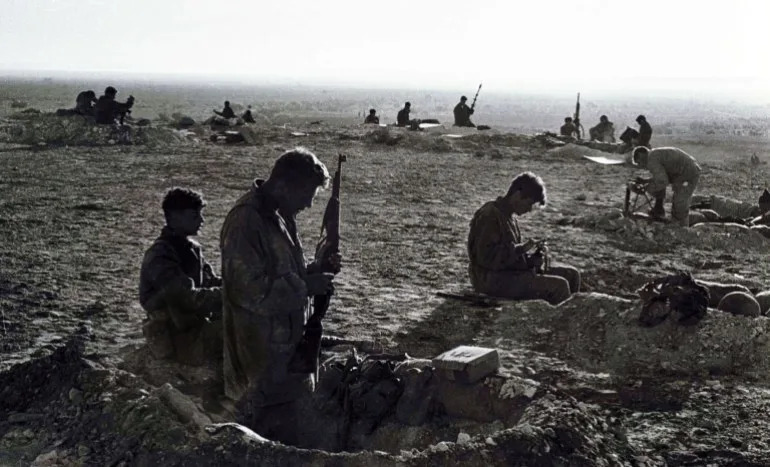
Israeli soldiers in foxholes as they clean their light weapons at a base at the Milta Pass during Operation Kadesh in the 1956 Middle East war. In October 1956, Israel, under continued cross-border commando raids from Egypt, crossed into the Sinai in an audacious plan to take control of the Suez Canal with France and the UK [Reuters]
1956 — Suez Crisis (Britain, France and the United States)
When Britain and France secretly coordinated with Israel to invade Egypt after the nationalisation of the Suez Canal, the operation caused a severe rift with the United States, which opposed the intervention and feared wider Soviet involvement. The crisis was ultimately resolved through UN diplomacy and the creation of the United Nations Emergency Force, an early model for UN peacekeeping.
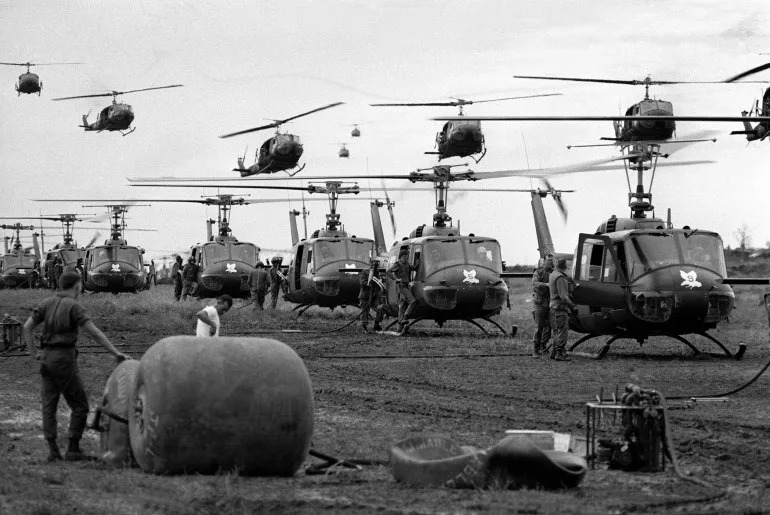
US Huey helicopters fly in formation over a landing zone in South Vietnam during the Vietnam War, date unknown [AP Photo]
1960s–1970s — Vietnam War (US and European Allies)
The Vietnam War produced deep transatlantic disagreements. Several European NATO members rejected US calls for direct military engagement; France publicly condemned the war and left NATO’s integrated military command in 1966 (rejoining the command structure decades later). The dispute kept NATO out of the conflict and contributed to organisational changes within the alliance.
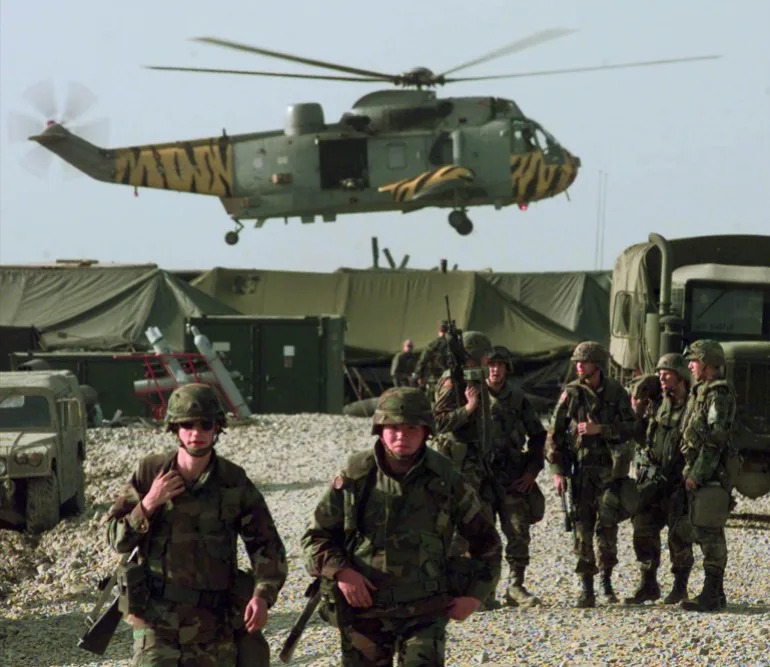
A British military helicopter, painted with tiger stripes, lands near the US Army camp at the Tirana, Albania airbase, Friday, April 30, 1999 [Reuters]
1999 — Kosovo Campaign (Greece's Opposition)
During NATO's air campaign against Yugoslavia in 1999, Greece objected on cultural and religious grounds, even seeing protesters block British troops transiting the country. Athens called for a halt to the bombing, underscoring political divisions within NATO over regional interventions.
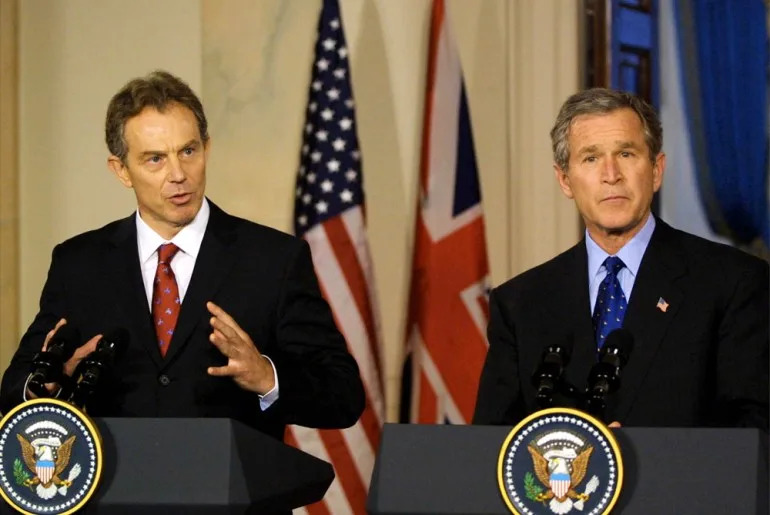
British Prime Minister Tony Blair addresses the media as US President George W Bush listens at the White House, January 31, 2003 in Washington, DC [Brad Markel-Pool/Getty Images]
2003 — The Iraq Rift
The US-led invasion of Iraq deepened splits with several European allies. France, Germany and Belgium rejected the US case for immediate military action, and the invasion proceeded largely under a "Coalition of the Willing" rather than NATO, leaving Article 5 uninvoked and straining transatlantic relations.
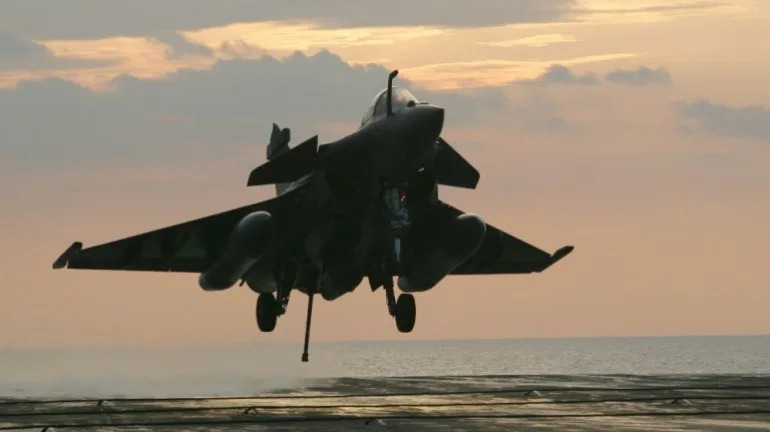
A French Navy Rafale jet fighter prepares to land on the Charles de Gaulle aircraft carrier on April 20, 2011, in the Mediterranean Sea, as part of the military operations of the Nato coalition in Libya [Alexander Klein/AFP/Getty Images]
2011 — Libya Intervention
In 2011 NATO members disagreed over command, scope and political goals of the intervention in Libya. Germany and Poland opposed military action; Italy and Turkey voiced reservations about leadership and mission creep. Deliberations delayed NATO's formal assumption of command of the air campaign for nearly two weeks after strikes began.
More Recent Strains
NATO has also faced disputes over Afghanistan, deployments in Eastern Europe after the Russia–Ukraine war, defence spending shortfalls and missile-defence plans. Despite recurrent tensions and public disagreements, the alliance has held together.
Why Greenland Matters
A US attempt to acquire or forcibly take Greenland would be without modern precedent among NATO allies and would raise questions about sovereignty, alliance law and whether Article 5 could be applied or weaponised in intra-alliance disputes. Greenland's strategic Arctic position and the presence of the Pituffik facility make the island geopolitically significant — and politically sensitive within a treaty alliance that relies on mutual trust and unanimous decisions.
Bottom line: NATO has survived major political rifts and several near-misses between members, but Greenland poses a unique test of whether the alliance can manage a dispute that directly pits two member states' interests against each other.
Help us improve.