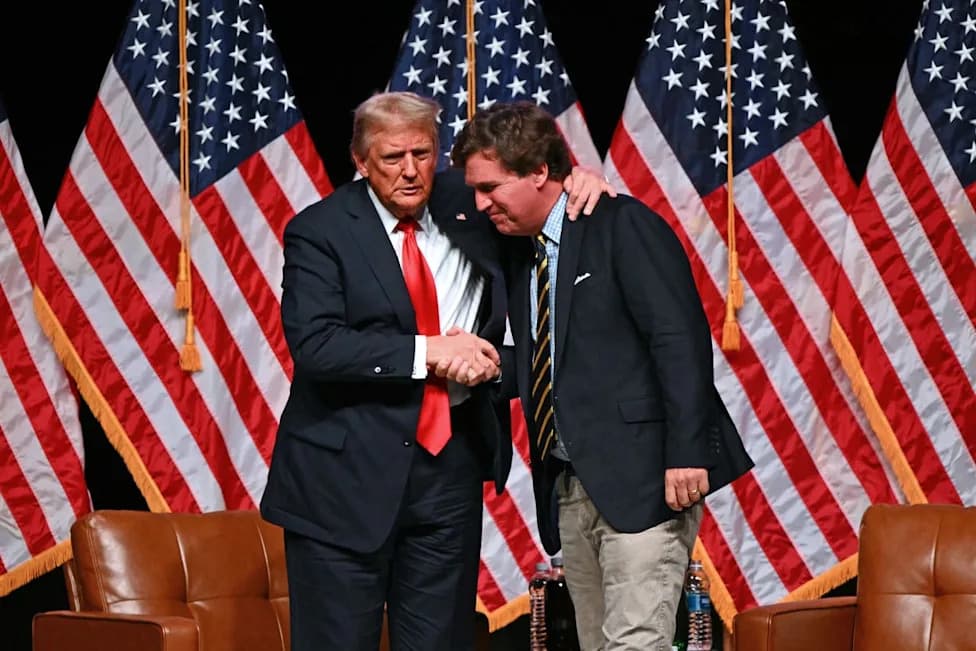
Tucker Carlson suggested in a recent newsletter that an Iranian nuclear capability might paradoxically stabilize the region, comparing the idea to North Korea’s deterrent effect on the Korean Peninsula. Carlson argued a bomb could deter U.S. intervention and alter Israeli calculations, comments that followed reports of violent suppression of protesters in Iran. Senator Ted Cruz sharply rebuked Carlson online, calling the argument "unbelievable" and mocking him. The exchange has revived debates about deterrence, proliferation risks, and media influence on foreign‑policy discussion.
Ted Cruz Calls Tucker Carlson 'Unbelievable' After Carlson Suggests An Iranian Nuclear Weapon Might Be 'A Good Thing'

Tucker Carlson Torches Ted Cruz in Bible, Israel Debate
Controversial conservative commentator Tucker Carlson sparked a new wave of debate this week after arguing in a newsletter that an Iranian nuclear capability might not be wholly negative. Carlson—who has reportedly visited the White House twice in recent days—has in recent months taken positions and hosted guests that increasingly depart from mainstream GOP foreign‑policy stances, sharpening his criticism of President Donald Trump’s approach to international affairs and of Israeli influence in the Middle East.
In Tuesday’s newsletter, Carlson asked rhetorically about the probability that Iran would actually use a nuclear weapon and leaned on historical examples to minimize that risk. He wrote:
"What are the chances Iran would actually launch a nuclear attack? History suggests they’re zero, no matter what Senator Graham says. No country in the so‑called ‘Axis of Evil’ has ever deployed a nuke, because doing so would be an act of suicide. In fact, the United States is the only nation to unleash its nuclear might as an act of war. It’s strange how Washington considers that a point of pride."
Carlson—writing amid reports that Iran’s security forces had violently suppressed pro‑democracy protesters earlier this month—posed a series of hypotheticals about whether nuclearization could paradoxically stabilize the region. He compared a potential Iranian deterrent to North Korea’s nuclear arsenal, arguing that Pyongyang’s capabilities have arguably helped prevent full‑scale wars or externally imposed regime changes on the Korean Peninsula since 2006.
He went on to ask whether an Iranian nuclear capability might deter U.S. intervention, reduce Israeli incentives to pursue territorial control in Gaza and the West Bank, or even lessen pressure on Iran’s rulers by removing the perceived threat of foreign “decapitation” efforts.
The column spread quickly online and drew immediate criticism from Sen. Ted Cruz (R‑TX). Cruz posted on social media: "Unbelievable. Now @TuckerCarlson is arguing it would be 'a GOOD thing' if the Ayatollah had a nuclear weapon." He also mocked Carlson with a derisive nickname, underscoring the pair’s long history of public clashes that date back to Carlson’s on‑air rebukes of the senator while at Fox News.
Wider Debate
The exchange reopened broader debates among conservatives and foreign‑policy commentators about the role of nuclear deterrence, the risk calculus of proliferation, and the influence media personalities have on public discussion of national security. Supporters of Carlson’s thought experiment argued it underscores the complexities of deterrence theory; critics said it dangerously normalizes the idea of authoritarian states acquiring the world’s most destructive weapons.
Originally published on Mediaite, the episode highlights how provocative commentary from high‑profile media figures can quickly shape political discourse and intensify divisions within a movement already split over the direction of U.S. foreign policy.
Help us improve.