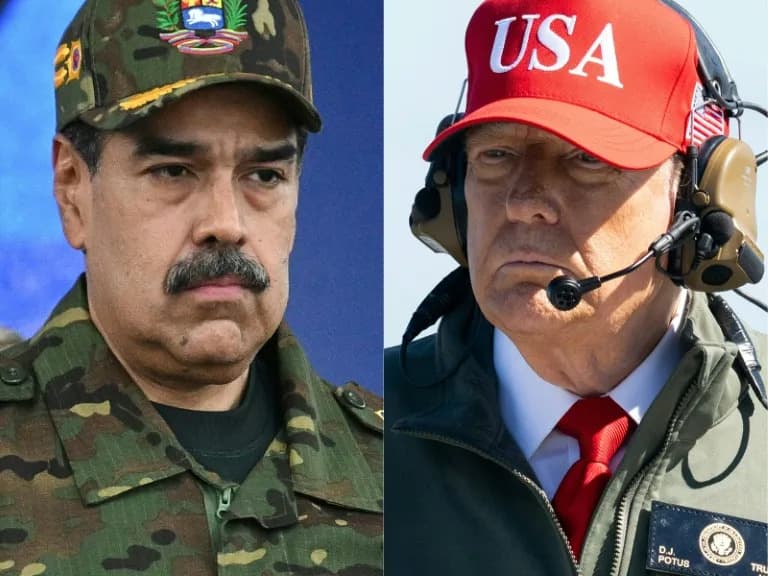
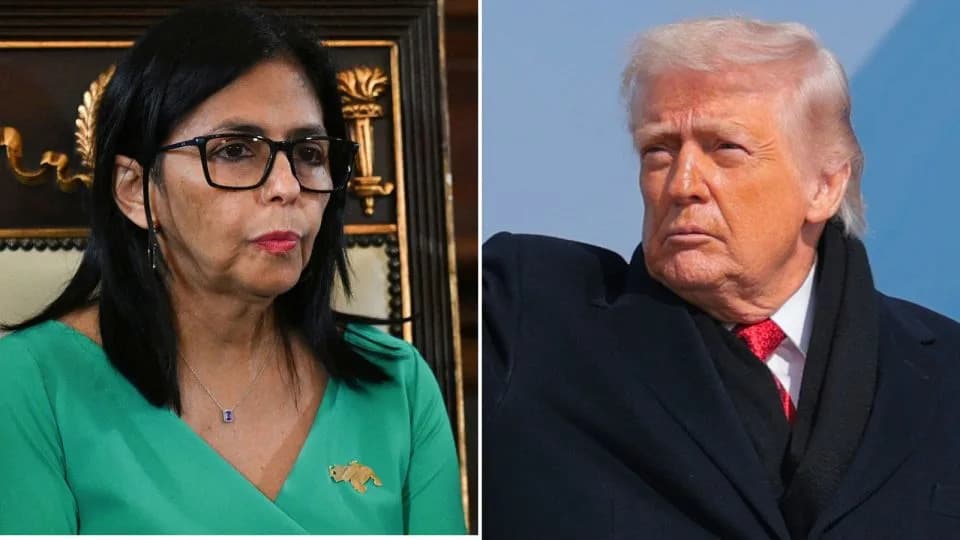
Reuters reports that U.S. officials held months of contact with Venezuela's interior minister Diosdado Cabello before a Jan. 3 operation that removed President Nicolás Maduro. Sources say Washington warned Cabello against using security forces or pro-government militias against the opposition and discussed sanctions and the indictment he faces. Cabello — long seen as an influential Maduro loyalist with ties to the military and colectivos — was not arrested; U.S. officials fear he could either stabilize or destabilize interim President Delcy Rodríguez's government.
Exclusive: U.S. Held Months-Long Contacts With Hardline Venezuelan Minister Cabello Before Raid

FILE PHOTO: Venezuela's interim President Delcy Rodriguez walks with Venezuela's National Assembly President Jorge Rodriguez and Venezuela's Interior Minister Diosdado Cabello before attending a press conference, more than a week after the U.S. launched a strike on the country and captured President Nicolas Maduro and his wife Cilia Flores, at Miraflores Palace in Caracas, Venezuela, January 14, 2026. REUTERS/Leonardo Fernandez Viloria/File Photo
Reuters reporters Erin Banco, Sarah Kinosian and Matt Spetalnick report that senior U.S. officials maintained months-long communications with Venezuela's powerful interior minister, Diosdado Cabello, in the run-up to the U.S. operation that removed President Nicolás Maduro on Jan. 3. Multiple sources said those contacts continued in the weeks before the raid and have persisted since Maduro's ouster.
U.S. Warnings to Cabello
According to four sources familiar with the matter, U.S. officials warned Cabello, 62, not to deploy the security services, intelligence agencies or pro-government militias under his influence against the political opposition. That security apparatus — which includes intelligence, police and military elements and pro-government colectivos — largely remained intact after the operation.
Scope and Purpose of Communications
Two sources said the exchanges dated back to the early days of the Trump administration and included discussions of U.S. sanctions on Cabello and the indictment he faces in a U.S. drug-trafficking case. Four people familiar with the matter said Washington has stayed in touch with Cabello since Maduro's removal. All sources spoke on condition of anonymity to discuss sensitive internal communications.
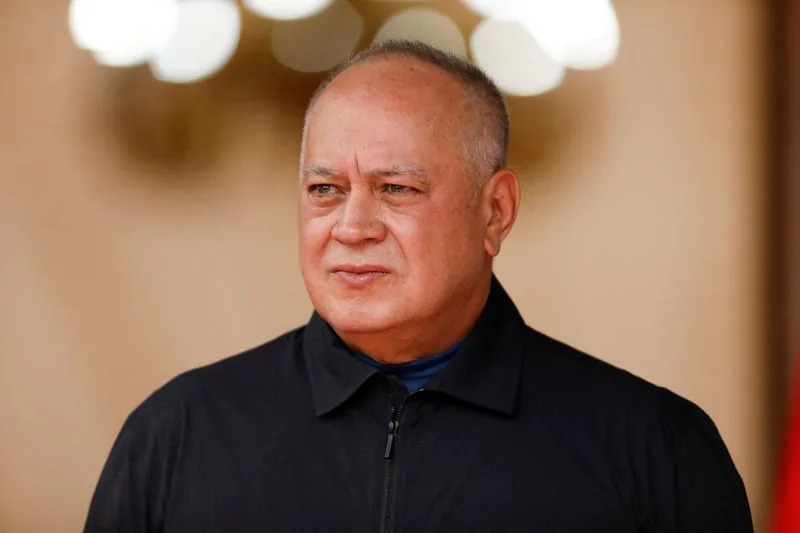
FILE PHOTO: Venezuela's Interior Minister Diosdado Cabello attends a press conference, more than a week after the U.S. launched a strike on the country and captured President Nicolas Maduro and his wife Cilia Flores, at Miraflores Palace in Caracas, Venezuela, January 14, 2026. REUTERS/Leonardo Fernandez Viloria/File Photo
Cabello's Influence and the Risk to Stability
Long regarded as Venezuela's second-most powerful figure and a longtime confidant of the late Hugo Chávez, Cabello is widely viewed as a key power broker with influence over military and civilian counterintelligence agencies and close ties to the colectivos — armed civilian groups that have been used to confront protesters. U.S. officials told Reuters they consider Cabello capable of either stabilizing or derailing interim President Delcy Rodríguez's hold on power.
Sanctions, Indictment and the Bounty
Cabello is named in the same U.S. drug-trafficking indictment that the U.S. cited in justifying Maduro's arrest, though Cabello was not detained during the operation. In 2020 the U.S. offered a $10 million reward for information on Cabello and charged him as a central figure in the so-called "Cartel de los Soles"; that bounty was later raised to $25 million. Cabello has publicly denied involvement in drug trafficking.
Domestic Politics and International Reaction
While interim President Rodríguez is seen by U.S. officials as the linchpin of post-Maduro governance, sources warn her rivalry with Cabello could spark internal conflict. Rodríguez has been installing loyalists in key posts and signaling cooperation to boost oil output. After the story published, Venezuela's government issued a statement denying any secret talks intended to divide the country's leadership. The White House did not respond to Reuters' request for comment.
Elliott Abrams, former U.S. special representative on Venezuela, told Reuters, "If and when he goes, Venezuelans will know that the regime has really begun to change."
(Reporting by Erin Banco in New York, Sarah Kinosian in Miami and Matt Spetalnick in Washington; Editing by Don Durfee, Rosalba O'Brien and Paul Simao)
Help us improve.