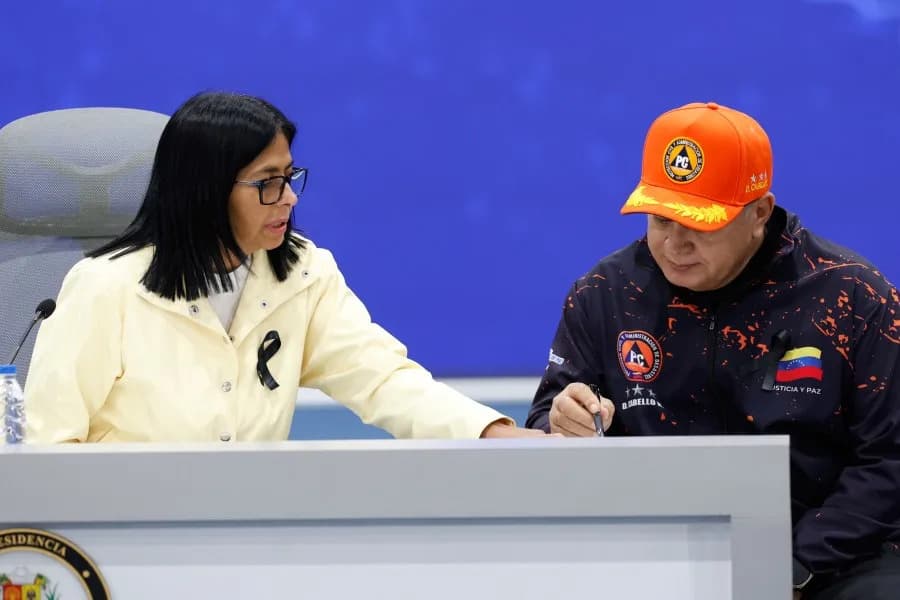
Diosdado Cabello is a longtime ally of Hugo Chávez and Nicolás Maduro who heads Venezuela’s internal security apparatus and influences paramilitary groups such as the Bolivarian Militia and colectivos. He rose from a 1992 coup participant to high ministerial roles and played a key role in restoring Chávez during the 2002 coup attempt. A 2024 UN human rights mission accused him of directing crackdowns, and he faces U.S. drug-trafficking indictments that Maduro’s government calls politically motivated. Cabello’s control over armed networks makes him a pivotal figure in Venezuela’s political and security landscape.
Diosdado Cabello: The Power Broker Behind Venezuela’s Internal Security

Cabello gives a V sign for victory as he marches in the rally for Maduro and Flores in Caracas on January 6, 2026 [Federico Parra/AFP]
Among thousands who protested in Caracas after the reported weekend abduction of President Nicolás Maduro, one figure drew particular attention: Interior, Justice and Peace Minister Diosdado Cabello. Wearing a blue cap reading “To doubt is to betray,” Cabello marched with demonstrators and later addressed the crowd beneath a large portrait of Maduro and his wife, Cilia Flores.
Who Is Diosdado Cabello?
Born in El Furrial, Monagas State, Cabello trained as an engineer and earned a graduate degree from Andrés Bello University. He rose through the ranks during Hugo Chávez’s presidency (1999–2013), serving as chief of staff and in several ministerial posts overseeing interior and justice, infrastructure and public works.
Early Military and Political Career
As a young officer, Cabello joined Chávez’s February 1992 coup attempt against President Carlos Andrés Pérez and spent two years in prison after its failure. After Chávez’s return to power, Cabello helped organize pro-Chávez grassroots groups known as Bolivarian Circles and later played a pivotal role during the brief April 2002 coup, ordering naval units to free Chávez and helping restore him to the presidency within hours.
Power and Influence
Over the past decade Cabello has consolidated significant influence in Venezuela’s ruling circle. He has been described by some analysts as one of the country’s most powerful figures, exerting control over the internal security apparatus and civilian armed groups while holding key government positions.
Control of Paramilitary Forces
As interior minister, Cabello oversees the Bolivarian Militia—a mass reserve force created under Chávez—and exerts influence over local armed groups called colectivos. These colectivos, often masked and heavily armed, have patrolled urban neighborhoods and at times acted in tandem with state security forces under the government’s “Civil-Military Union” model.
Accusations of Repression and Legal Troubles
An independent United Nations human rights mission reported in 2024 that Cabello has directed crackdowns on dissent, including a 2017 operation known as Operation Tun Tun, which involved arrests following door knocks. The UN team also documented coordinated actions in which colectivos and security forces suppressed protests and, at times, fired warning shots without apparent restraint.
Cabello, alongside President Maduro and former interior minister Ramón Rodríguez Chacín, also faces drug-trafficking indictments brought by the U.S. Department of Justice, which alleges long-running involvement by Venezuelan officials in the cocaine trade. Maduro and his allies have dismissed those charges as politically motivated and framed them as part of an alleged imperialist threat tied to Venezuela’s oil resources.
Military Balance and Strategic Significance
The episode in which U.S. special forces were alleged to have seized Maduro and Cilia Flores—if confirmed—highlighted the stark imbalance between U.S. and Venezuelan conventional military capabilities. The United States fields well over a million active-duty personnel and thousands of aircraft and advanced weapons systems, whereas Venezuela’s formal armed forces are far smaller.
That imbalance, however, does not eliminate the strategic importance of paramilitary networks under Cabello’s influence: Venezuela reportedly maintains hundreds of thousands of militia and paramilitary personnel—forces that could challenge or complicate any foreign ground operation.
Why Cabello Matters
Cabello’s combination of political standing, control over internal security structures and ties to armed civilian groups make him a central—and controversial—figure in contemporary Venezuelan politics. Whether viewed as a stabilizing enforcer for the Maduro government or as an architect of repression depends on one’s perspective and political stance.
Bottom line: Diosdado Cabello is a longstanding Chávez-Maduro ally whose reach across Venezuela’s security and political apparatus makes him one of the country’s most consequential power brokers.
Help us improve.