In the early hours after Venezuelan President Nicolás Maduro was seized and taken to the United States, video surfaced showing Interior Minister Diosdado Cabello wearing a helmet and bulletproof vest and flanked by armed men in Caracas. The footage, filmed while the sky was still dark, recorded the sound of drones overhead.
In the video Cabello denounced Maduro’s capture as “a criminal, terrorist attack against our people” and urged citizens to remain calm. “Trust our leadership. Trust in our military and political leaders during the situation we’re facing,” he said.
Allegations and U.S. Actions
U.S. authorities that same morning unsealed a superseding indictment accusing Maduro and others of drug trafficking and related crimes. Cabello’s name appears second on the indictment, directly after Maduro’s, making him the most prominent Venezuelan official named now that Maduro is in U.S. custody.
Washington has targeted Cabello for years. The U.S. Treasury sanctioned him, his wife and his brother in 2018 for alleged narcotics trafficking. In 2020 U.S. prosecutors returned an indictment and initially placed a $10 million reward for information leading to his arrest; that bounty has since been increased to $25 million. U.S. authorities allege Cabello is linked to the so-called “Cartel de los Soles,” an alleged drug-trafficking network involving officials within Venezuela’s security services. Cabello has repeatedly denied these accusations, calling them a "big lie."
Power, Background and Public Profile
At 62, Cabello is one of the last senior figures from Hugo Chávez’s inner circle. A committed chavista, he took part in Chávez’s failed 1992 coup attempt and later helped build the movement that brought Chávez to power. He served as vice president under Chávez and briefly assumed the presidency for a few hours during the 2002 unrest before allowing Chávez to return to office.
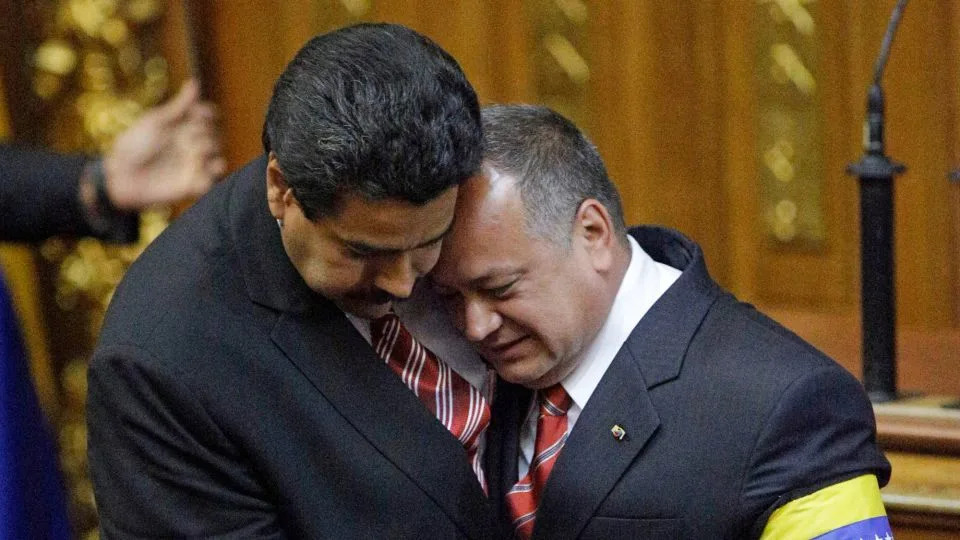
In this image from March 8, 2013, President Nicolás Maduro, left, embraces National Assembly President Diosdado Cabello after Maduro was sworn in as Venezuela’s acting president at the National Assembly in Caracas, Venezuela. - Fernando Llano/AP
Appointed interior minister in 2024, Cabello oversees Venezuela’s domestic security apparatus and commands state-aligned militias. Rights groups have accused his ministry of participating in a campaign of repression as tensions with the United States rose in late 2025, including allegations of political kidnappings and enforced disappearances. In November, Ámbar Castillo publicly blamed Cabello after her daughter Samanta disappeared following a police detention; Castillo said, “I hold Diosdado Cabello, the minister of interior and justice, responsible for the persecution our family is facing.”
Cabello also cultivates a strong public persona. After Chávez’s death in 2013, he launched a weekly television program, Con el Mazo Dando (literally, “Hitting It With the Club”), in which he mixes long monologues, political gossip and denunciations of opponents in front of a live studio audience. Human rights organizations say the show has been used as an instrument of intimidation; Amnesty International criticized Cabello in July 2025 for announcing the arrest of a journalist on air and has previously accused him of harassing activists via the program.
Analysts’ View: A Precarious Position
“There’s essentially three centers of power in Venezuela right now,” said Brian Fonseca, a professor at Florida International University. “You have the Maduro center of gravity, which acting president Delcy Rodríguez represents. You have Vladimir Padrino López, who is minister of defense. The third, arguably the most important, is Diosdado Cabello.”
With Maduro in U.S. custody, analysts say Cabello is one of the regime’s most influential remaining figures because of his control over internal security forces and militias. But that influence may not protect him from heavy sanctions, indictments and the new reality signaled by Maduro’s capture.
“Cabello is in survival mode,” Fonseca said. “If the Americans can go in and capture Maduro, that’s a message to Cabello, Rodríguez and Padrino: No one is untouchable.”
Fonseca argued that Cabello’s history of hardline anti‑U.S. rhetoric, combined with existing legal exposure, limits his options in negotiations with Washington. “He’s either going to moderate, or he’s gone,” Fonseca said. “He’s spent his entire life in opposition to the United States. That’s really hard to back away from. I think his best chances are exile, or jail, or he fights to the death.”
Note: Allegations of drug trafficking and human rights abuses remain accusations in court or before international bodies; Cabello has denied wrongdoing. CNN’s Germán Padinger contributed to this report.