The UCLA study found that dark-eyed juncos nesting on campus developed longer beaks during the Covid-19 pandemic—when dining halls closed and human food scraps became scarce—and then reverted to shorter, urban-adapted bills after students returned. Researchers Pamela Yeh and Eleanor Diamant documented sharp, year-by-year shifts and argue the pattern may reflect rapid natural selection driven by changing food resources. The team is now analyzing genetic samples to test whether allele frequencies changed; independent experts note the finding highlights how quickly wildlife can respond to human-driven environmental change.
College Juncos' Beaks Shifted During the Pandemic — A Possible Case Of Rapid Evolution
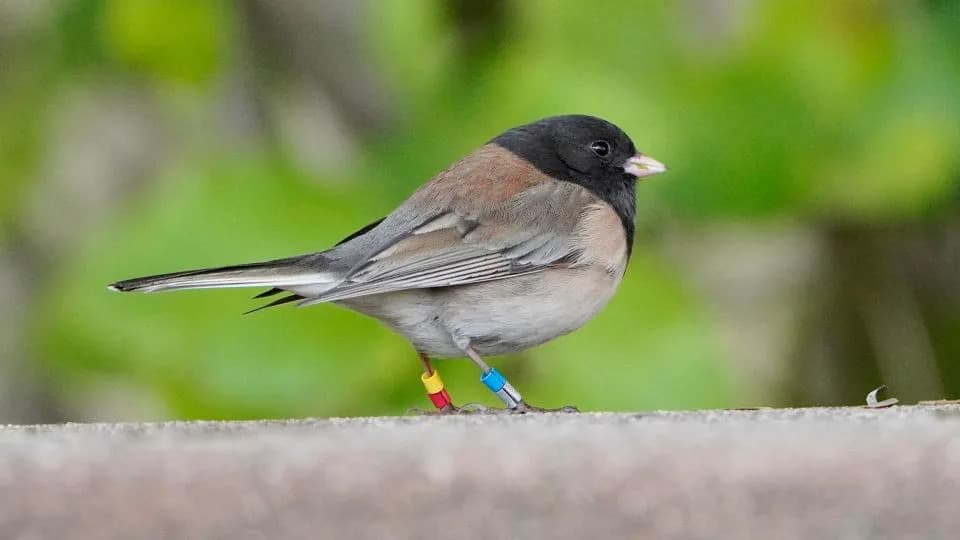
Research suggests that the dark-eyed junco songbird experienced rapid evolution while college campuses were shuttered during the Covid-19 pandemic. - Sierra Glassman
Dark-eyed juncos have been a familiar presence on the University of California, Los Angeles campus for decades, where these songbirds forage among students and staff. Native to mountain forests, this sparrow-family species is not typically urban, but as climate change and habitat shifts have affected their high-elevation ranges, some juncos have taken up residence in Southern California cities and on college grounds such as UCLA.
UCLA researchers found a striking, short-term reversal in beak shape among the campus juncos that coincided with the Covid-19 pandemic. Birds hatched in 2021 and 2022 developed longer beaks—more like their mountain-dwelling counterparts—while birds hatched before the pandemic and again in 2023–2024 exhibited the shorter, stubbier bills typical of the campus population. The team reported the findings in December in the Proceedings of the National Academy of Sciences.
The study, led by Eleanor Diamant and coauthored by Pamela Yeh, suggests that changes in food availability on campus drove rapid selection on beak morphology. Shorter, stubbier beaks may be better suited to an urban diet of human food scraps, while longer beaks are advantageous for picking up seeds and insects in more natural mountain habitats. In 2020, when campus dining halls mostly closed and students left, food scraps became scarce—creating conditions that may have favored longer-beaked nestlings. When students returned and campus food sources resumed, the population shifted back toward shorter bills.
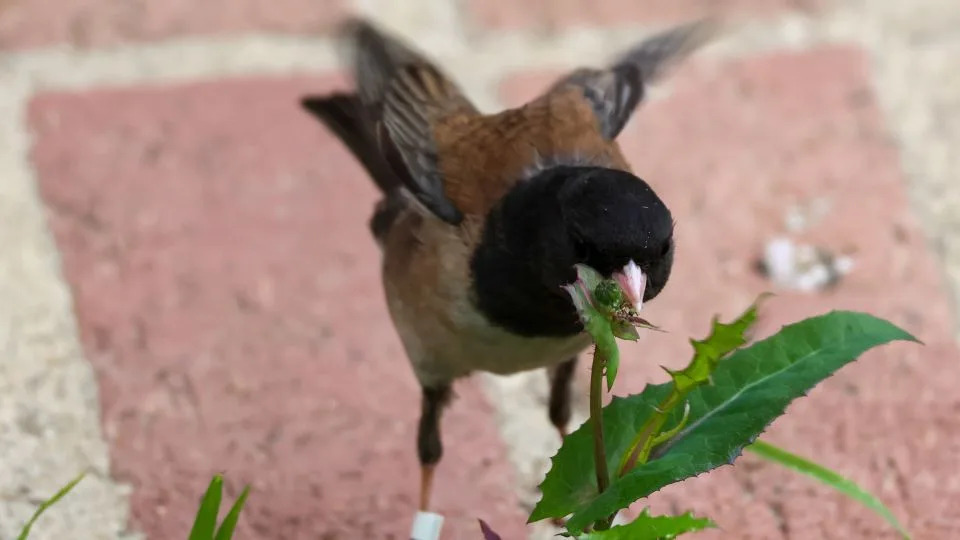
A junco uses its beak to get at greenery on the UCLA campus. - Sierra Glassman
Evidence, Alternatives, and Next Steps
“We often think about evolution as a slow process,” Diamant said, noting how surprised the team was to see such a stark year-by-year change. Yeh, who has studied the UCLA juncos for roughly 30 years, emphasized the broader implication: humans and wildlife are tightly connected, and rapid evolutionary change may be happening in many places we do not yet carefully monitor.
The authors favor natural selection as the primary explanation but acknowledge other possibilities that must be ruled out. Gene flow—an influx of mountain birds into the campus flock—could shift trait averages, though the team argues this is unlikely because other behavioral traits did not change in ways that would suggest a large immigration event. To test whether the beak changes have a genetic basis, the researchers are analyzing DNA from blood samples to see if allele frequencies shifted across the pandemic years.
The results add to a growing number of studies showing rapid morphological responses to human-driven changes. The authors cite earlier work—including a 2017 study on great tits and a 2025 report on hummingbirds—where bird populations evolved longer beaks in response to bird feeders. The UCLA juncos provide a striking example of two rapid pulses of change: into pandemic conditions and then back out as campuses reopened.

Researchers hypothesize that, compared with the longer-beaked mountain-dwelling birds, the shorter beaks on campus birds might be better suited for a diet of human food scraps - Sierra Glassman
“It’s exciting and surprising to see such rapid changes in a familiar bird like the Dark-eyed Junco,” said Ian Owens of Cornell University, who was not involved in the study. “And it’s particularly fascinating to see it happen as a response to a direct human-induced change like the pandemic.”
Why This Matters
Long-term datasets such as the UCLA team’s make discoveries like this possible. Jeff Podos, a behavioral ecologist at the University of Massachusetts Amherst, noted that without sustained monitoring the two quick pulses of change might have gone undetected. Understanding how and when wildlife can rapidly adapt is important for conservation, especially for species experiencing broader population declines.
While human activity has damaged many ecosystems, the campus juncos offer a cautious note of optimism: some populations can respond quickly to altered conditions. As Diamant put it, “If they can do it, and it can surprise us, maybe other organisms can, too.”
Reporting: Taylor Nicioli. The team’s peer-reviewed paper appears in the Proceedings of the National Academy of Sciences. Ongoing genetic analyses will help determine whether the observed morphological shifts reflect changes in allele frequencies consistent with natural selection.
Help us improve.