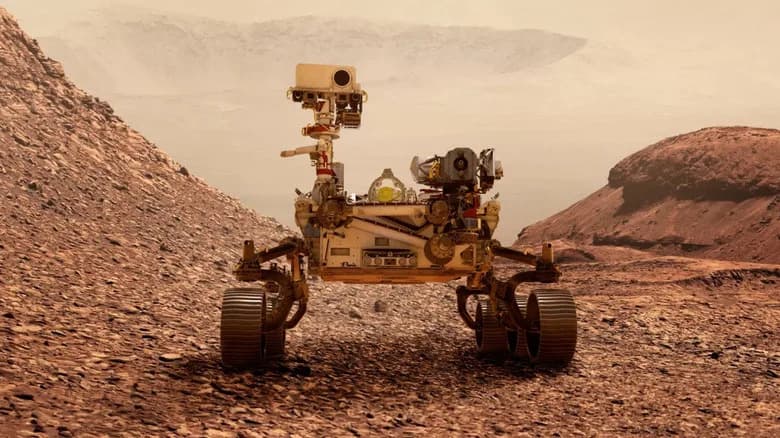
Researchers are conducting a coordinated laboratory campaign to reproduce the unusual speckles and ringed blobs on Cheyava Falls, a mudstone Perseverance found in Jezero Crater. The features — nicknamed “poppy seeds” and “leopard spots” — contain reduced iron and sulfides and are associated with organic material. Because Mars Sample Return is uncertain and samples likely won’t arrive before 2040, JPL scientists will create Mars-like mudstones, sterilize some and inoculate others, then subject them to controlled conditions to test whether life or abiotic chemistry best explains the textures. The results will guide future rover searches and narrow plausible scenarios for ancient Martian chemistry or biology.
Scientists Launch Lab Campaign To Recreate Mars' Cheyava Falls — Testing Whether Its 'Poppy Seeds' And 'Leopard Spots' Came From Life

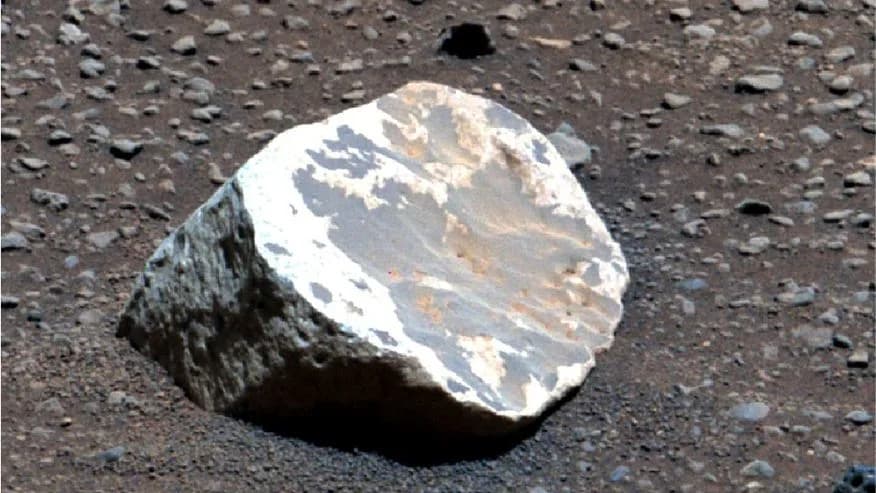
Potentially microbe-made small dark “poppy seed” speckles and larger dark-rimmed “leopard spot” blobs dot the surface of “Cheyava Falls,” one of the most intriguing rocks ever found on Mars.NASA/JPL-Caltech/MSSS
A school-desk-sized slab of mudstone on Mars — dubbed Cheyava Falls — has become one of planetary science's most tantalizing mysteries. Found by NASA's Perseverance rover in Jezero Crater in 2024, the rock formed from fine, water-washed sediments about 3.5 billion years ago and is studded with odd speckles and ringed blobs the team calls “poppy seeds” and “leopard spots.” The outcrop also contains abundant organic material, making its origins especially interesting to astrobiologists.
Why Cheyava Falls Matters
The poppy-seed speckles and leopard-spot blobs are rich in reduced iron (Fe(II)) and, in the spots' case, sulfides. On Earth, similar textures in organic-rich mudstones are sometimes produced by microbes that use redox chemistry to extract energy. But equivalent mineral changes can also arise from nonbiological heating and long-term chemistry. Because both routes can produce the same mineral products, distinguishing a biological origin from an abiotic one is challenging.
Key Minerals And Chemistry
The poppy seeds contain Fe(II) in the mineral vivianite (seen as dark specks), formed when oxidized iron (Fe(III)) picks up electrons. The leopard spots include vivianite rims and interiors of greigite, a mineral that contains Fe(II) plus sulfides produced by reduction of preexisting sulfates. These textures act like a “fossilized chemical reaction” — records of local redox changes preserved in the rock.
Why Not Bring The Rock Back?
Definitive laboratory tests on Earth would be the gold standard, but the NASA-led Mars Sample Return (MSR) campaign is politically uncertain and expensive. Even if MSR proceeds, samples collected by Perseverance — including pieces of Cheyava Falls — likely would not arrive on Earth until around 2040. That long wait motivated an alternate approach.
JPL’s Plan B: Make Mars On Earth
A team convened by NASA's Jet Propulsion Laboratory is launching a systematic laboratory campaign to recreate the seeds and spots in Mars-like mudstones. The plan is to synthesize analog mudstones based on Perseverance measurements, then pursue two parallel pathways:
- Abiotic experiments: Sterilized or uninhabited muds will be subjected to controlled temperatures, pressures and gas mixtures to test whether purely chemical processes can yield the observed minerals and textures.
- Biotic experiments: Other analogs will be inoculated with terrestrial microbes known to reduce iron and sulfate to see whether living communities produce comparable poppy seeds and leopard spots under Mars-like conditions.
Sterilization And Controls
High heat would change the starting chemistry, so teams will often use dry heat microbial reduction (DHMR) — a gradual, low-moisture warming method used to sterilize spacecraft — to inactivate microbes while preserving much of the original mineralogy. Continuous biological assays and other controls will confirm sterility where required.
What The Experiments Will Tell Us
The laboratory campaign cannot by itself prove ancient life on Mars. But by mapping all plausible formation pathways and the environmental constraints that produce each outcome, scientists can assess which scenarios are most likely. For example, if microbes are required to make the textures under conditions consistent with Jezero's ancient lake, that strengthens a biological interpretation. If abiotic pathways readily reproduce the features under plausible Martian conditions, that lowers the inference of life.
“Take your best guess as to what was in the mud. Take your best guess as to what the nature of the organic matter is. Stir them up together, let it all settle to the bottom, and watch what happens,” — Joel Hurowitz, Stony Brook University, Perseverance team member.
Next Steps For The Rover And For Science
Researchers expect the lab tests to produce poppy seeds and leopard spots both with and without microbial help, but under different boundary conditions. Those laboratory fingerprints will inform where Perseverance should search next in Jezero for rocks whose geochemical makeup best matches the lab-produced analogs. Multiple, independent lines of evidence will be needed to build a convincing case for ancient life.
For now, Cheyava Falls is a compelling target that has already reshaped how scientists think about searching for signatures of ancient life on Mars. "Finding it was the easy part. Now the hard work begins," Hurowitz says.
Help us improve.