
The January full Moon (the "Wolf Moon") peaks on Saturday, Jan. 3, 2026; it rises just before 5:00 p.m. EST and reaches peak illumination around 6:14 p.m. EST. This full Moon is a supermoon—about 225,130 miles (362,312 km) from Earth—so it will appear slightly larger and brighter than average. Viewing is best looking south after ~5:00 p.m.; the Moon will be high overnight (≈74°). The article also explains basic lunar terms and highlights Indigenous and folk names for this lunar cycle.
Super Wolf Moon: How and When to See January’s Full Moon (Jan. 3, 2026)

(Credit: Paul Souders/Getty Images)
The next full Moon—January’s traditional "Wolf Moon"—arrives on Saturday, Jan. 3, 2026. That evening the Moon will rise just before 5:00 p.m. Eastern Standard Time (EST) and reach peak illumination shortly after.
January Moon Phases
🌕 Full Moon: Jan. 3, 5:02 p.m. EST
🌗 Third Quarter: Jan. 10, 10:48 a.m. EST
🌑 New Moon: Jan. 18, 2:52 p.m. EST
🌓 First Quarter: Jan. 25, 11:47 p.m. EST
Viewing Tips
The January full Moon reaches peak illumination at about 6:14 p.m. EST on Jan. 3—more than an hour after moonrise—so the Moon should be well above the horizon by then. You don’t need to catch the exact moment of peak to appreciate a full Moon; thanks to a slight orbital wobble called lunar libration, the Moon can look essentially full for a day before and after the official peak.
For the best view, look toward the southern sky any time after roughly 5:00 p.m. on Jan. 2 or Jan. 3. The Moon climbs high overnight: between Jan. 2 and 3 it reaches about 74° elevation on the celestial dome, and the next night it will reach roughly 71°. Early morning commuters can still spot it before it sets—around 8:00 a.m. EST it will sit a few degrees north of due west.
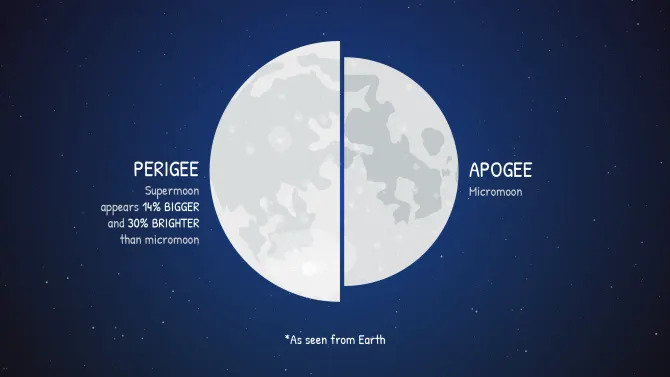
The May 2025 full Moon will appear visibly smaller than normal.
Why This Is a Supermoon
This January full Moon qualifies as a supermoon, meaning the Moon is nearer to Earth than its long-term average distance and therefore appears slightly larger and brighter. Average lunar distance: ~238,900 mi (384,472 km). On Jan. 3, 2026 the Moon will be about 225,130 mi (362,312 km) from Earth. For context, the December 2025 full Moon was about 221,965 mi (357,219 km) from Earth. Observers can notice up to roughly a 15% apparent-size difference between the smallest full Moons (micromoons) and the largest (supermoons).
Quick Orbital Terms
Perigee — the Moon’s closest point to Earth in its orbit.
Apogee — the Moon’s farthest point from Earth.
Syzygy — when three or more celestial bodies (for example, the Sun, Moon, and Earth) line up; a full Moon near perigee is sometimes called a perigee-syzygy, or supermoon.
Cultural Names And Traditions
In the Northern Hemisphere, January’s full Moon is most commonly called the Wolf Moon. Many Indigenous and folk traditions give this lunar cycle other evocative names that reflect winter conditions: the Mohawk call it the Big Cold Moon, the Anishinaabe/Ojibwe sometimes the Great Spirit Moon, and the Western Abenaki the Greetings‑Maker Moon. Other names—from the Cheyenne, Omaha, Passamaquoddy, Arapaho, and Choctaw—record wind, snow, and the period of scarce food resources historically known as the "hungry gap."
These names capture both the hardships and the quieter, reflective beauty of midwinter nights. Folklore linked to this season includes stories such as the Algonquian wendigo—tales meant to warn about the dangers of greed during hard times.

bright white moon appears just over the snow capped mountain peak on a pale blue sky. There is alpen-glow on the mountains, a soft yellow light. In the foreground is a frozen lake as well as trees covered in ice and snow.A
A Note About Wolves
The Wolf Moon name evokes images of wolves howling in winter. Wolves are cooperative hunters and use howls to communicate across long distances; on still nights, a howl can carry for miles. Silas, the ambassador gray wolf at the nonprofit Wolf Conservation Center in South Salem, New York, is one of the center’s well-known animals—viewers can watch Silas and his den-mates (Nikai and Kinari) via the center’s live stream and learn about its programs at nywolf.org.
Credit: NASA/JPL. Photo credit where noted.
Season’s Note
Whether you celebrate Christmas, Hanukkah, Yule, or other winter traditions, enjoy the season safely and warmly. Happy Moon‑watching—and see you in 2026!


