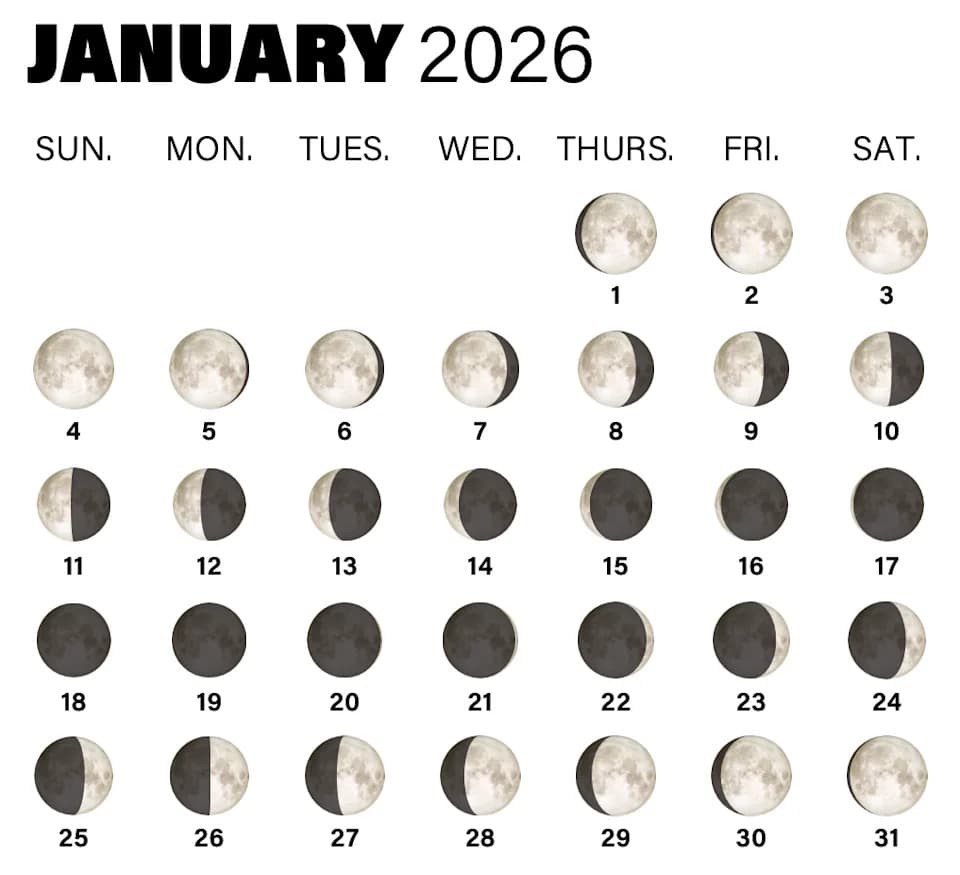
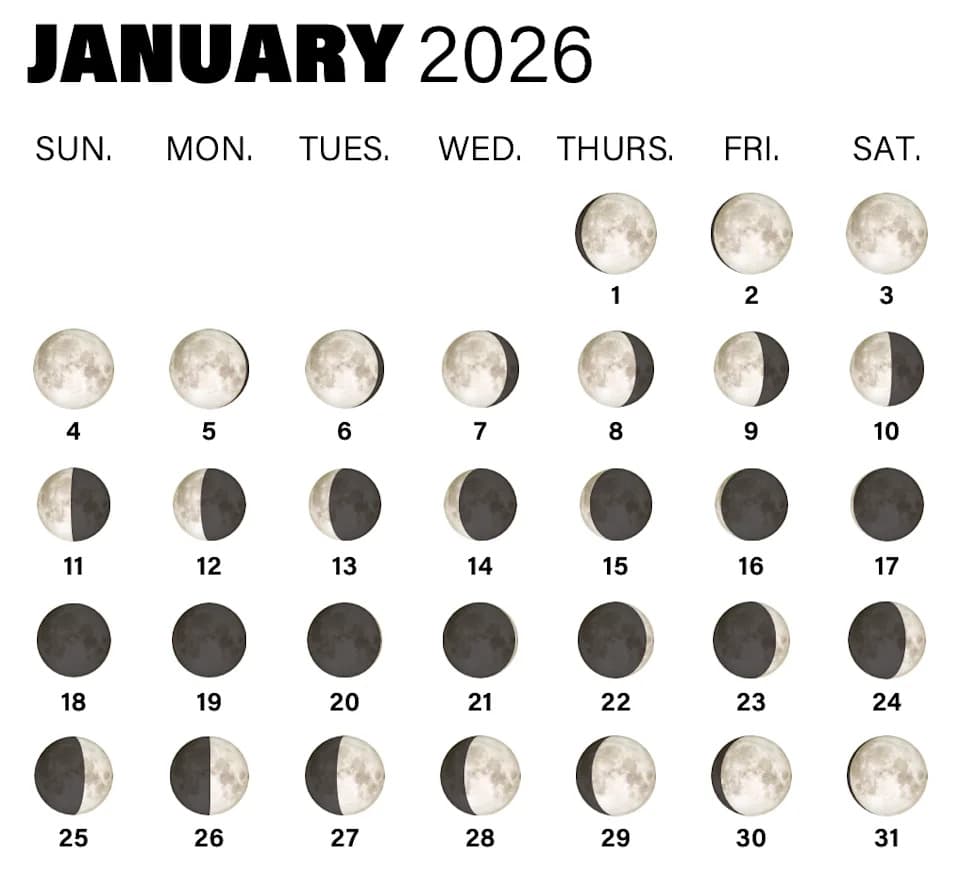
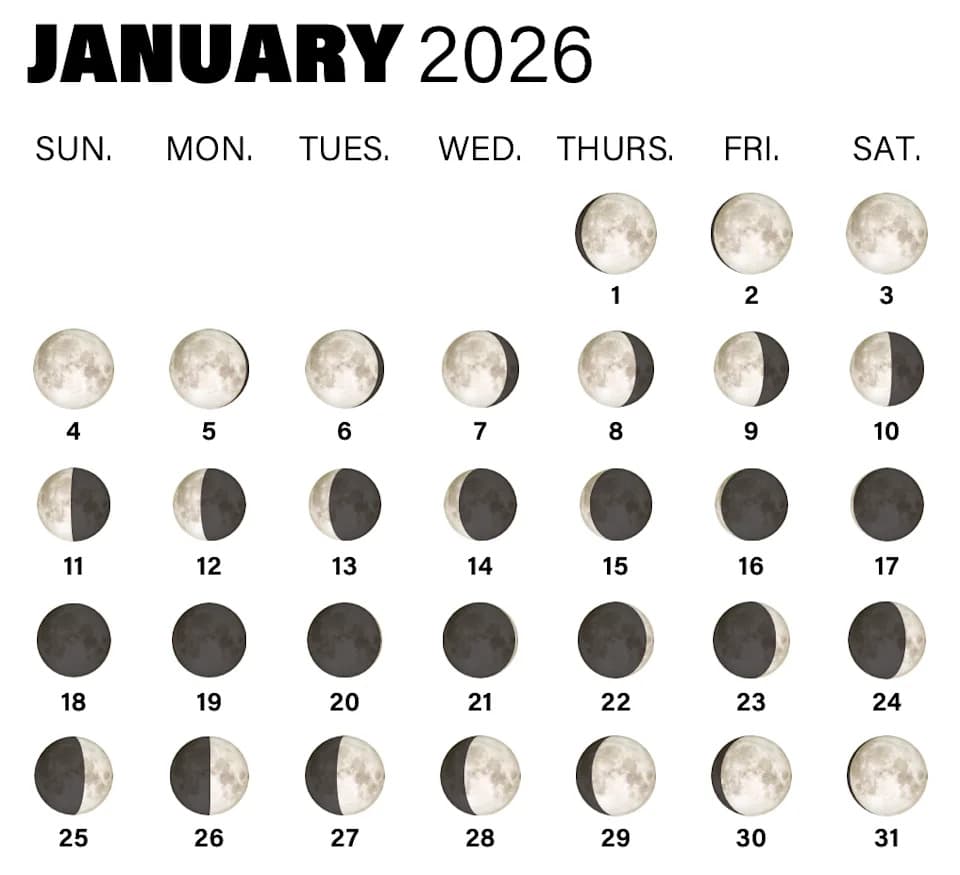
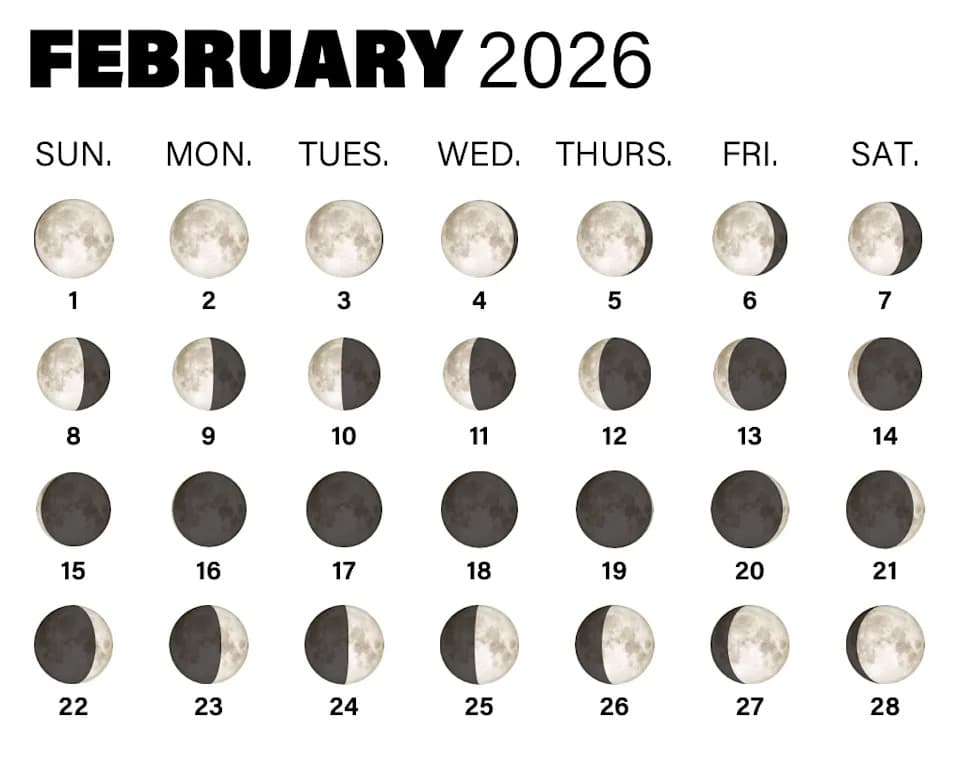
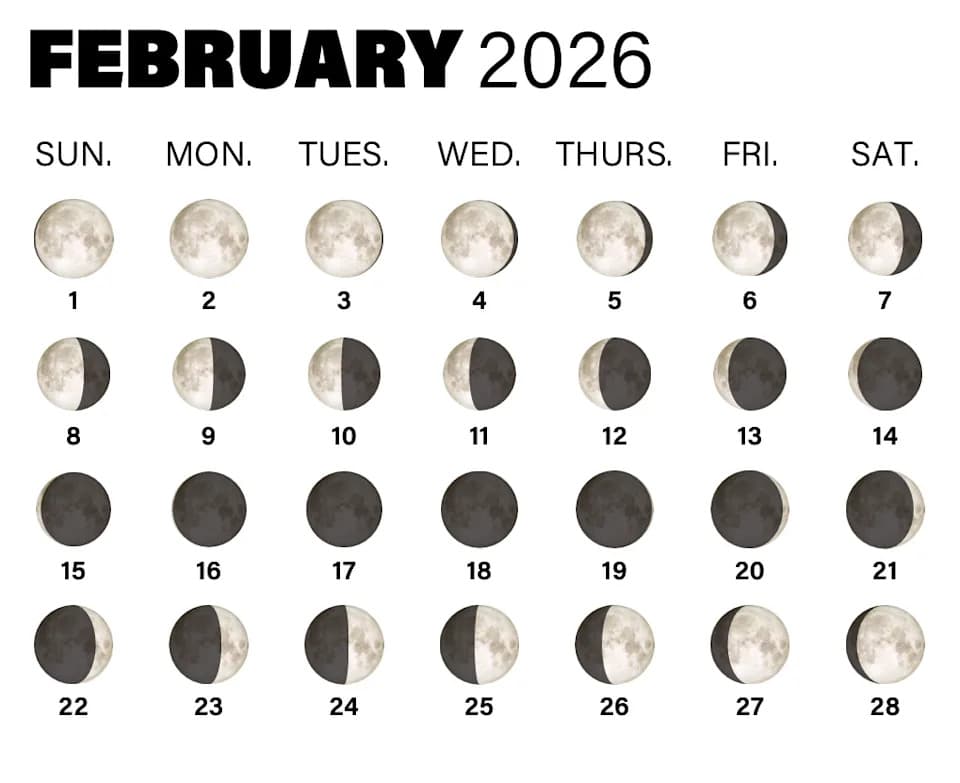
This guide explains why Full Moons occur, lists every Full Moon date and traditional name for 2025, and provides selected day-by-day sky notes for late December into early January. Highlights include close Moon approaches to Pluto, Saturn, Neptune and Uranus in late December and a perigee on Jan. 1 (223,910 miles / 360,348 km). The article also defines Super Moon, Blue Moon, Black Moon and Harvest Moon and includes a full table of lunar-phase dates for 2025.
2025 Full Moon Calendar — Dates, Names, Daily Sky Notes and How to Watch

Note: Moon phases in the calendar vary in size due to the distance from Earth and are shown at 0h Universal Time. Credit: Astronomy: Roen Kelly
The Full Moon occurs when Earth lies nearly directly between the Sun and the Moon, so the lunar hemisphere facing us is fully illuminated. As the Moon orbits Earth, the angle of sunlight striking and reflecting from its surface changes, producing the familiar sequence of lunar phases.
This guide lists every Full Moon in 2025 with traditional names, provides selected day-by-day sky notes for late December into early January, and explains common Moon terms (Super Moon, Blue Moon, Black Moon, Harvest Moon) and how lunar phases affect tides. All times shown in the daily notes are local for 40° N, 90° W unless otherwise specified; other times in the article are Eastern.
Full Moons in 2025 (Dates and Traditional Names)
Below are the Full Moon dates for 2025 with the traditional names most commonly used in North American sources. Times, if needed, can vary by location; these dates are shown in local calendar terms.
- Jan. 21 — Wolf Moon
- Feb. 20 — Snow Moon
- Mar. 22 — Worm Moon
- Apr. 20 — Pink Moon
- May 20 — Flower Moon
- Jun. 18 — Strawberry Moon
- Jul. 17 — Buck Moon
- Aug. 16 — Sturgeon Moon
- Sep. 21 — Corn Moon (often the Harvest Moon)
- Oct. 21 — Hunter’s Moon
- Nov. 20 — Beaver Moon
- Dec. 19 — Cold Moon
Selected Daily Sky Notes (Late December — Early January)
Sunrise, sunset, moonrise and moonset times below are given for 40° N, 90° W local time. Moon illumination percentages are given for 10:00 P.M. local time at that location. All other times are Eastern unless noted.
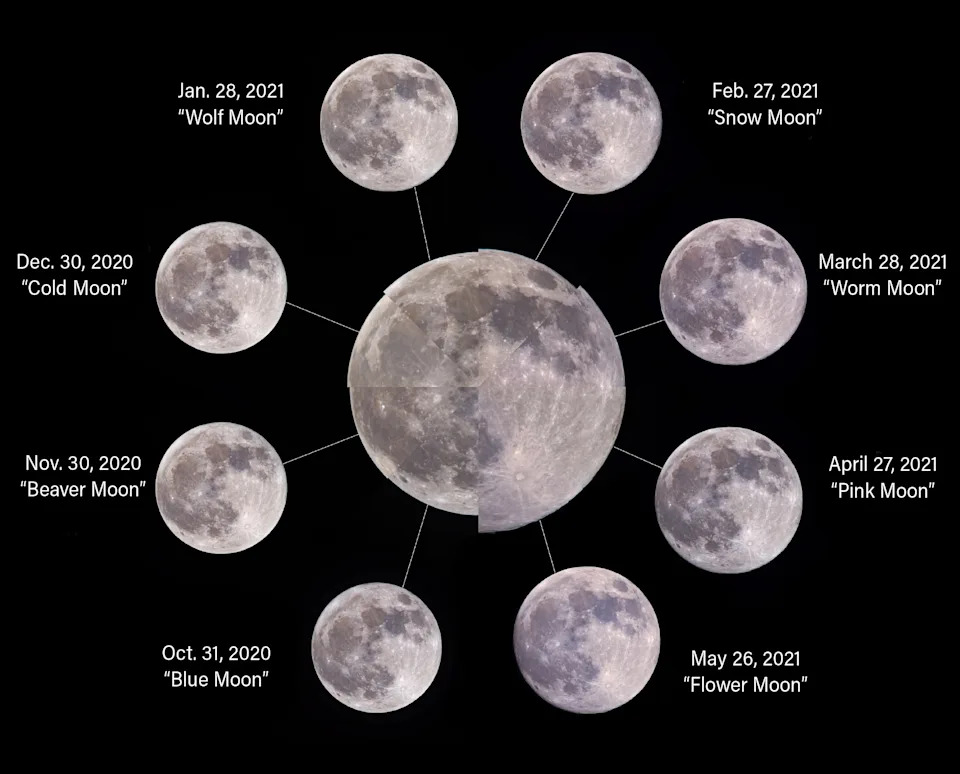
A composite of each month’s Full Moon in 2020 and 2021. Credit: Soumyadeep Mukherjee
Friday, December 19 — New Moon at 8:43 P.M. EST.
Sunrise: 7:18 A.M. | Sunset: 4:37 P.M. | Moonrise: 7:19 A.M. | Moonset: 4:01 P.M. | Moon Phase: New
Saturday, December 20
Sunrise: 7:18 A.M. | Sunset: 4:37 P.M. | Moonrise: 8:10 A.M. | Moonset: 4:57 P.M. | Moon Phase: Waxing Crescent (1%)
Sunday, December 21
Sunrise: 7:19 A.M. | Sunset: 4:38 P.M. | Moonrise: 8:54 A.M. | Moonset: 5:59 P.M. | Moon Phase: Waxing Crescent (4%)
Monday, December 22 — The Moon passes 0.6° north of Pluto at 4:00 P.M. EST.
Sunrise: 7:19 A.M. | Sunset: 4:38 P.M. | Moonrise: 9:32 A.M. | Moonset: 7:04 P.M. | Moon Phase: Waxing Crescent (9%)
Tuesday, December 23
Sunrise: 7:20 A.M. | Sunset: 4:39 P.M. | Moonrise: 10:03 A.M. | Moonset: 8:10 P.M. | Moon Phase: Waxing Crescent (15%)
Wednesday, December 24
Sunrise: 7:20 A.M. | Sunset: 4:40 P.M. | Moonrise: 10:29 A.M. | Moonset: 9:17 P.M. | Moon Phase: Waxing Crescent (24%)
Thursday, December 25
Sunrise: 7:20 A.M. | Sunset: 4:40 P.M. | Moonrise: 10:53 A.M. | Moonset: 11:23 P.M. | Moon Phase: Waxing Crescent (33%)
Friday, December 26 — The Moon passes 4° north of Saturn at 11:00 P.M. EST. The pair will be visible in the evening sky, sinking toward the western horizon later on.
Sunrise: 7:21 A.M. | Sunset: 4:41 P.M. | Moonrise: 11:15 A.M. | Moonset: 11:31 P.M. | Moon Phase: Waxing Crescent (43%)
Saturday, December 27 — The Moon passes 3° north of Neptune at 4:00 A.M. EST, about 10 hours before First Quarter at 2:10 P.M. EST. By sunset the Moon will lie in southern Pisces, east of Neptune and near Saturn.
Sunrise: 7:21 A.M. | Sunset: 4:42 P.M. | Moonrise: 11:38 A.M. | Moonset: — | Moon Phase: Waxing Gibbous (54%)
Sunday, December 28
Sunrise: 7:21 A.M. | Sunset: 4:42 P.M. | Moonrise: 12:02 P.M. | Moonset: 12:40 A.M. | Moon Phase: Waxing Gibbous (65%)
Monday, December 29
Sunrise: 7:22 A.M. | Sunset: 4:43 P.M. | Moonrise: 12:30 P.M. | Moonset: 1:53 A.M. | Moon Phase: Waxing Gibbous (76%)
Tuesday, December 30
Sunrise: 7:22 A.M. | Sunset: 4:44 P.M. | Moonrise: 1:04 P.M. | Moonset: 3:09 A.M. | Moon Phase: Waxing Gibbous (85%)
Wednesday, December 31 — The Moon passes 5° north of Uranus in Taurus at 7:00 A.M. EST. By evening the Moon will sit about 7.5° east of the Pleiades, with Uranus roughly 4.5° south of the cluster.
Sunrise: 7:22 A.M. | Sunset: 4:45 P.M. | Moonrise: 1:47 P.M. | Moonset: 4:28 A.M. | Moon Phase: Waxing Gibbous (92%)
Thursday, January 1 — Perigee (closest point to Earth) at 4:44 P.M. EST. Distance: 223,910 miles (360,348 kilometers). With Full Moon just days away, the first Full Moon of 2026 will qualify as a Super Moon based on this close approach.
Sunrise: 7:22 A.M. | Sunset: 4:45 P.M. | Moonrise: 2:42 P.M. | Moonset: 5:47 A.M. | Moon Phase: Waxing Gibbous (98%)
Friday, January 2
Sunrise: 7:22 A.M. | Sunset: 4:46 P.M. | Moonrise: 3:50 P.M. | Moonset: 6:57 A.M. | Moon Phase: Full
Understanding Lunar Phases And Special Moon Terms
The eight principal lunar phases are: New Moon, Waxing Crescent, First Quarter, Waxing Gibbous, Full Moon, Waning Gibbous, Last Quarter, and Waning Crescent. The synodic month — the average time from one Full Moon to the next — is about 29.5 days. Although the exact instant of a Full Moon is a specific alignment moment, the Moon appears nearly full to the naked eye for roughly three days.
Common Traditional Names
Traditional Full Moon names (Wolf, Snow, Worm, etc.) originate from Native American, colonial North American and other regional naming systems that tie lunar timing to seasonal events, wildlife behavior, and agricultural cycles.
Other Named Moons And What They Mean
- Super Moon: A Full Moon occurring near lunar perigee (the Moon’s nearest orbital point to Earth), appearing slightly larger and brighter than average.
- Blue Moon: The second Full Moon in a calendar month with two Full Moons; occurs roughly every 2.7 years. Not actually blue except under rare atmospheric conditions.
- Black Moon: An informal term describing either the second New Moon in a month or the third New Moon in a season that has four New Moons. As a New Moon it is not visible from Earth (except during a total solar eclipse).
- Harvest Moon: The Full Moon nearest the autumnal equinox. It rises close to sunset and can provide extended evening moonlight useful historically for harvest work.
How Full Moons Affect Tides
The Moon’s gravity pulls on Earth’s oceans, creating tidal bulges. During both Full and New Moons, Earth, Moon and Sun align closely, producing spring tides — larger than average high tides and lower low tides due to combined gravitational forces.
All Lunar-Phase Dates in 2025 (Quick Reference)
The following lists the New Moon, First Quarter, Full Moon and Last Quarter dates for each month of 2025 (dates shown as calendar days):
- Jan. 6 (New) | Jan. 13 (First Quarter) | Jan. 21 (Full) | Jan. 29 (Last Quarter)
- Feb. 5 | Feb. 12 | Feb. 20 | Feb. 27
- March 6 | March 14 | March 22 | March 29
- April 4 | April 12 | April 20 | April 27
- May 4 | May 12 | May 20 | May 26
- June 2 | June 11 | June 18 | June 25
- July 2 | July 10 | July 17 | July 24
- Aug. 1 | Aug. 9 | Aug. 16 | Aug. 23 | Aug. 31
- Sept. 7 | Sept. 14 | Sept. 21 | Sept. 29
- Oct. 6 | Oct. 13 | Oct. 21 | Oct. 29
- Nov. 5 | Nov. 12 | Nov. 20 | Nov. 28
- Dec. 4 | Dec. 11 | Dec. 19 | Dec. 27
This guide will be refreshed periodically with updated sky-event timings and viewing tips. For location-specific moonrise, moonset and precise Full Moon times, consult a local almanac or astronomy app and convert times to your time zone.
Help us improve.