Gum arabic — the powdered resin from Acacia senegal — has become a lucrative and contested commodity in Sudan’s war. Smuggling, looting and taxation along trade routes have allowed the RSF to extract revenue even as official Sudanese exports fell after April 2023. European buyers remain major importers, but traceability gaps mean some purchases may indirectly benefit armed groups. The trade is now riskier and less profitable for the small-scale producers who depend on it.
How Gum Arabic Is Fueling Sudan’s War: The Hidden Commodity Powering the RSF
(Al Jazeera)
Gum arabic — a powdered resin tapped from the Acacia senegal tree — has become an unexpected but significant source of revenue in Sudan’s ongoing conflict. Smuggled across borders, looted from stockpiles and taxed along trade routes, this everyday industrial ingredient is helping to bankroll the paramilitary Rapid Support Forces (RSF).
What Is Gum Arabic and Why It Matters
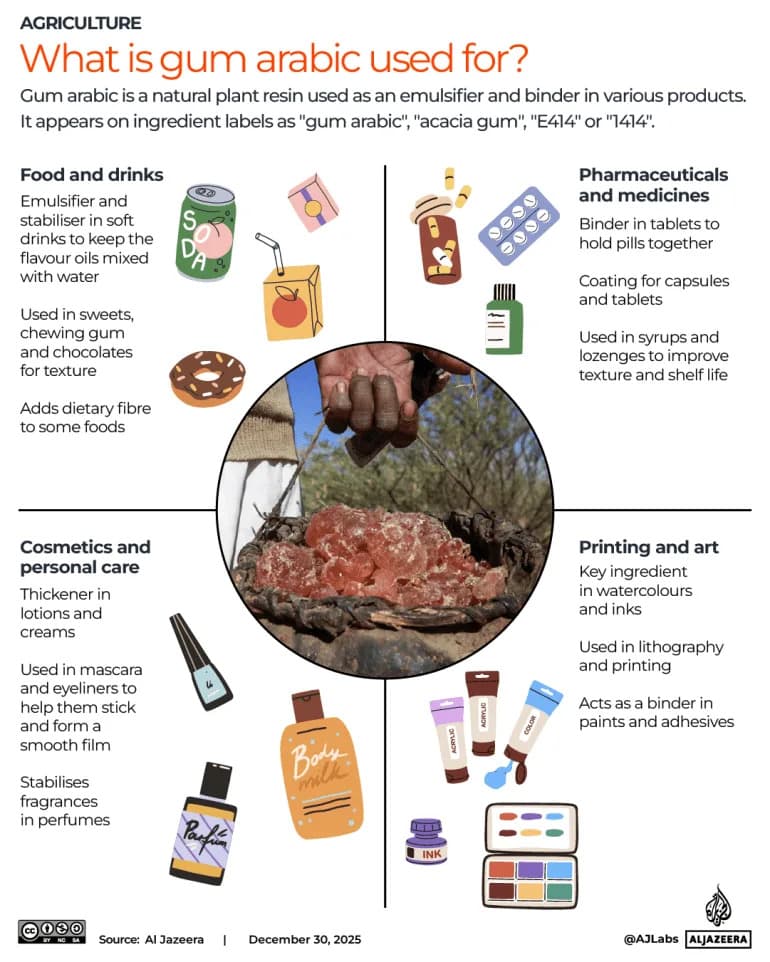
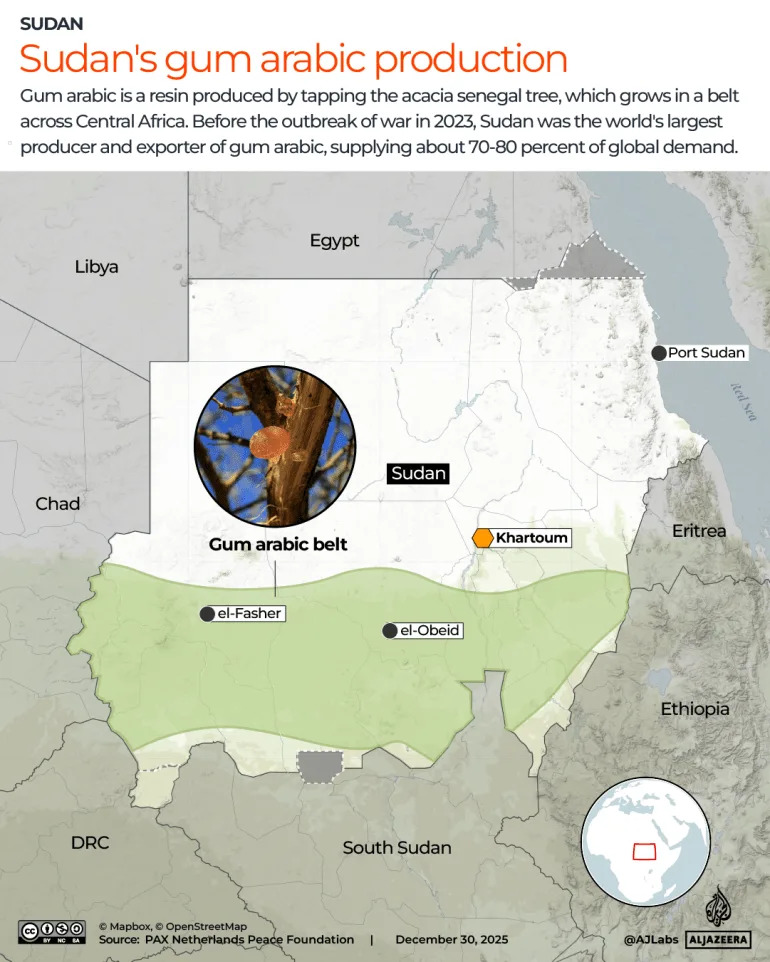
Gum arabic is the dried sap of the Acacia senegal tree, produced mainly in a belt across Central and East Africa. Once harvested and powdered, it acts as an emulsifier and binder in a wide variety of products — from soft drinks, ice cream and confectionery to chewing gum, adhesives, paints and some cosmetics. On ingredient lists it commonly appears as “gum arabic”, “acacia gum” or the food additive code E414.
Two Varieties, One Global Market
There are two commercially important varieties: the tougher, more sought-after hashab and the flakier, less valuable talha. Sudan’s climate is particularly well suited to producing hashab, which made the country the dominant global supplier before the outbreak of large-scale fighting in April 2023.
(Al Jazeera)
Scale And Economic Importance
Global manufacturers remain heavily reliant on gum arabic. Nearly 200,000 tonnes were imported for industrial use in 2024, in a market valued at roughly $300 million. Historically, when the United States sanctioned Sudan in the 1990s, gum arabic was explicitly exempted from the embargo — a sign of its commercial importance.
How The Trade Has Been Distorted By Conflict
Before April 2023, Sudan supplied an estimated 70–80% of the world’s hashab. After the war began, official Sudanese export figures plunged, but global demand persisted. Researchers found a corresponding rise in exports reported by neighbouring countries — a pattern that points to large-scale cross-border smuggling of Sudanese gum.
“The trade has … traditionally [been] quite opaque, and there are no clear figures,”
said Joris van de Sandt, a researcher with the Dutch peace organisation PAX, describing how hard the trade is to monitor.
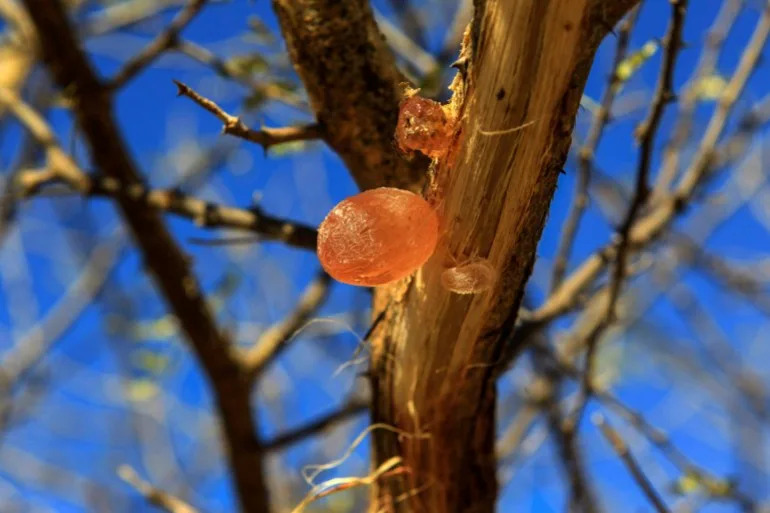
Gum arabic is seen on an acacia tree in el-Nahud, North Kordofan [File: Mohamed Nureldin Abdallah/Reuters]
Traders move gum arabic across borders into Chad, South Sudan and other neighbouring states to avoid conflict-free certification and to evade levies imposed by both Khartoum and the RSF. Once across a border, Sudanese gum is often blended with local supplies and relabelled to hide its origin.
RSF Involvement And Revenue Extraction
More worrying, investigators say the RSF itself has targeted the gum trade: looting stockpiles, imposing taxes at checkpoints, controlling key routes and extracting levies at border crossings. That combination of theft and taxation has transformed what was a vital rural livelihood into a contested, high-risk commodity.
“In the beginning, the RSF didn’t know anything about gum arabic; they just taxed people who were moving it, like any other good,”
Sudanese exporter Haisam Abdelmoneim told Al Jazeera. Researchers add: “Armed groups are controlling the routes, and they’re controlling stockpiles, and they are controlling border crossings, and they keep extracting revenue on all of these.”
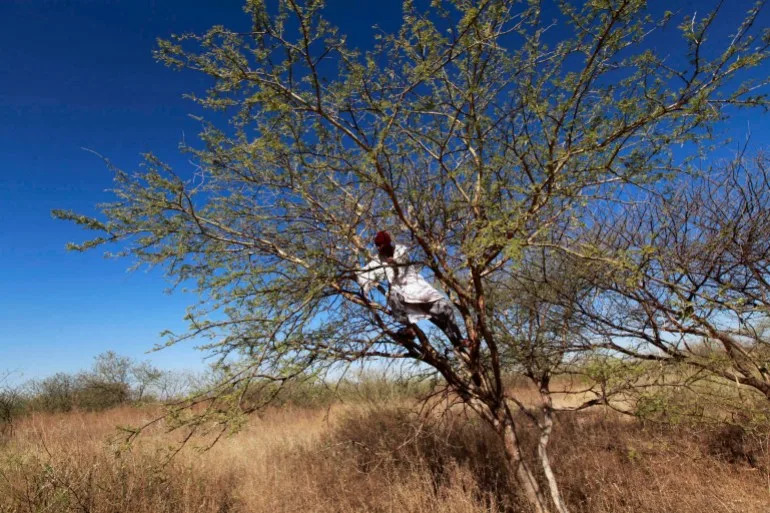
A farmer climbs an acacia to collect gum arabic in el-Nahud [Mohamed Nureldin Abdallah/Reuters]
Global Buyers And Traceability Challenges
European companies — particularly firms in France and Germany — are among the largest buyers of raw gum arabic. While many importers assert they carry out due diligence, researchers from PAX and other organisations report persistent gaps in traceability that make it difficult to guarantee supplies are conflict-free.
When contacted, Nexira said it had suspended purchases when local conditions prevented adequate visibility and control. Alland & Robert said it enforces rigorous traceability standards. Researchers, however, warn that the opacity of the trade and the mixing of supplies across borders make absolute assurances hard to sustain.
Human Cost
Gum arabic supports the livelihoods of millions of small-scale producers, tappers and traders in Sudan. Although the price per tonne of hashab has more than doubled since the war began, most of the additional revenue is being captured by middlemen, armed groups and smugglers — leaving primary producers poorer and the trade more insecure.
As long as control of routes and border crossings remains contested, gum arabic will remain both a vital export commodity and a source of conflict financing. Strengthening supply‑chain transparency, independent verification and responsible purchasing by large buyers are urgent measures recommended by researchers seeking to reduce the trade’s role in funding violence.
Help us improve.