Researchers at CUNY ASRC have demonstrated the first laboratory observation of "time reflections," where electromagnetic waves are reflected by a sudden, uniform temporal change in a medium. Using a metamaterial strip with fast electronic switches and reservoir capacitors, the team doubled the strip's impedance abruptly and produced a time-reversed copy of incoming broadband signals. The finding, reported in Nature Physics, confirms a 50-year-old prediction and could enable advances in wireless communications and low-energy wave-based computing.
Scientists Create a 'Time Mirror': First Laboratory Observation of Time Reflections Using a Metamaterial

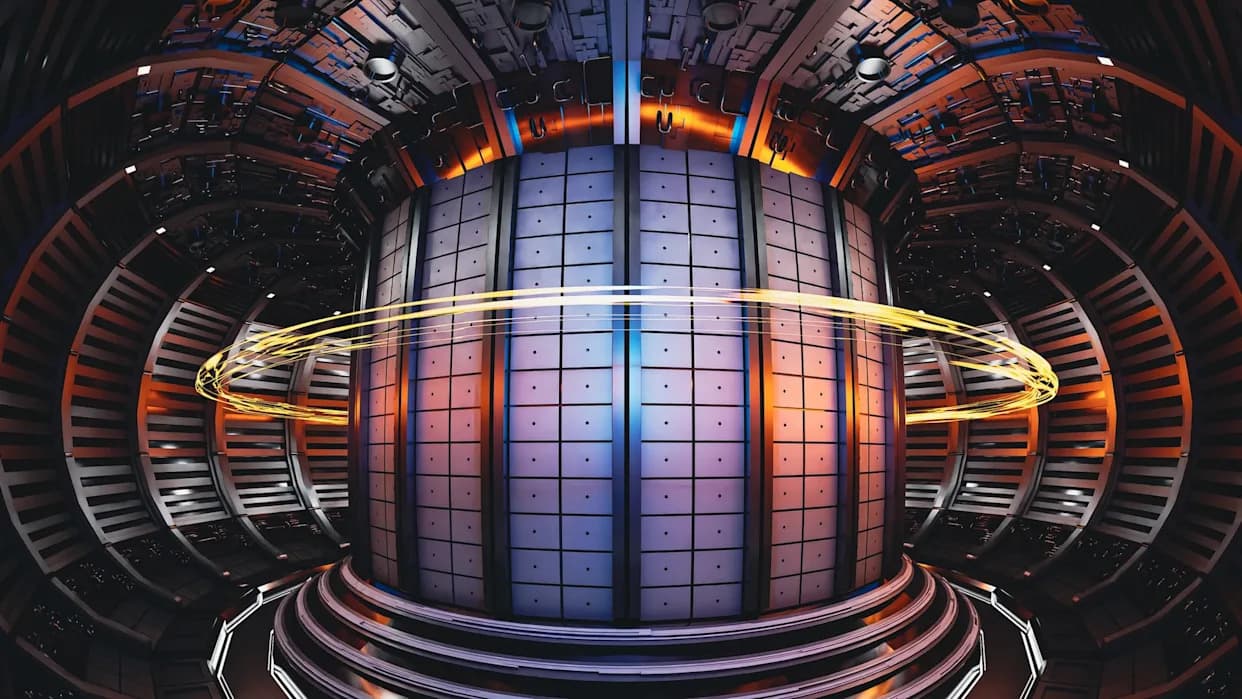
Scientists Confirm Existence of Time ReflectionsTetra Images - Getty Images
Researchers at the Advanced Science Research Center (CUNY ASRC) have for the first time observed an extraordinary phenomenon long predicted by physicists: electromagnetic waves reflecting in time rather than in space. The team engineered a metamaterial whose effective properties can be switched abruptly, producing a time-reflected copy of an incoming broadband signal. The results are published in Nature Physics.
What Is a Time Reflection?
Spatial reflection — light bouncing from a mirror or sound echoing from a wall — is familiar. A time reflection occurs when the properties of the medium through which a wave travels are changed suddenly and uniformly in time. That abrupt temporal interface forces part of the wave to reverse its temporal progression and convert to a different frequency.
How the Experiment Worked
Instead of attempting to change the host material itself, the CUNY team built a metamaterial: a narrow metallic strip populated with fast electronic switches connected to reservoir capacitors. By triggering those switches simultaneously, they abruptly doubled the strip’s electrical impedance, creating the uniform, rapid temporal change required to produce a time-reflected signal.
"It is very difficult to change the properties of a medium quick enough, uniformly, and with enough contrast to time reflect electromagnetic signals because they oscillate very fast," said Gengyu Xu, a coauthor and postdoctoral researcher at CUNY ASRC. "Our idea was to avoid changing the properties of the host material, and instead create a metamaterial in which additional elements can be abruptly added or subtracted through fast switches."
What They Observed
The abrupt change produced a time-reversed copy of the incoming broadband signals: the waveform returned in reverse temporal order, and its frequency content shifted. Because the last part of the original signal is reflected first, a hypothetical "time mirror" would show the most recent events before earlier ones — analogous to watching a tape rewind. The experiment confirmed both the reversal in time order and the associated frequency conversion.
Why This Matters
Confirming time reflections validates a decades-old theoretical prediction and enriches our understanding of wave dynamics. Practical implications include finer control of electromagnetic signals for applications such as improved wireless communications and the development of low-energy, wave-based computing components that exploit temporal manipulation of waves.
"This has been really exciting to see, because of how long ago this counterintuitive phenomenon was predicted, and how different time-reflected waves behave compared to space-reflected ones," said Andrea Alù, corresponding author and director of the CUNY ASRC Photonics Initiative.
This demonstration opens a new experimental avenue for exploring temporal metamaterials and may inspire novel technologies that deliberately manipulate waves in time as well as space.
Help us improve.