Chief Justice John Roberts used his year‑end report to mark the Declaration of Independence’s 250th anniversary, calling Thomas Paine a “recent immigrant” and invoking the Reconstruction Amendments as steps toward equality. His wording drew notice as the Supreme Court prepares to decide, by July, a high‑profile case about whether the Fourteenth Amendment guarantees birthright citizenship to children of noncitizens. Roberts’ rhetoric contrasts with past instances where praise for precedent did not predict the Court’s direction, and his authored opinions have at times substantially shifted the balance of presidential power.
As Nation Marks 250th, Roberts’ Year‑End Report Frames Equality — With High‑Stakes Rulings on Citizenship and Presidential Power Looming

Chief Justice John Roberts used his year‑end report, released around New Year’s Eve, to reflect on the federal judiciary and to mark the 250th anniversary of the Declaration of Independence. His customary address combined historical remarks with a theme that invites readers to consider how those themes might relate to the Supreme Court’s current docket.
One line in particular drew attention: Roberts described Thomas Paine as a “recent immigrant” to the North American colonies in the late 1700s. While historically accurate, the choice of that word resonated against the backdrop of the administration’s recent and high‑profile immigration litigation.
That connection is especially salient because the Court is expected to decide by July a major challenge to birthright citizenship. The Trump administration asks the Court to adopt a narrow reading of the Fourteenth Amendment, arguing it was meant to confer citizenship only on newly freed slaves and their children — and not on the children of noncitizens or temporary visitors. That view departs from long‑standing precedent dating back more than a century, and it has drawn intense public and legal scrutiny.
Roberts also highlighted the Reconstruction Amendments — the 13th, 14th and 15th — noting they abolished slavery and enshrined due process, equal protection and voting rights for Black men. He portrayed those post‑Civil War measures as steps toward fulfilling the equality promise of the nation’s founding.
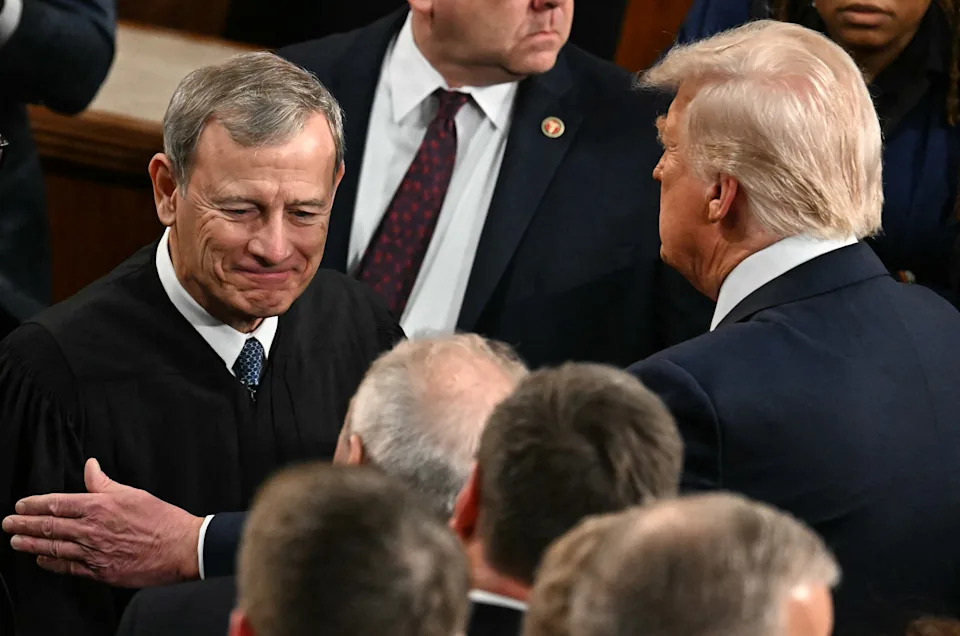
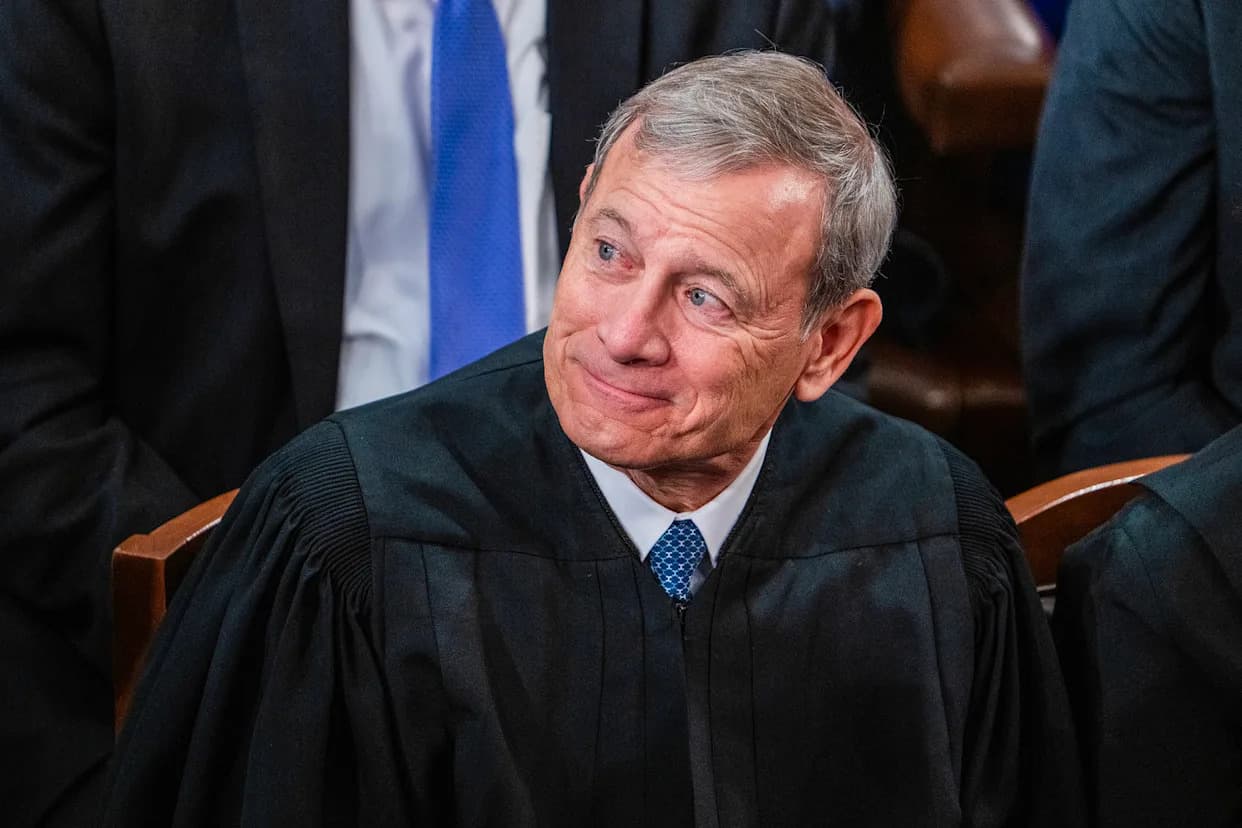
President Donald Trump, right, greets Supreme Court Chief Justice John Roberts as Trump to address to a joint session of Congress in the House Chamber of the US Capitol on March 4, 2025.(Jim Watson / AFP via Getty Images)
How much the chief justice’s rhetoric signals how the Court will rule is uncertain. Roberts did not name pending cases in his report — which would be atypical for an institutional message — but observers recall that in a prior year‑end note he praised Brown v. Board of Education, only to preside over a term in which the Court significantly narrowed race‑conscious admissions policies. That episode underscores that praise for precedent does not always predict future doctrinal outcomes.
Roberts’ influence on the Court is complicated. He now sits on a bench with a conservative majority that does not need his vote to form a majority, yet he remains capable of shaping landmark opinions. His authorship of an opinion that provided broad presidential immunity before former President Trump left office is an example of a ruling with major implications for executive power. The Court has otherwise issued decisions expanding presidential authority since Trump’s return to public life, with notable exceptions — for example, a refusal to permit the immediate deployment of the National Guard in Chicago that drew a three‑justice dissent from Republican appointees.
Roberts closed his report by pledging that the guarantees of the nation’s founding documents "remain firm and unshaken."
As the Court approaches a year likely to include consequential rulings on immigration, voting rights and executive power, that pledge reads as both aspiration and open question. Some of the uncertainty reflects the simple fact that the chief justice does not always control where the Court goes. Some of it reflects occasions when he clearly does.
If you have questions or comments, please submit them through the publication’s form for a chance to be featured in the Deadline: Legal Blog and newsletter.
Help us improve.