
The Supreme Court’s December session opened with arguments that could significantly alter protections for independent agencies and campaign-finance limits. In Trump v. Slaughter, Solicitor General John Sauer urged the Court to overturn the 1935 Humphrey’s Executor precedent, a move Justice Sotomayor warned could "destroy the structure of government." The administration also urged revisiting a 2001 campaign-finance ruling to permit party-candidate coordination, a change critics call a "bait and switch" that could erode broader regulatory limits.
Supreme Court Hearings Spotlight GOP Push To Reshape Independent Agencies And Campaign Finance

Welcome back, Deadline: Legal newsletter readers. The Supreme Court concluded its December hearing session this week with high-stakes arguments that could reshape the balance of power between the presidency, independent federal agencies and political parties.
What Was Argued
On Monday, Justice Sonia Sotomayor warned that the administration’s position in Trump v. Slaughter could "destroy the structure of government." During oral argument she told U.S. Solicitor General John Sauer:
"You’re asking us to destroy the structure of government and to take away from Congress its ability to protect its idea that the government is better structured with some agencies that are independent."
Sauer urged the Court to overturn the long-standing 1935 precedent in Humphrey’s Executor v. United States, which has insulated many independent federal agencies from direct presidential removal and control. The argument suggested that, for the administration, the central question may be not whether it will prevail but how it will achieve that outcome.
Campaign Finance Case
On Tuesday, a separate Justice Department lawyer pressed the Court to relax limits on campaign coordination. Sarah Harris, representing the administration, backed plaintiffs including JD Vance who seek to allow political parties to coordinate campaign spending directly with candidates. Harris urged the Court to discard a 2001 precedent that upheld restrictions on such coordination, arguing that "intervening developments have demolished" that ruling’s rationale.
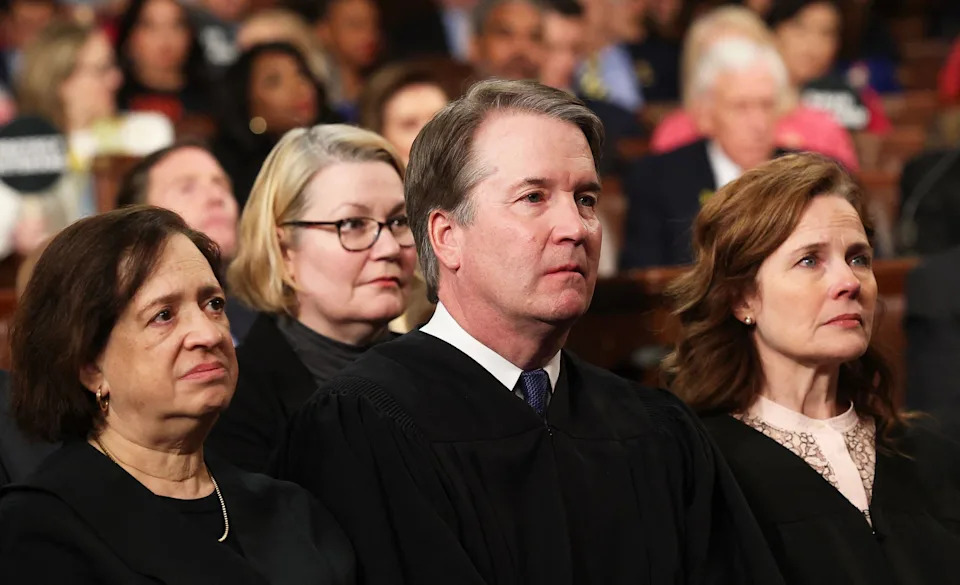
Supreme Court Justice Elena Kagan, Chief Justice John Roberts and Justice Amy Coney Barrett at the U.S. Capitol.(POOL/AFP via Getty Images)
Those "intervening developments" include changes to the Court’s composition. Justice Clarence Thomas — the lone dissenter in the 5-4 2001 decision — criticized the earlier ruling for offering what he saw as uneven First Amendment protection. Thomas now sits on a conservative majority that some observers say is more receptive to reimagining free-speech and campaign-finance doctrines.
Broader Concerns
Opponents of rolling back these precedents warned the Court that easing campaign-finance limits could be a strategic "bait and switch" aimed at dismantling other regulatory guardrails. Roman Martinez, arguing to preserve the law, told the justices: "What they’re really aiming at is all the other laws that they want to take down." The exchange underscored fears that changes to one body of law could have ripple effects across government structure and election rules.
If you have questions or comments for the newsletter, submit them through the form for a chance to be featured in the Deadline: Legal Blog and newsletter.
Originally published on MS NOW.


